



Understanding the Impact of Hard Water in Central Illinois
#
Do i need a water softener in central illinois is a question most homeowners here eventually ask - and the short answer is: almost certainly yes.
Quick Answer: Should You Get a Water Softener in Central Illinois?
| Factor | Central Illinois Reality |
|---|---|
| Water hardness | Hard to very hard across most of the region |
| Hardness level | Often above 10.5 grains per gallon (very hard) |
| Peoria hardness | Around 22.4 gpg - extremely hard |
| Hard water damage | Causes scale buildup, appliance wear, dry skin |
| Softener needed? | Yes, for most Central Illinois households |
Nearly all of Illinois sits on limestone and dolomite bedrock. As groundwater moves through this geology, it picks up calcium and magnesium. By the time that water reaches your tap, it can already be working against your pipes, appliances, and even your skin.
The effects are easy to miss at first: a white crust around the faucet, dishes that never look clean, or a water heater that runs constantly. Over time, these small signs add up to real costs for homeowners trying to protect their property.
This guide will help you understand what Central Illinois hard water means for your household and how to know if a softener is the right call.
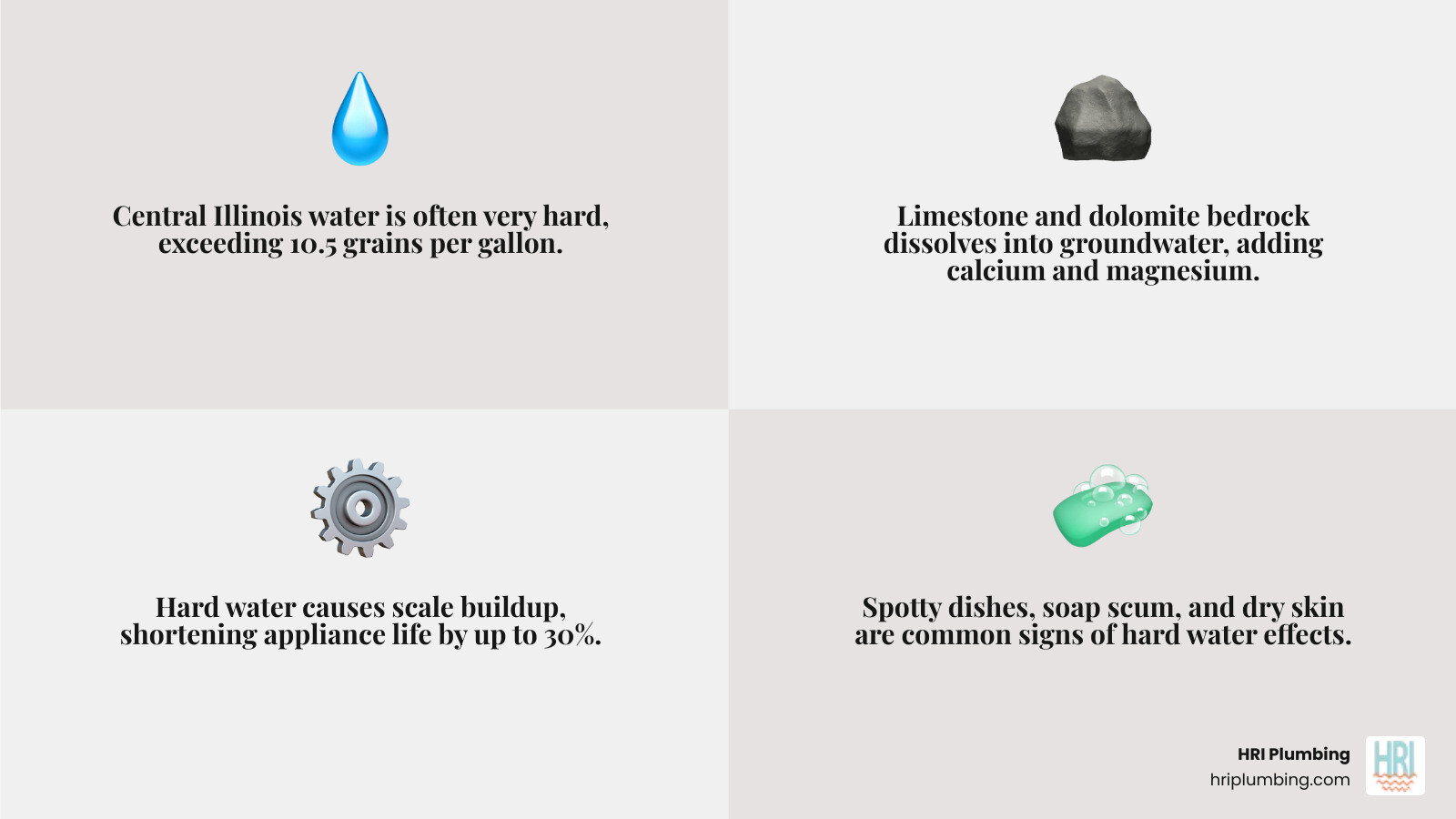
To understand why so many neighbors in Jacksonville, Springfield, and Rushville struggle with plumbing, we look at the geology. Central Illinois is filled with limestone and dolomite. As rain filters into our aquifers, it dissolves these rocks, carrying high concentrations of calcium and magnesium into municipal and well water systems.
In plumbing, we measure this hardness in Grains per Gallon (GPG). Water is considered "hard" at 7 GPG. In Central Illinois, we regularly see numbers above 10.5 GPG, classified as "very hard." In Peoria, levels can soar to 22.4 GPG.
When hard water is heated, minerals crystallize into scale. This scale acts as an insulator inside your water heater. Research shows water heaters can lose up to 29% efficiency due to this buildup. This leads to premature equipment failure, often forcing replacements every 6 to 8 years instead of the expected 12 to 15 years.
Beyond pipes, there is a human cost. The body can absorb contaminants through the skin during a shower. Hard water strips away natural oils, leaving skin itchy and hair brittle. If you notice these issues, you might need Water Softener Repair Springfield IL or Water Softener Repair Sherman IL to restore your system.
Signs You Need a Water Softener in Central Illinois
If you aren't sure if you have a hard water problem, look for these "red flags":
- Limescale: A white, crusty substance on showerheads or faucets is calcium carbonate.
- Spotty Dishes: Cloudy glasses or white water spots that won't wipe away.
- Soap Scum: A thick, gray film on tub tiles. Hard water prevents soap from dissolving properly.
- Skin and Hair Issues: Chronic dry skin, itchy scalp, or eczema flare-ups caused by mineral irritation.
- Laundry Woes: Stiff, scratchy clothes and fast-fading colors.
- Reduced Water Pressure: Scale buildup inside pipes narrows the path for water flow.
Residents in outlying areas can reach out for Water Softener Repair Jacksonville IL or Water Softener Repair Rochester IL to address these headaches.
Benefits of Installing a Water Softener
Installing a water softener often pays for itself. When discussing the Benefits of Using a Water Softener on Your Home, we focus on long-term savings.
By removing minerals, you extend the lifespan of every water-using appliance. Washing machines require 35% less detergent to achieve the same cleanliness with soft water. Energy savings are also significant; because your water heater doesn't fight scale, utility bills drop. For more perks, check our Water Softener Repair Springfield IL Guide.
Addressing Iron and Contaminants
Hardness isn't the only issue. Many homeowners deal with iron, indicated by orange or reddish-brown stains in toilets and sinks. Standard softeners handle small amounts of iron, but heavy iron requires specialized treatment.
Additionally, municipal water may contain chlorine, nitrates, or disinfection byproducts. A softener is a great first step, but it doesn't remove chemicals. For comprehensive protection, we recommend combining a softener with a whole-home filtration system or Reverse Osmosis (RO) unit. Learn more in our Water Filtration Solutions Hard Water Problems article or our Water Softener Repair Jacksonville IL Guide.
Choosing and Maintaining the Right System for Your Home
Choosing a water softener requires proper sizing. If the system is too small, it will run out of soft water; if too large, it wastes salt and water during regeneration.
Most systems in Central Illinois are salt-based ion exchange systems. These swap calcium and magnesium for sodium or potassium. While "salt-free" conditioners exist, they don't remove minerals, making salt-based systems the gold standard for our "very hard" water. For families in Water Softener Repair Rushville IL or Water Softener Repair Chatham IL, finding the right grain capacity is key.
How to Size a Water Softener
To size a system, use this formula:
- Daily Requirement: Multiply household size by 75 gallons (average daily use).
- Total Grains: Multiply that by your water's hardness in GPG.
- Iron Factor: Add 5 GPG to hardness for every 1 ppm of iron.
- Buffer: Add "one person" to the count for high-efficiency appliances.
For example, a family of four with 20 GPG hardness needs to remove 6,000 grains per day. A 24,000 to 32,000-grain system is usually ideal. See the Water Softener Repair Rushville IL Guide for more details.
Essential Maintenance
To keep your system efficient:
- Check Salt Levels: Keep the brine tank at least half-full.
- Watch for Salt Bridges: Break up any hard crust that forms in the brine tank.
- Clean the Brine Tank: Every year or two, remove sediment or "salt mush."
- Use the Bypass Valve: Don't waste softened water on the lawn or pool.
- Sanitize: Sanitize the system if it has been idle for a long period.
If your water feels hard again, consult our guide on Troubleshooting Water Softener Problems.
Professional Solutions from HRI Plumbing
At HRI Plumbing, we provide solutions tailored to your specific neighborhood. Whether you need a new installation or a repair, our team offers transparent service and 24/7 support. We help protect your home from the "silent destroyer" that is hard water.
More info about water filtration services
Final Thoughts: Is a Softener Worth It?Hard water damage can cost a Central Illinois household over $1,000 annually in repairs and energy loss. Over a decade, that's significant savings. So, do i need a water softener in central illinois? If you value your appliances, your skin, and your budget, the answer is a resounding yes.


