



The August Transition: Preparing Your Home for Peak Laundry Season
The end of summer means one thing for busy families: it is time to start checking washing machine supply lines before the endless back-to-school laundry cycles begin. When the calendar flips to late summer, household routines undergo a massive shift. The relaxed pace of July, with its occasional loads of pool towels and light clothing, quickly gives way to the rigid, high-demand schedule of the school year. Suddenly, your laundry room is running non-stop to keep up with daily school uniforms, heavy fall sports gear, and regular clothing changes. In our years of serving Jacksonville families, the team at HRI Plumbing has seen firsthand how most homeowners overlook the severe physical toll this sudden high-volume usage takes on their home's plumbing systems. Proactively evaluating your laundry room's infrastructure is critical to prevent unexpected water damage just as the school year begins.
If you are concerned about the age of your hoses or the integrity of your laundry room connections, reaching out for professional plumbing services and proactive leak detection and repair can save you from a major headache.
To understand the sheer volume difference, consider how your household's water demands change during the August back-to-school transition. The sudden spike in usage is exactly what pushes older, weakened plumbing components past their breaking point.
• Cycle Frequency — Relaxed Summer Routine: Spaced out, a few times a week — Peak Back-to-School Routine: Back-to-back daily cycles
• Load Weight — Relaxed Summer Routine: Lightweight fabrics, swimsuits — Peak Back-to-School Routine: Heavy denim, sweatshirts, dense uniforms
• Water Temperature — Relaxed Summer Routine: Mostly cold water washes — Peak Back-to-School Routine: Frequent hot water cycles for sanitizing sports gear
• System Rest Time — Relaxed Summer Routine: Days between heavy usage — Peak Back-to-School Routine: Hours (or minutes) between loads
This dramatic shift in daily operations means your plumbing system has very little time to recover between pressure surges. Preparing for this transition ensures your home remains functional and flood-free during the busiest months of the year.
The Hidden Mechanics of High-Volume Laundry Stress
Washing machines do not draw water the same way a bathroom faucet does. When you turn on a sink, you manually open and close the valve, allowing the water pressure to increase and decrease gradually. Washing machines, however, rely on automated, fast-acting solenoid valves to control water flow. These valves snap open instantly to flood the washing drum and slam shut the millisecond the machine registers it is full. This abrupt mechanical action creates a significant physical shockwave inside your pipes.
When water is traveling at high speed through your supply lines and is suddenly forced to stop, the kinetic energy has nowhere to go. It crashes against the closed valve and reverberates back through the hose. This phenomenon is known as "water hammer." While your pipes are usually secured behind the drywall, the flexible hoses connecting the wall to your machine bear the brunt of this violent force. If you are also dealing with a lack of hot water during these busy mornings, upgrading your water heater capacity for the back-to-school rush is another smart seasonal move.
Understanding Pressure Surges in Your Supply Lines
The mechanical stress of multiple loads of sports uniforms in a single evening compounds these pressure surges. Here is exactly what happens inside your supply lines during a busy laundry day:
• Kinetic shockwaves: The abrupt stopping of water flow sends kinetic energy back through the hose, causing it to physically jump or shudder.
• Material fatigue: Repeated shocks weaken the structural integrity of the rubber over time, stretching the material at a microscopic level.
• Simultaneous demand: The sudden demand for hot and cold water simultaneously strains the entire laundry supply system, testing the crimps and connections at both ends of the hose.
• Zero recovery time: Back-to-back cycles mean the rubber material stays heated, pressurized, and stressed for hours on end, accelerating the degradation process.
Over time, these unseen mechanical stresses turn a flexible, durable rubber hose into a fragile liability just waiting for one final pressure surge to break it apart.
Recognizing the Warning Signs of a Failing Rubber Hose
Because the degradation happens from the inside out, standard rubber supply lines can look perfectly fine one day and burst the next. However, if you know what to look for, there are often subtle visual clues that a hose is nearing the end of its structural life. Inspecting your laundry room connections should be a mandatory part of your August back-to-school transition checklist.
When our technicians evaluate supply lines, we pay close attention to these critical warning signs:
• Blistering and bubbling: Run your hand along the length of the hose. If you feel structural deformities, bubbles, or physical bulging on the exterior of the rubber, the inner lining has already failed, and water is pushing against the thin outer layer.
• Hairline cracks: Check for dry rot and hairline cracks along the bend of the hose where it connects to the back of the machine or the wall valve. These areas experience the most physical stress and movement during the spin cycle.
• Rust and discoloration: Look closely at the metal crimps at the connection points. Any rust, hard water scaling, or green oxidation indicates that micro-leaks are already occurring.
• Unexplained moisture: This is a particularly tricky warning sign depending on your local climate. Late-summer humidity in Central Illinois frequently causes condensation on cold water lines. Homeowners in Jacksonville often mistake this moisture for normal "sweating" from the muggy air, completely missing the fact that it is actually a dangerous micro-leak at the hose connection.
If you notice any of these symptoms, the hoses are no longer safe for daily use. Do not wait for the situation to worsen; a visual warning sign means the material is already compromised.
Why Standard Rubber Supply Lines Fall Short
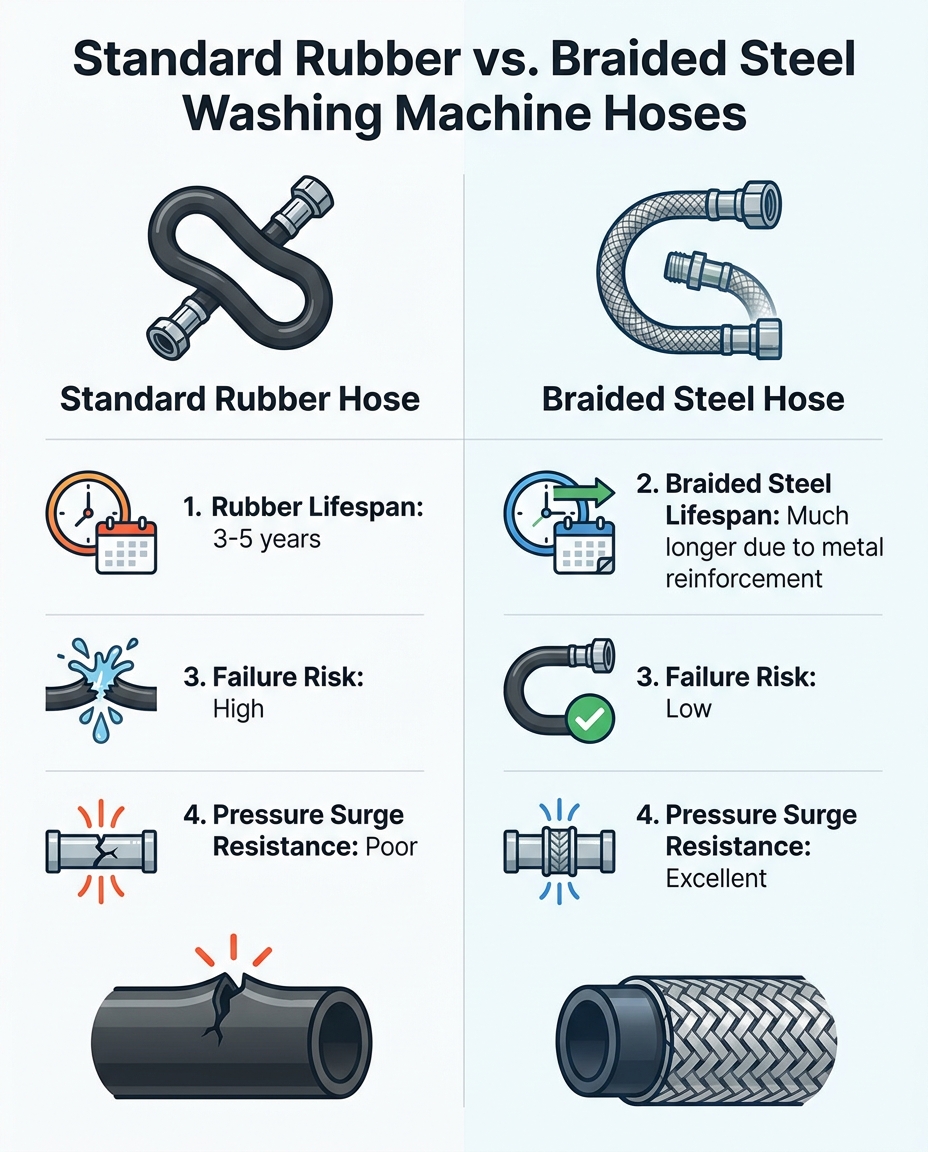
Standard rubber washing machine hoses are inexpensive, which is why they are often included by default when you purchase a new appliance. However, this low cost comes with a significant trade-off in longevity and safety. Industry data confirms that standard rubber hoses typically have a reliable lifespan of only three to five years. Pushing them beyond this window—especially during the peak back-to-school laundry season—is an unnecessary gamble with your property.
According to the Insurance Institute for Business & Home Safety (IBHS), washing machine hose failures are consistently ranked as a leading cause of home water damage claims. A burst hose does not simply drip; it can pump hundreds of gallons of water per hour directly into your home. Because laundry rooms are often located on upper floors or near primary living spaces in modern floor plans, the resulting catastrophic flooding can destroy multiple rooms in a matter of minutes.
At HRI Plumbing, our emergency dispatchers see the devastating effects of indoor water damage all too frequently. During one particularly busy fall season here in Jacksonville, our technicians responded to a severely flooded home—not from a storm, but from a single ruptured rubber washing machine hose that gave out during a weekend laundry marathon. Our technician arrived quickly to stop the flooding, but the sheer stress of sudden, uncontrollable water damage leaves a lasting impact on a family. A burst washing machine hose can release just as much water into your living space as a severe weather event, turning a normal evening into a crisis requiring immediate emergency plumbing intervention.

The True Cost of Indoor Flooding
The aftermath of a burst hose extends far beyond simply mopping up water. Indoor flooding ruins drywall, warps hardwood flooring, and destroys personal belongings within minutes. Furthermore, the disruption to a busy family routine is often more stressful than the physical damage itself. Being displaced or losing the use of essential appliances during the first weeks of school creates utter chaos. Preventative maintenance is significantly more manageable, affordable, and predictable than recovering from a sudden indoor flood.
The Braided Steel Upgrade: A Proactive Solution
The most effective way to eliminate the risk of a burst supply line is to upgrade your system entirely. Braided stainless steel hoses are the industry standard for safe, reliable laundry room plumbing. These upgraded lines encase a flexible, durable inner core with a tightly woven metal mesh exterior. This metal jacket serves a critical purpose: it physically prevents the inner tubing from expanding and bursting outward when high-pressure surges and water hammer shockwaves hit the line.
Upgrading to braided steel provides immediate peace of mind, knowing your plumbing system can easily handle the heavy back-to-school laundry volume without faltering. As trusted local plumbing experts in Jacksonville, our HRI Plumbing technicians help families proactively protect their homes with these simple but critical upgrades. From our experience dealing with botched DIY jobs, we strongly advise against treating this as a weekend project. Having a licensed professional perform the upgrade is essential for several reasons.
First, laundry room wall valves often sit untouched for years. When a homeowner attempts to force them closed, the corroded internal stems can snap, causing an immediate leak inside the wall. A professional plumber knows how to safely manipulate aging valves or replace them if they are compromised. Second, washing machine connections are notoriously easy to cross-thread. Improper installation will result in a slow, hidden drip that rots the floorboards over time. Finally, a professional will validate your home's overall water pressure as part of our comprehensive repiping and upgrades services. If your municipal water pressure is coming into the house too high, even braided steel lines will experience undue stress. A professional ensures the entire system is balanced and secure.
Protecting Your Home Routine for the Busy Parent
Parents already have enough to manage with the August back-to-school transition. Between coordinating drop-off schedules, supervising homework, managing sports practices, and preparing daily meals, your mental bandwidth is fully occupied. Your home's infrastructure should support this busy routine, not threaten to derail it. A quick, professional plumbing assessment eliminates one major source of potential home anxiety, allowing you to focus on your family instead of worrying about your appliances.
Combining hose upgrades with a general inspection of your laundry room maximizes your home's efficiency. When an HRI Plumbing professional evaluates your space, we look at the entire operational picture:
1. Testing the shutoff valves: Ensuring the hot and cold wall valves can actually be turned off in an emergency without leaking.
2. Evaluating the drain standpipe: Checking that the drain can handle the rapid discharge of modern, high-efficiency washing machines without overflowing onto the floor.
3. Inspecting the supply lines: Removing the old rubber hoses and properly torquing the new braided steel lines to exact specifications.
4. Checking appliance leveling: Ensuring the washing machine is perfectly level to prevent violent shaking during the spin cycle, which stresses both the machine and the attached plumbing.
Taking care of these details before the August rush ensures your home is ready to support your family's daily needs without interruption. A smoothly running laundry room is the unsung hero of a successful school year.
Frequently Asked Questions About Laundry Room Plumbing
Why do washing machine hoses burst?
Washing machine hoses burst primarily due to a combination of material fatigue and water hammer. Every time the machine's internal valves snap shut, a shockwave of water pressure slams into the hose. Over time, these repeated surges stretch and weaken standard rubber materials until they simply cannot hold the pressure anymore, resulting in a sudden rupture.
How often should you replace washing machine hoses?
Standard rubber washing machine hoses should be replaced every three to five years to ensure safety. Even if they look perfectly fine on the outside, the internal lining degrades with constant exposure to heat, pressure, and water chemistry. Upgrading to braided stainless steel extends this lifespan, but all hoses should still be inspected annually for signs of wear.
Are braided washing machine hoses better?
Yes, braided stainless steel washing machine hoses are significantly better and safer than standard rubber lines. The woven metal exterior physically constricts the inner tubing, preventing it from expanding and bursting when subjected to high water pressure. This metal reinforcement provides a massive upgrade in durability and home flood prevention.
What is the life expectancy of a rubber washing machine hose?
The reliable life expectancy of a standard rubber washing machine hose is roughly three to five years. After the five-year mark, the risk of catastrophic failure increases exponentially. Heavy usage, such as frequent hot water cycles for large families, can degrade the rubber even faster, making proactive replacement essential.
Can late-summer humidity in Central Illinois affect my laundry plumbing?
Late-summer humidity in Central Illinois frequently causes condensation to form on cold water lines, which can mask serious plumbing issues. Homeowners in Jacksonville often assume this moisture is just seasonal "sweating," when it may actually be a dangerous micro-leak at the hose connection. This makes professional inspections critical, as a trained eye can tell the difference between harmless condensation and a failing pipe.
Secure Your Laundry Room Before the School Bell Rings
Do not wait for a rubber hose to burst during a late-night laundry session to realize your system was compromised. The August back-to-school transition brings enough chaos without adding a flooded laundry room to the mix. Ensure your home is fully prepared for the heavy demands of the new school year by taking proactive steps today. Reach out to the team at HRI Plumbing to discuss your plumbing needs, schedule a comprehensive inspection, and secure your home with a braided steel upgrade before the peak laundry season begins.


