


Are You Nearing Your Septic Capacity Limit Before Winter?
You flush a toilet or run a load of laundry, and the drains seem just a fraction slower than they did a month ago. You know the system needs maintenance eventually, but calculating the right septic pumping schedule for your household size often feels like a guessing game. At HRI Plumbing, our team often sees homeowners relying on generic timelines, hoping they won't hit their tank's capacity limit at the worst possible moment.
As we move into September early fall prep before ground freezes, guessing is no longer a viable strategy. Entering the winter season with a septic tank that is at or near its maximum capacity sets the stage for catastrophic backups when the ground is frozen solid and unworkable. Instead of waiting for warning signs, you need a clear mathematical framework comparing your tank's capacity against your daily water usage. This allows you to make a confident go/no-go decision on scheduling maintenance this fall. By doing the math now, you prevent emergency situations and ensure your system operates smoothly through the colder months. If you need assistance evaluating your system, securing professional plumbing services before the frost line drops is the safest approach.
The Baseline: Understanding Standard Tank Capacities
To calculate an accurate maintenance timeline, you first need to understand the foundational variables of your system. In our experience servicing properties throughout the Jacksonville area, the vast majority of residential homes utilize 1,000 to 1,500-gallon standard septic tanks. This capacity dictates exactly how much wastewater your system can process at any given time.
The Environmental Protection Agency (EPA) provides a baseline recommendation of pumping every three to five years. However, our technicians always remind customers that this is merely a starting point, not a hard rule. A tank's capacity is specifically designed to hold wastewater long enough for solid waste to settle to the bottom as sludge, while lighter fats and oils float to the top as scum. The clear liquid in the middle, known as effluent, then safely exits into the drain field.
The primary driver that dictates how fast your tank fills is average indoor water usage. On average, a single person generates approximately 70 gallons of wastewater per day. Every time you shower, flush a toilet, or run the dishwasher, you add to that daily total. If your tank is undersized for your actual water usage, the settling process is disrupted, pushing solid waste out into the drain field. This is why accurate sizing and routine septic services are crucial to maintaining a healthy, functioning waste management system.
Average Daily Water Usage Breakdown
• Showers and Baths — Estimated Daily Gallons (Per Person): 15 - 20 gallons
• Toilet Flushing — Estimated Daily Gallons (Per Person): 15 - 18 gallons
• Laundry (Washing Machine) — Estimated Daily Gallons (Per Person): 15 - 20 gallons
• Faucets (Sinks, Brushing Teeth) — Estimated Daily Gallons (Per Person): 10 - 15 gallons
• Dishwashing — Estimated Daily Gallons (Per Person): 2 - 5 gallons
The Household Size Multiplier: How Occupants Accelerate Fill Rates
The Problem: A 1,000 to 1,500-gallon standard septic tank does not fill at a static rate. The number of people living in the home dramatically shifts the pumping timeline, often moving it from the comfortable five-year mark down closer to the three-year minimum. A family of four generates significantly more wastewater than a retired couple, drastically reducing the time between necessary pump-outs.
The Cause: Every additional occupant adds roughly 70 gallons of water to the system daily. Furthermore, temporary influxes can overwhelm a system that is already nearing its capacity. When you host holiday guests or have extended family stays, your daily water usage can easily double. Our plumbers frequently respond to post-holiday emergencies where excessive water usage—such as running multiple back-to-back loads of laundry or taking unusually long showers—creates turbulence inside the tank. This turbulence disrupts the critical settling process, stirring up the sludge layer and preventing solids from separating from the liquids.
The Solution: You must adjust your maintenance schedule based on your actual occupancy, not just the size of the tank. Ignoring these variables leads directly to untreated wastewater and suspended solids escaping into the drain field, causing permanent clogs. If you frequently host guests or have a large family, you need to monitor your system closely. Recognizing the signs your septic tank needs immediate repair can save you from a complete system failure when the drain field becomes compromised.
The Garbage Disposal Effect on Solid Waste Accumulation
While water usage dictates how fast liquid moves through your system, solid waste accumulation is a completely different variable. Septic systems are designed primarily to process human waste and greywater, not heavy food solids. If your home utilizes 1,000 to 1,500-gallon standard septic tanks, introducing a garbage disposal completely alters the standard mathematical framework for maintenance.
The heavy toll of food waste: Our team always warns customers that frequent use of a garbage disposal can increase your required pumping frequency by up to 50 percent. Unlike human waste, which breaks down relatively quickly through bacterial action, food scraps take significantly longer to decompose. Coffee grounds, vegetable peels, and starches do not dissolve; they simply sink to the bottom of the tank.
This excess organic matter creates a much thicker sludge layer at the bottom of the tank. As the sludge layer grows upward, it reduces the effective liquid capacity of the tank. A 1,000-gallon tank with two feet of excess sludge now operates like a much smaller tank, meaning wastewater moves through it too quickly for proper settling. Homeowners with garbage disposals must automatically calculate their maintenance schedule closer to the three-year minimum to account for this rapid solid accumulation. If you rely heavily on your disposal, investing in routine drain cleaning can help keep your interior pipes clear, but it will not stop the sludge from building up in the main tank.
Calculating the Right Septic Pumping Schedule for Your Household Size
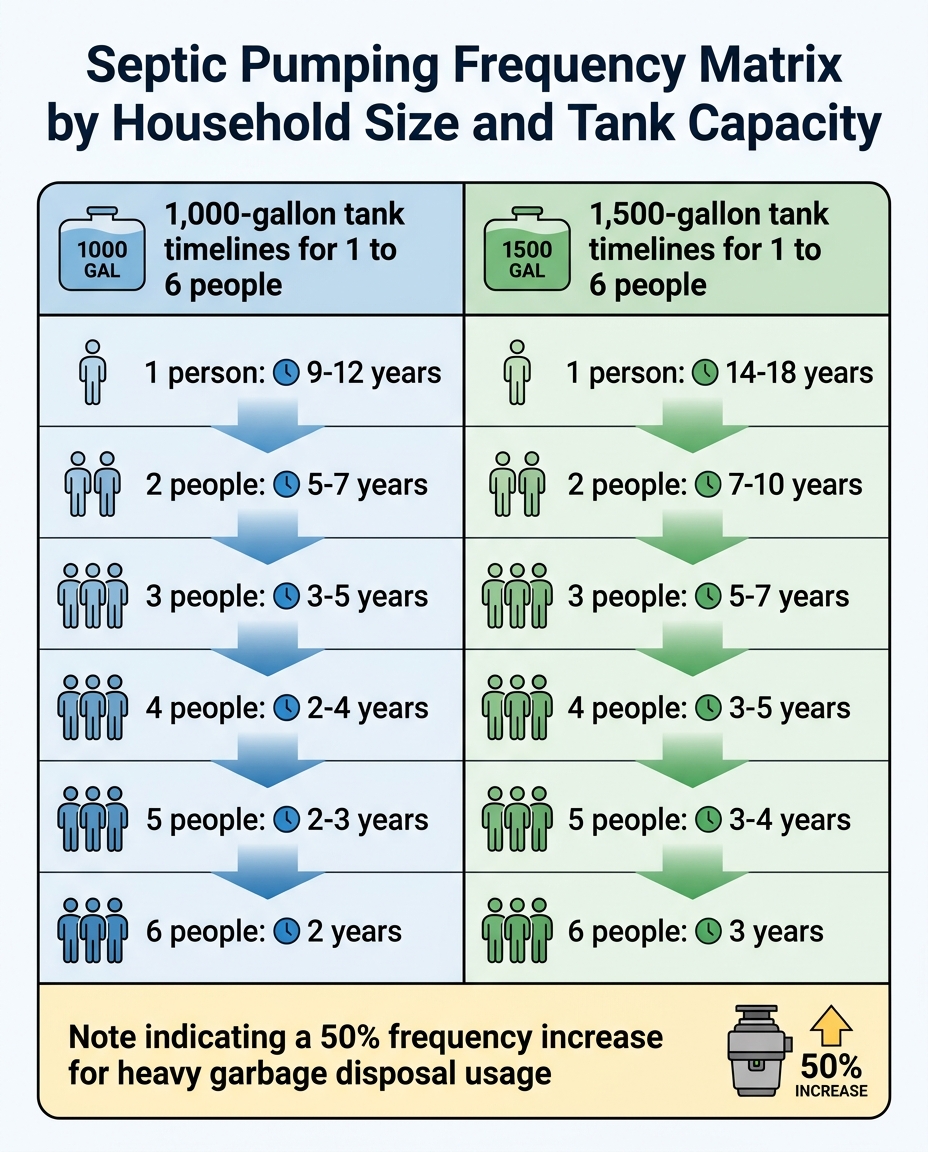
Synthesizing these variables—tank size, household size, and disposal usage—gives you a concrete decision-making framework. Instead of guessing, you can use the established EPA averages to determine exactly where your system stands. Here is how our team recommends calculating your specific timeline based on 1,000 to 1,500-gallon standard septic tanks.
1. Determine your baseline timeline based on a 1,000-gallon tank: If you have two people in the home, you can typically wait about 5.9 years between pump-outs. However, if you have four people, that timeline shrinks drastically to approximately 2.6 years.
2. Determine your baseline timeline based on a 1,500-gallon tank: A larger tank offers more buffer room. With four people, a 1,500-gallon tank requires pumping roughly every 4.2 years. If your household grows to six people, the timeline drops to about 2.6 years.
3. Apply the garbage disposal penalty: If you use a garbage disposal daily, subtract 20 to 30 percent from your calculated timeline. For example, a four-person home on a 1,000-gallon tank (normally 2.6 years) should schedule maintenance closer to the two-year mark.
4. Execute the Go/No-Go rule: Look at the calendar. If your calculation puts you within six months of your maximum timeline this fall, schedule the service now. Do not push a borderline tank through the winter months.

Why the Pre-Winter Window is Critical for System Assessment
Anchoring your mathematical calculation to the calendar is just as important as the math itself. September is the critical window for septic maintenance in the Midwest. This period allows ample time to evaluate your tank's capacity before the frost line drops deep into the soil. With the transition from humid, wet summers that heavily saturate the soil to the deep winter freezes that harden the ground, Central Illinois requires your drain field to be performing optimally before the weather turns.
Saturated soils from spring and summer rain leave your drain field stressed. If you enter the winter with a tank full of sludge, that stressed drain field will be forced to accept solid waste just as the ground begins to freeze. Our technicians know firsthand that attempting to access, dig, and pump a failing system when the ground is frozen solid is a logistical nightmare. The heavy machinery required to break through the frost line adds immense difficulty to what should be a routine maintenance task.
Proactive assessment is always preferable to reactive emergency response during severe weather. Navigating these seasonal transitions requires trusted local expertise to understand exactly how Central Illinois soil conditions handle overworked drain fields. When a local homeowner recently reached out to us with a general plumbing need during the fall, our technician promptly addressed the issue, clearly explained the situation regarding their system's capacity, and provided straightforward information so the family could make an informed decision before the freeze. Getting that assessment done early ensures peace of mind through the holidays.
What Happens When You Ignore the Math
The Problem: Delaying a necessary pump-out bridges the gap between theoretical calculations and real-world plumbing failures. When you ignore the math for homes in Jacksonville IL and surrounding rural properties, the mechanical failure process begins quietly underground—a pattern our team sees far too often.
The Cause: As sludge levels get too high inside the tank, the effective liquid capacity shrinks. Without enough time for separation, raw solids and heavy greases escape the tank and flow directly into the drain field laterals. A thick, slimy layer called a biomat forms in the soil trenches. Once this biomat becomes too thick, the soil can no longer absorb liquid, causing irreversible clogging in the drain field.
The Solution: A clogged drain field leads directly to wastewater backing up into the home's lower levels, bathtubs, or yard. Severe backups often damage connecting plumbing infrastructure, turning a routine pump-out into a massive, highly invasive repair project. During a recent summer, our crew assisted a local homeowner who experienced a severe sewer backing up; our technician had to replace a large portion of the sewer line, which included extensive digging to replace a connecting water line, though the massive job was ultimately completed in less than a day.
To avoid extensive sewer line repair, stick strictly to your calculated timeline. Keep in mind that any physical inspection, lid removal, or pumping must be handled exclusively by a licensed professional. Opening a septic tank poses severe health and safety risks, including exposure to toxic methane gases, and should never be attempted as a DIY project.
Make Your Septic Pumping Decision with Confidence
Knowing your household size and tank capacity removes the guesswork from septic maintenance. By applying the standard formulas to your daily water usage and garbage disposal habits, you gain a clear, factual timeline. Calculating the right septic pumping schedule for your household size ensures you never push your system beyond its limits.
As we focus on September early fall prep before ground freezes, making a confident go/no-go decision is your best defense against winter plumbing disasters. Take a few minutes to review how long it has been since your last service, factor in your household size, and evaluate your timeline. If the math indicates you are nearing your capacity limit, consult with our team at HRI Plumbing to evaluate your specific system usage and schedule a pump-out before the cold weather sets in.
Frequently Asked Questions
How often should a 1000 gallon septic tank be pumped for a family of 4?
A 1,000-gallon septic tank serving a family of four typically needs to be pumped every 2.6 years. This timeline is based on average daily water usage of roughly 70 gallons per person. If your family uses a garbage disposal frequently or runs excessive loads of laundry, you may need to reduce that timeline closer to two years.
Does a garbage disposal affect how often a septic tank needs pumping?
Yes, heavy garbage disposal use can increase your required pumping frequency by up to 50 percent. Food scraps do not break down as quickly as human waste, causing the sludge layer at the bottom of the tank to accumulate much faster. Homeowners with disposals should plan to pump their tanks more frequently to prevent solids from escaping into the drain field.
What happens if you wait too long to pump your septic tank?
Waiting too long allows the sludge layer to grow so high that solid waste is pushed out into the drain field. This clogs the soil absorption trenches, preventing wastewater from draining properly. Eventually, this leads to raw sewage backing up into your home's bathtubs and floor drains, often requiring a complete drain field replacement.
Can you go 10 years without pumping a septic tank?
Going 10 years without pumping is highly risky and generally only possible for a single person living alone with a very large tank (e.g., 1,500 gallons) and no garbage disposal. For standard families, waiting a decade guarantees that thick sludge will accumulate and compromise the drain field. The EPA recommends evaluating and pumping most residential systems every three to five years.
How does average water usage per person impact my septic tank?
Average water usage determines how quickly wastewater flows through the tank. If a household uses significantly more than the average 70 gallons per person per day, the water moves too fast for solids to settle to the bottom. This turbulence stirs up the sludge, increasing the risk of clogs in your outbound plumbing lines.
Why is fall considered the best time to pump a septic tank in the Midwest?
Fall provides the ideal window to ensure your tank is empty before the winter frost hardens the ground. Pumping in September prepares the system to handle holiday guest influxes without overflowing. Additionally, attempting to locate, dig, and access a septic tank during a winter emergency is incredibly difficult and disruptive when the soil is frozen solid.


