


The Hidden Risks of Ignoring Fall Plumbing Preparation
Your outdoor plumbing is exposed, and the temperatures are steadily dropping, but you haven't yet tackled your seasonal home maintenance checklist. At HRI Plumbing, our team has seen firsthand what happens when outdoor hose bibbs are left connected and crawlspace pipes remain uninsulated before the first hard overnight freeze puts your property at severe risk. Water left sitting in vulnerable lines expands as it freezes, building immense pressure that eventually ruptures metal or plastic fixtures. Before the heavy autumn rains transition into sudden freezes, identifying which fixtures require immediate winterization is absolutely critical. Knowing exactly what to look for—and understanding when to call a professional for proper isolation and draining—can mean the difference between a secure home and catastrophic water damage.
If your system is already showing signs of failure, you may need sump pump repair and replacement or emergency plumbing services in Jacksonville.
Many homeowners in Jacksonville IL mistakenly believe that as long as the indoor thermostat is set to a comfortable temperature, the entire plumbing system is safe. However, in our experience, the most severe vulnerabilities exist on the perimeter of the home and in unconditioned spaces. By the time October pre-winter prep rolls around, the window for proactive prevention is rapidly closing. A comprehensive approach to seasonal maintenance requires looking beyond generic household chores and focusing specifically on the mechanical systems that protect your property from the elements.
Evaluating Visible vs. Hidden Plumbing Risks
Understanding where your home is most vulnerable is the first step in effective seasonal maintenance. Risks are generally categorized by their location and visibility.
• Exterior (Visible) — Common Vulnerabilities: Connected garden hoses, exposed spigots, and uninsulated outdoor supply lines. — Potential Consequences of Inaction: Ice blockages force pressure backward into the home, bursting interior pipes behind walls.
• Unconditioned (Hidden) — Common Vulnerabilities: Pipes running through crawlspaces, unfinished basements, and unheated garages. — Potential Consequences of Inaction: Ambient temperatures drop below freezing, causing rapid ice formation in stagnant supply lines.
• Drainage (Hidden) — Common Vulnerabilities: Sump pump discharge lines that lack proper slope or are clogged with autumn debris. — Potential Consequences of Inaction: Water freezes inside the discharge pipe, causing the pump motor to burn out and the basement to flood.
Addressing these categories methodically ensures that no critical vulnerability is overlooked before the weather turns hostile.
Understanding the Impact of Fall Weather on Vulnerable Pipes
The problem: The transition from autumn to winter is rarely a smooth, gradual decline in temperature. In regions like Jacksonville IL, the specific climate pattern often involves heavy seasonal precipitation followed by rapid, unpredictable overnight freezes. Our plumbers frequently respond to emergency calls where this exact combination created a dangerous scenario where the ground is heavily saturated with water just as the ambient air temperature plummets.
The cause: When temperatures drop, the thermodynamic properties of water become a severe threat to residential plumbing. According to data from the Insurance Institute for Business & Home Safety (IBHS) and the Environmental Protection Agency (EPA), pipes exposed to temperatures below 20 degrees Fahrenheit without proper insulation are at a significantly higher risk of freezing and bursting. The mechanics of a pipe burst are often misunderstood. The ice itself does not directly break the pipe where it forms. Instead, as the water freezes and expands, it pushes the remaining liquid water toward closed faucets, creating immense hydraulic pressure. Once that pressure exceeds the structural limits of the copper, PVC, or PEX piping, a rupture occurs.
The solution: Proactive intervention requires a dual approach: flood readiness and freeze prevention. The severity of the risk cannot be overstated—a mere 1/8-inch crack in a frozen pipe can release up to 250 gallons of water per day into a home, causing devastating structural damage and mold growth. Preparing for the heavy rains means ensuring your sump pump is fully operational, while preparing for the freeze requires systematic insulation and winterization of all supply lines.
The Anatomy of a Pipe Burst
To fully grasp why October pre-winter prep is so critical, it helps to understand the exact timeline of a plumbing failure during a sudden freeze.
• Initial Temperature Drop: The ambient air in a crawlspace or exterior wall cavity drops below the critical 20-degree Fahrenheit threshold.
• Ice Nucleation: Stagnant water inside the uninsulated pipe begins to crystallize, expanding by approximately 9% in volume.
• Pressure Spikes: The expanding ice block acts as a piston, compressing the liquid water trapped between the ice and a closed faucet or valve.
• Material Failure: Unable to withstand the thousands of pounds of hydraulic pressure, the pipe wall splits, usually at a joint or weak point.
• The Thaw: The actual flooding often goes unnoticed until the weather warms slightly, melting the ice block and allowing pressurized water to flow freely through the new rupture.
Essential Sump Pump Troubleshooting Checks for Homeowners
Before the heavy fall rains fully saturate the ground, verifying that your basement's primary defense system is operational is a mandatory part of October pre-winter prep. Over our years of serving the Jacksonville community, we always recommend these actionable, safe DIY checks to confirm basic functionality without requiring dangerous mechanical disassembly.
1. Verify the Power Source: Begin by inspecting the electrical connection. Ensure the sump pump is plugged directly into a working Ground Fault Circuit Interrupter (GFCI) outlet. Avoid using extension cords, which can cause voltage drops and motor damage. Press the "Test" and "Reset" buttons on the GFCI outlet to confirm it is functioning correctly, as power surges during fall storms can easily trip these sensitive breakers.
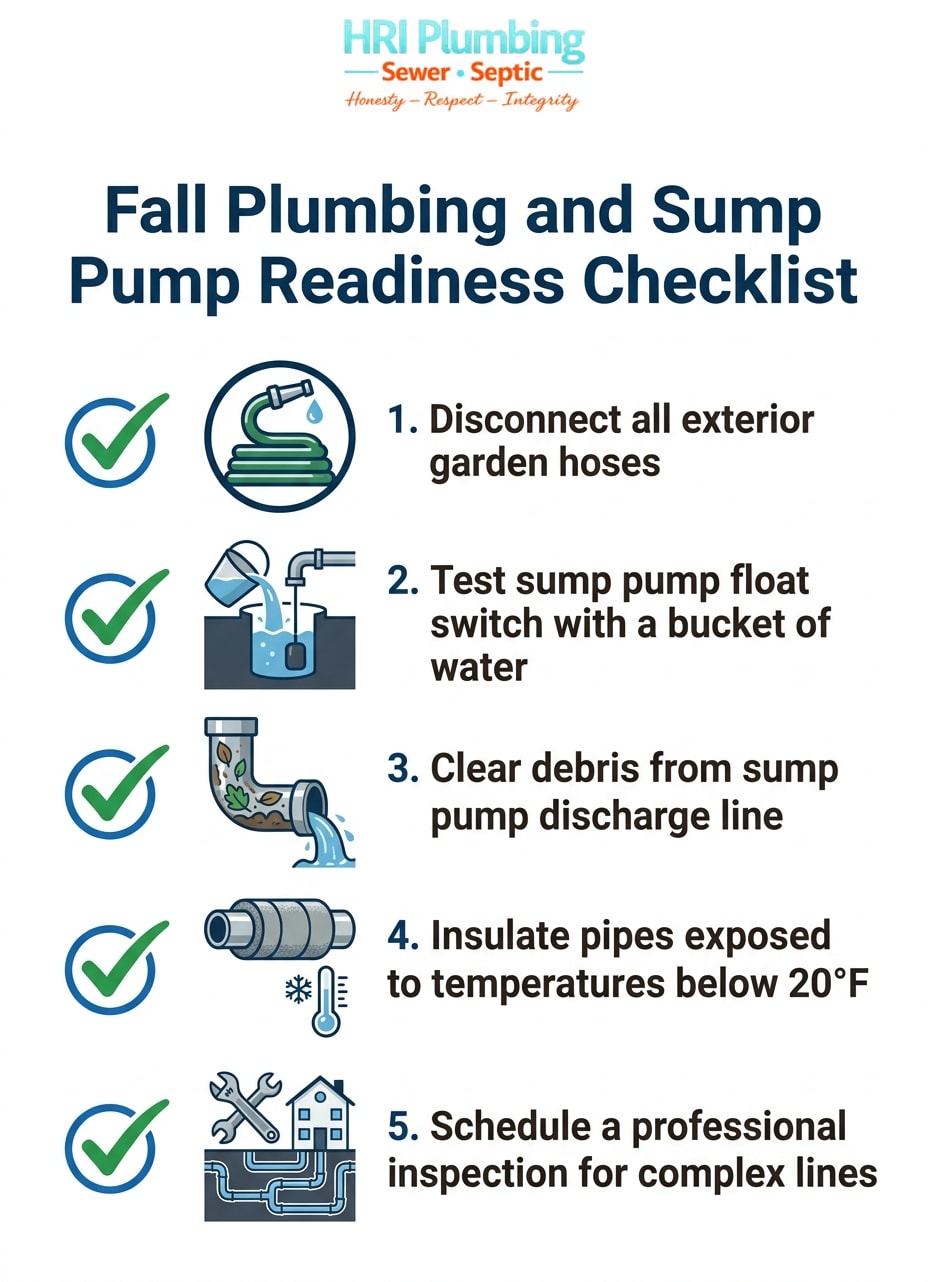
2. Test the Float Switch: The most critical mechanical check is the bucket test. Slowly pour a five-gallon bucket of water directly into the sump pit. Watch the float switch carefully. As the water level rises, the float should lift smoothly, automatically activating the pump. Once the pump turns on, it should rapidly drain the pit and shut off automatically as the float lowers. If the float binds or the pump fails to activate, you may be looking at troubleshooting a sump pump that is not working.
3. Listen to the Motor: While the pump is running during the bucket test, listen closely to the sound of the motor. A healthy pump operates with a smooth, consistent hum. If you hear unusual grinding, rattling, or a high-pitched whine, it could indicate a failing impeller, worn bearings, or debris trapped in the intake screen.
It is important to clarify that these are strictly visual and basic functional checks. If the pump fails the bucket test or exhibits electrical issues, complex mechanical repairs require the attention of a licensed professional.
Clearing Debris from the Sump Pit
Over the dry summer months, dirt, gravel, and general basement debris can easily accumulate inside the sump pit. When the fall rains arrive, this debris mixes with the incoming water to form a thick sludge.
This accumulation poses a serious threat to the system's reliability. Heavy debris can physically jam the float switch against the side of the pit, preventing the pump from turning on when the water level rises. Alternatively, smaller pebbles and grit can be sucked into the intake screen, clogging the impeller and causing the motor to overheat and fail prematurely.
Homeowners should safely remove visible obstructions using a wet/dry vacuum or a gloved hand. Always unplug the pump before reaching into the pit. Focus on clearing the bottom of the basin and ensuring the area around the float switch is completely unobstructed. Do not attempt to dismantle the pump housing to clean internal components.
Inspecting the Sump Pump Discharge Line Before Freezing Temperatures
The interior mechanics of a sump pump are only half of the equation; the exterior discharge line is highly vulnerable to freezing and blockages during the fall season. If the water cannot safely exit the property, the system will fail regardless of how well the motor runs.
Locate the Exit Point: Begin by finding exactly where the discharge line exits the foundation of the home. Verify that the pipe directs water at least 10 to 20 feet away from the foundation walls. If the water is discharged too close to the house, it will simply seep back into the soil, forcing the pump to run continuously in a process known as short-cycling.
Check for Autumn Blockages: Inspect the exterior opening of the pipe for blockages caused by fallen autumn leaves, packed dirt, or even small animal nests. As part of your October pre-winter prep, clear away any organic material that has built up around the exit point.
Evaluate the Grading and Slope: The physical slope of the discharge line is critical. The pipe must maintain a continuous downward flow. If the line sags or sits perfectly flat in certain sections, residual water will pool inside the pipe after the pump shuts off. When temperatures drop below freezing, this pooled water turns to solid ice. The next time the pump activates, it will push water against an impenetrable ice blockage, forcing the water back into the basement and likely burning out the pump motor in the process.
Discharge Line Health Checklist
Use this diagnostic checklist to evaluate the safety of your exterior drainage setup before the frost sets in:
• Pipe Exit Distance — Ideal Condition: Discharging 10-20 feet away from the foundation. — Warning Signs to Address: Water pooling against the basement walls or foundation slab.
• Line Slope — Ideal Condition: Continuous downward angle relying on gravity. — Warning Signs to Address: Dips, sags, or flat sections where water visibly rests.
• Exit Clearance — Ideal Condition: Completely free of leaves, mud, and snow buildup. — Warning Signs to Address: Packed autumn debris blocking the mouth of the pipe.
• Extension Hoses — Ideal Condition: Rigid PVC or securely attached, sloped flexible hosing. — Warning Signs to Address: Kinked, crushed, or disconnected extension lines.
Exterior Plumbing Defenses: Securing Hose Bibbs and Spigots
Securing exterior plumbing is arguably the most urgent task on any seasonal home maintenance checklist. In our experience, guiding the home into winter requires completely severing the connection between vulnerable outdoor fixtures and the warm interior water supply.
1. Identify All Exterior Water Sources: Walk the entire perimeter of the property and locate all exterior hose bibbs, spigots, and irrigation connections. We often see homeowners remember the main garden hose but forget a secondary spigot tucked behind bushes or near the garage.
2. Disconnect and Store Garden Hoses: The critical importance of disconnecting all garden hoses before the first freeze cannot be overstated. A connected hose acts as a trap. When the water inside the hose freezes, the ice expands backward into the spigot and the home's interior plumbing system. This backward pressure is the leading cause of burst pipes inside exterior walls during the early winter months. Once disconnected, drain the hoses completely and store them in a garage or shed to prolong their lifespan.
3. Drain the Residual Water: If your home is equipped with interior shut-off valves for the exterior lines, turn off the water supply from the inside. Then, go back outside and open the spigot to allow any residual water trapped in the pipe to drain out completely. Leave the exterior valve open throughout the winter to give any remaining droplets room to expand safely.
4. Install Insulated Faucet Covers: For older plumbing fixtures or homes without interior shut-off valves, installing insulated faucet covers provides a crucial layer of added protection. These inexpensive foam domes trap the ambient heat radiating from the home's interior walls, keeping the metal spigot just warm enough to prevent freezing during typical cold snaps.
Crawlspace and Basement Pipe Insulation Strategies
While exterior fixtures are obvious targets for winterization, interior pipes located in unheated areas of the home are equally vulnerable. In Jacksonville IL, crawlspaces, unfinished basements, and unheated garages can experience rapid temperature drops that mirror the outdoor climate.
Locate Vulnerable Supply Lines: Grab a flashlight and trace the path of the water supply lines running through these unheated spaces. You are looking specifically for exposed copper, CPVC, or PEX piping. Hot water lines should be insulated for energy efficiency, but cold water lines are the primary targets for freeze prevention.
Identify Signs of Inadequate Insulation: If the pipes are currently wrapped, inspect the material for damage. Look for missing sections, condensation buildup, or insulation that has been chewed away by pests. Bare pipes or compromised insulation require immediate attention before the temperatures drop.
Apply Foam Pipe Insulation Sleeves: The most effective DIY defense for exposed sections is the installation of tubular foam pipe insulation sleeves. These sleeves are slit down the side, allowing them to slip easily over existing pipes. Ensure that the seams are securely taped shut and that mitered corners are cut precisely so no gaps remain. Even a one-inch gap in the insulation can serve as an entry point for freezing air, negating the protection of the entire sleeve.
Seal Foundational Gaps: Insulation alone cannot combat a direct blast of freezing air. We always warn homeowners against ignoring small drafts or foundational gaps near piping. Inspect the perimeter of the crawlspace or basement for cracks, unsealed vents, or gaps around conduit penetrations. Sealing these gaps with weatherstripping or expanding foam is a critical step. A hidden pipe burst in a dark crawlspace can run for days unnoticed, making basement leak detection a difficult and stressful process after the fact.
Common Pipe Insulation Materials
Selecting the right material ensures maximum protection against rapid temperature drops.
• Polyethylene Foam Sleeves — Best Application: Straight runs of copper or PEX in basements. — Key Benefits: Inexpensive, easy to install, and highly effective for standard residential use.
• Fiberglass Wrap — Best Application: High-heat applications or extremely cold, drafty crawlspaces. — Key Benefits: Superior thermal resistance, though requires protective gear during installation.
• Rubber Insulation Tape — Best Application: Complex joints, valves, and tight corners. — Key Benefits: Flexible and moldable, perfect for sealing gaps between standard foam sleeves.
Recognizing When to Call a Professional Plumber
The problem: Many homeowners attempt to push the boundaries of their DIY capabilities during seasonal prep, inadvertently causing damage or missing critical vulnerabilities that only become apparent when a pipe bursts.
The cause: While visual checks, bucket tests, and hose disconnections are safe and highly recommended DIY tasks, the complexities of modern plumbing systems often require specialized knowledge. Isolating and draining complex lines, repairing faulty sump pump motors, or safely navigating electrical components near standing water are not tasks suited for weekend warriors.
The solution: Establishing a clear boundary between safe homeowner maintenance and tasks requiring a licensed professional serves as a vital decision point. If your sump pump fails the bucket test, exhibits complex electrical issues, or makes severe grinding noises, professional intervention is necessary. Similarly, if you discover supply lines that are inaccessible for insulation or suspect that your home's shut-off valves are corroded and failing, calling an expert is the safest route.
The rationale for professional winterization is rooted in catastrophic risk prevention. Addressing a failing valve or a struggling pump in October is a routine service call for our crew; dealing with a flooded basement or a burst pipe in January is a major disaster. Relying on a local Jacksonville plumber ensures that the unique environmental challenges of the region are factored into your home's defense strategy. At HRI Plumbing, we provide local expertise and rapid emergency response times for homeowners dealing with urgent basement flooding risks or sudden freezes, delivering the peace of mind that comes from having a certified expert verify your home's winter readiness.
Frequently Asked Questions About Fall Plumbing Maintenance
What should I do to my house in the fall to prevent plumbing issues?
The most critical steps involve disconnecting all exterior garden hoses and insulating exposed supply lines in unheated spaces. A thorough October pre-winter prep routine should also include testing the sump pump with a bucket of water to ensure it activates properly. Finally, clear all leaves and debris from exterior drainage lines to prevent water from backing up and freezing near the foundation.
How do I prepare my plumbing for winter?
Preparing your plumbing requires a combination of draining vulnerable lines and insulating exposed pipes. Start by shutting off interior valves leading to outdoor spigots, then open the exterior taps to drain any residual water. Apply high-quality foam insulation sleeves to all pipes located in crawlspaces, basements, and garages to protect them from rapid temperature drops.
How do you check a sump pump before winter?
You check a sump pump by performing a visual inspection and a basic functional test. First, verify that the unit is securely plugged into a working GFCI outlet. Next, slowly pour a bucket of water into the sump pit to confirm that the float switch rises smoothly and triggers the pump to turn on and drain the basin.
When should I winterize my outside faucets?
You should winterize your outside faucets well before the first hard overnight freeze is forecasted in your area. For most regions experiencing cold winters, completing this task by mid-to-late October provides a safe buffer. Delaying this chore until November significantly increases the risk of trapped water freezing and bursting the pipes inside your walls.
What pipes need to be insulated in a crawlspace?
Any water supply line running through an unheated or unconditioned space must be insulated to prevent freezing. This primarily includes cold water lines made of copper, CPVC, or PEX, as they are highly susceptible to rapid ambient temperature drops. Hot water lines should also be insulated to improve energy efficiency and reduce heat loss as the water travels to the fixtures.
Why is my sump pump running but not pumping water?
A sump pump that runs without moving water usually suffers from a mechanical blockage or an airlock. The most common culprits are a clogged intake screen at the bottom of the pit or an obstruction in the exterior discharge line. Additionally, a failed impeller or a stuck check valve can prevent the pump from generating the necessary suction to move the water outward.
Finalize Your Home's Winter Defenses Today
Completing a targeted seasonal home maintenance checklist is the most effective way to protect your property from the severe consequences of dropping temperatures. By taking the time during your October pre-winter prep to disconnect hoses, insulate vulnerable crawlspace pipes, and verify the functionality of your sump pump, you build a robust defense against both flooding and freezing.
Gaining a clear, professionally-guided understanding of what plumbing vulnerabilities to look for ensures that you aren't caught off guard by the first hard freeze. If your visual inspections uncover failing equipment, corroded valves, or inaccessible pipes, do not leave those issues to chance. Reach out to our team at HRI Plumbing for professional assistance to properly isolate and drain vulnerable lines, ensuring your home remains safe, dry, and secure all winter long.


