


Introduction to Selecting a Commercial Water Heater
A commercial water heater is a heavy-duty water heating system designed to meet the high hot water demands of businesses, restaurants, hotels, healthcare facilities, and other commercial buildings — far beyond what any residential unit can handle.
Here's a quick overview of what you need to know:
- Types: Gas tank, electric tank, tankless (on-demand), and heat pump commercial water heaters
- Capacity: Ranges from under 10 gallons up to 100+ gallons, with MBH ratings from 48 up to 4,000
- Fuel options: Natural gas, liquid propane, or electric (including 208V, 480V, and other voltages)
- Top brands: A.O. Smith, Bradford White, Rheem, Lochinvar, State, and others
- Key difference from residential: Built for higher recovery rates, greater durability, stricter certifications, and continuous demand
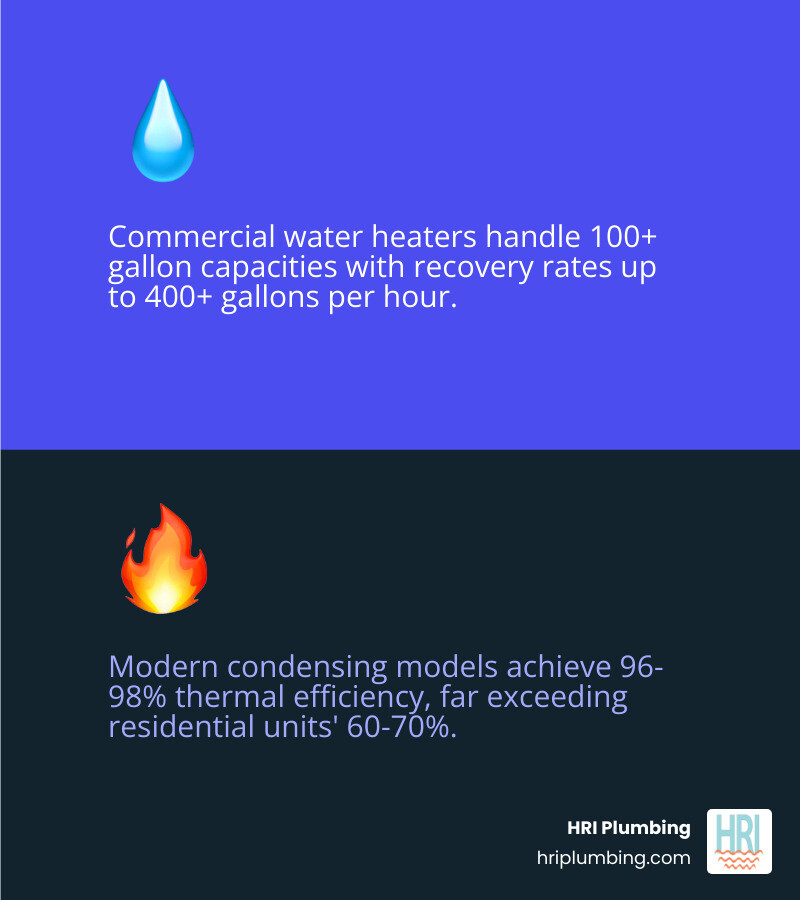
- Efficiency: Modern condensing models reach up to 96–98% thermal efficiency
- Upcoming regulation: New DOE energy standards take effect October 6, 2026 — affecting which models qualify
For businesses in Jacksonville, Springfield, and Rushville, IL, choosing the wrong commercial water heater can mean cold water during peak hours, unnecessary energy waste, or costly emergency repairs. Whether you run a restaurant that needs constant hot water through a busy dinner rush or manage a facility with dozens of occupants, getting the right system installed correctly makes a real difference to your bottom line and daily operations.
This guide breaks down everything you need to know — from selecting the right type and size, to understanding the latest efficiency standards, to keeping your system running reliably for years.
Key Factors for Choosing the Right commercial water heater
When we help businesses in Springfield or Jacksonville select a new commercial water heater, we don't just look at the size of the tank. The "right" choice depends on a complex web of factors including your specific industry, the physical layout of your mechanical room, and your long-term energy goals.
Modern systems have evolved significantly. While traditional atmospheric gas units were once the standard, many facilities are now moving toward condensing gas units or high-efficiency electric heat pumps. A condensing gas unit, for example, captures heat from exhaust gases that would otherwise be wasted, pushing thermal efficiency to 96% or higher.
Comparing Commercial Water Heater Types
| Feature | Gas Tank Models | Electric Tank Models | Tankless Systems |
|---|---|---|---|
| Recovery Rate | Very High | Moderate | Instantaneous |
| Installation Space | Large footprint | Moderate | Compact/Wall-mount |
| Fuel Type | Natural Gas / Propane | Electricity (Multi-volt) | Natural Gas / Propane |
| Best For | High-volume restaurants | Office buildings | Space-saving needs |
| Efficiency | Up to 98% (Condensing) | High (No standby loss) | High (On-demand only) |
Choosing between natural gas and liquid propane often comes down to what is already available at your Springfield facility. If you are in a more rural area near Rushville, propane might be your primary option. Electric models are incredibly versatile, with voltages ranging from 120V for light-duty needs to 480V for heavy industrial applications.

Understanding Capacity and MBH for Your commercial water heater
Capacity in the commercial world is measured in two ways: storage volume (gallons) and heating power (BTU or MBH). MBH stands for thousands of British Thermal Units per hour. For instance, a common high-demand rating is 199.9 MBH, which is often the "sweet spot" for many restaurants because it provides massive heating power without crossing into certain more stringent boiler regulatory categories.
If your business has a high peak demand—like a hotel where everyone showers at 7:00 AM—you need a large gallon distribution, often exceeding 100 gallons, paired with a high MBH rating to ensure the water stays hot. Conversely, a business that needs a steady but smaller stream of hot water might prioritize recovery rate over storage. Calculating this demand requires looking at your "First Hour Rating," which is the amount of hot water the unit can provide in one hour starting with a full tank.
For complex facilities, we often recommend a Commercial Plumber Springfield IL Guide to help navigate these sizing calculations, as an undersized unit will fail prematurely due to constant overworking.
Advanced Technologies in Modern commercial water heater Systems
The technology inside a commercial water heater today is a far cry from the simple "fire under a bucket" designs of the past. We are seeing a massive shift toward "smart" water heating.
- Condensing Technology: By using a secondary heat exchanger, these units achieve up to 96-98% thermal efficiency.
- iCOMM™ Connectivity: Leading manufacturers now offer mobile apps that allow facility managers to monitor water temperature, leak detection, and error codes remotely.
- Modulating Burners: Instead of being just "on" or "off," modulating burners can adjust their flame size (sometimes with a 10:1 turndown ratio) to match the exact demand, saving a significant amount of fuel.
- Durable Construction: Options like glass-lined tanks provide excellent corrosion resistance, while stainless steel tanks offer longevity in even the harshest water conditions.
If you are looking for specialized guidance on these features for a facility in the Jacksonville area, our Commercial Plumber Jacksonville Guide offers deeper insights into local installation trends.
Navigating New DOE Standards and Energy Efficiency
As of April 2026, we are quickly approaching a major regulatory milestone. New Department of Energy (DOE) standards are set to take effect on October 6, 2026. These standards will mandate higher minimum efficiency levels for commercial water heating equipment.
What does this mean for you?
- Future-Proofing: If you are replacing a unit now, it is wise to choose an ENERGY STAR® certified model that already meets or exceeds these 2026 standards.
- LEED and Emissions: Many new units are designed for Ultra-Low NOx emissions, helping businesses meet environmental goals and LEED ratings.
- Standby Loss Reduction: Improved insulation in modern tanks significantly reduces "standby loss," which is the heat lost while the water is just sitting in the tank.
Upgrading to a high-efficiency system isn't just about compliance; it's about reducing the overhead of your business. In some cases, a full Commercial Pipe Replacement Springfield may be necessary to accommodate the different venting or drainage requirements of these high-efficiency condensing units.
Installation and Maintenance of Your Commercial Water Heater
Installing a commercial water heater is not a "DIY" project. These units are heavy, complex, and involve high-pressure systems and high-voltage electricity or gas lines. Proper installation ensures that your warranty remains valid and your building stays safe.
Professional Installation Requirements in Jacksonville and Springfield
In cities like Jacksonville and Springfield, local plumbing codes are strict regarding how a commercial water heater is vented and connected.
- Venting Types: High-efficiency condensing units often require PVC, CPVC, or specialized polypropylene venting because their exhaust is cool and acidic. Older atmospheric units use metal B-venting. Getting this wrong can lead to carbon monoxide leaks or pipe corrosion.
- ASME Compliance: Many commercial applications require tanks that are ASME-rated (American Society of Mechanical Engineers) to ensure they can handle high pressures safely.
- Backflow Prevention: To protect the city's clean water supply, commercial installations must include backflow prevention devices, which we test and certify during installation.
- Safety Components: Thermal expansion tanks and temperature/pressure (T&P) relief valves are non-negotiable safety features that protect your plumbing system from exploding under pressure.
For more details on the standards we follow, see our Commercial Plumbing Jacksonville IL Guide.
Essential Maintenance for Longevity and Performance
A commercial water heater is an investment, and like any investment, it needs protection. Because these units work much harder than residential ones, they accumulate "scale" (mineral buildup) much faster.
Our maintenance protocol includes:
- Tank Flushing: Removing sediment that settles at the bottom of the tank, which can otherwise act as an insulator and cause the tank to overheat and crack.
- Anode Rod Inspection: These "sacrificial" rods attract corrosive elements in the water so the tank doesn't rust. They must be replaced every few years.
- Heating Element/Burner Testing: Ensuring that electric elements aren't burnt out and gas burners are firing cleanly.
- Scale Prevention: In areas with hard water, we often recommend water softeners or scale-inhibiting systems to extend the life of the heater.
If you notice a leak or a drop in temperature, don't wait. We provide expert Commercial Water Heater Repair to get your business back up and running. You can also Find Businesses That Do Commercial Water Heater Repair in the Springfield IL Area to see why local reputation matters.
Why HRI Plumbing is the Trusted Choice for Local Businesses
At HRI Plumbing, we understand that hot water is the lifeblood of your business. Whether it’s for sanitizing dishes in a restaurant, providing comfort in a hotel, or maintaining hygiene in a clinic, a failure is not an option.
We serve Jacksonville, Springfield, and Rushville with a commitment to honesty and integrity. Our USP is simple: we provide 24/7 support because plumbing emergencies don't stick to a 9-to-5 schedule. Our technicians are experts in the latest commercial technologies, from high-efficiency condensing gas units to the newest heat pump models.
We offer:
- Same-day service for urgent repairs.
- Comprehensive maintenance plans to prevent breakdowns before they happen.
- Expert sizing and selection to ensure you aren't paying for more capacity than you need—or suffering with too little.
- Affordable, transparent solutions tailored to the specific needs of Illinois business owners.
When it's time to replace your old system or if you need a reliable partner for ongoing maintenance, trust the team that knows the local codes and the unique challenges of Illinois water. For professional help, visit our Commercial Water Heater Repair and Replacement page to schedule a consultation. We are here to keep the hot water flowing so you can focus on running your business.


