



The Myth of Endless Hot Water for Large Families
Most homeowners believe that upgrading to an on-demand system guarantees unlimited hot showers for everyone in the house, but does a tankless water heater actually make sense for a family of five? The short answer is that tankless water heaters are heavily marketed on the promise of "endless" hot water, which sounds like the perfect solution for a large, busy household. However, "endless duration" does not mean "unlimited simultaneous flow," and that is a critical distinction our team at HRI Plumbing has to make when multiple people need to get ready for the day at the exact same time.
The real test of any household plumbing system usually arrives with the August back-to-school morning rush. During the summer, waking hours are staggered and hot water usage is spread out. But once school starts, the schedule shifts to synchronized routines. Overlapping fixture usage—like two showers running while the dishwasher cleans last night's plates—puts immense strain on a water heater's output. If you are currently evaluating your plumbing services and equipment, you are likely facing a major decision point: determining whether a single high-capacity tankless unit, a multiple-unit configuration, or a traditional high-recovery tank is the right choice to keep your five-person household running smoothly.
The Math Behind the Morning Rush: Understanding Peak Demand
To understand how a tankless system performs under pressure, you have to look at how these units are measured. Unlike traditional tanks that hold a specific volume of water (like 50 or 75 gallons), tankless capacity is measured entirely by flow rate. This metric is known as Gallons Per Minute (GPM). If your household's simultaneous Gallons Per Minute (GPM) demand exceeds what the unit can heat on the fly, you will experience performance issues, no matter how new or advanced the system is.
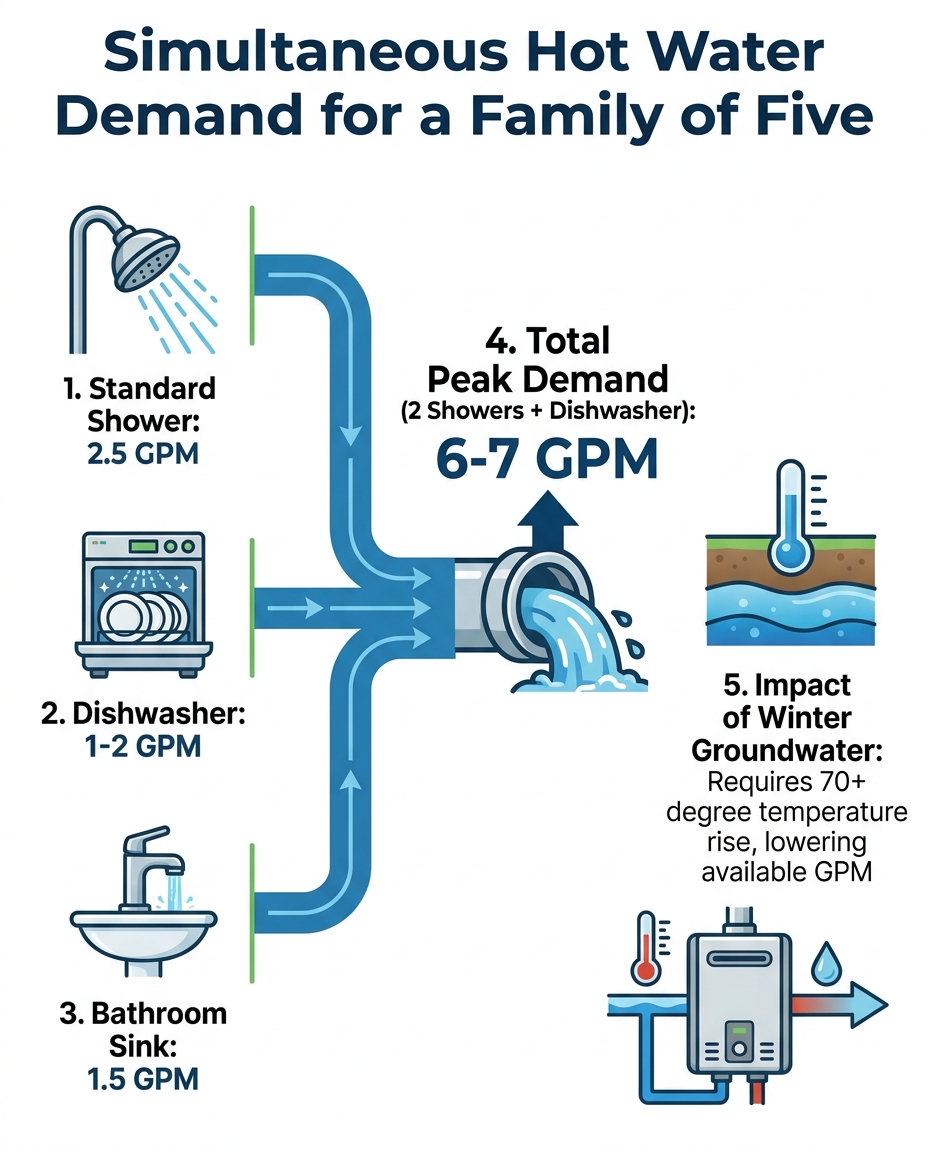
Multiple bathrooms being used at once is the true test of a tankless system's capacity. If you have recently completed bathroom remodeling to add a master suite or a Jack-and-Jill bathroom for the kids, your home now has the physical fixtures to draw massive amounts of water concurrently. A standard showerhead uses about 2.5 gallons per minute, while a modern running dishwasher adds another 1 to 2 gallons per minute to the total load.
Calculating Your Household's Maximum GPM
Figuring out your peak demand requires a simple but essential calculation. Here is how we typically map out our clients' family morning routines:
1. Identify concurrent activities: Determine exactly which fixtures are realistically running at the exact same time on your busiest mornings.
2. Assign a GPM value to each fixture: Standard showerheads (2.5 GPM), bathroom sink faucets (1.5 GPM), and dishwashers (1 to 2 GPM).
3. Calculate the baseline load: Running two showers simultaneously instantly creates a 5.0 GPM demand.
4. Add secondary appliances: If the dishwasher (1.5 GPM) or a washing machine is running while those showers are active, your total required flow rate jumps to 6.5 or 7.0 GPM.
For a family of five, a 7.0 GPM peak demand is incredibly common. A single tankless unit must be able to heat that specific volume of water instantly as it passes through the heat exchanger. If it cannot, the system has to compromise.

Why Winter Groundwater Changes the Equation
Understanding your GPM demand is only half the battle. The other half is dictated by the weather outside and the ground below. The concept of temperature rise is the most critical factor in tankless water heater performance. Temperature rise is the difference between the incoming cold groundwater temperature and your desired output temperature, which is usually set around 120 degrees for residential safety and comfort.
In colder climates, the incoming groundwater can be exceptionally cold, requiring the heater's burners to work much harder to bridge the gap. As local plumbers here in Jacksonville IL, our team at HRI Plumbing sees this issue constantly when winter hits. While late-summer water lines might deliver water at 65 degrees (requiring only a 55-degree rise to hit 120), winter groundwater can easily plunge to 45 degrees or lower. That means the water heater suddenly requires a 75-degree temperature rise just to produce a comfortable shower.
The mechanical reality of a tankless unit is that it has a fixed maximum heating capacity. To achieve a high temperature rise when the water is freezing cold, a tankless unit must slow down the water flow so it spends more time inside the heat exchanger. This directly reduces the maximum available GPM for your house. A system heavily marketed as an 8 GPM unit in a warm southern climate might only produce 4 to 5 GPM during a midwestern winter. Right when your family needs hot water the most, the system's actual output capacity shrinks.
What Happens When You Exceed Tankless Capacity?
The Problem: You are in the master bathroom taking a shower, two kids turn on the shower in the hallway bathroom, and someone starts the washing machine. Suddenly, your water pressure drops to a weak trickle, or the water temperature starts fluctuating wildly.
The Cause: Modern tankless systems are equipped with built-in safety mechanisms, specifically automated flow restrictors and temperature sensors. If your family's demand (for example, 7 GPM) exceeds the unit's winter heating capacity (which might be capped at 5 GPM due to cold groundwater), the system refuses to send you lukewarm water. Instead, it automatically restricts the physical flow of water through the pipes to ensure whatever water does pass through reaches the set 120-degree mark.
The Solution: The unit isn't actually "running out" of hot water in the way a traditional tank does. It is simply protecting the set temperature by restricting flow. In our experience, resolving this requires either upgrading the system's capacity, adding a secondary unit, or strictly staggering the family's morning shower schedule so that peak demand never exceeds the unit's winter GPM limit.
Side-by-Side Comparison: Tankless vs. High-Recovery Tanks
For a household of five, choosing the right system often comes down to weighing the benefits of a single high-capacity tankless unit against a traditional high-recovery tank. Both strategies have distinct advantages, but they handle heavy simultaneous usage very differently.
• Hot Water Delivery — High-Capacity Tankless Unit: Endless duration, but capped flow rate (GPM) — High-Recovery Traditional Tank: Massive simultaneous flow, but limited total volume
• Peak Morning Rush — High-Capacity Tankless Unit: Struggles if demand exceeds GPM capacity — High-Recovery Traditional Tank: Handles multiple showers easily until tank depletes
• Space Requirements — High-Capacity Tankless Unit: Wall-mounted, highly compact — High-Recovery Traditional Tank: Requires significant floor space for 50-75 gallons
• Energy Efficiency — High-Capacity Tankless Unit: Only heats water when a faucet is open — High-Recovery Traditional Tank: Maintains stored water temperature 24/7
• Winter Performance — High-Capacity Tankless Unit: GPM output drops due to cold groundwater — High-Recovery Traditional Tank: Flow rate unaffected by groundwater temperature
Pros and Cons for Large Households
A tankless system offers the undeniable benefit of endless showers—provided those showers are taken one after another rather than at the exact same time. It takes up less space in your utility room and offers higher long-term energy efficiency because you aren't paying to keep 75 gallons of water hot overnight. Additionally, federal tax credits or local utility incentives may apply to qualifying high-efficiency installations. The primary cons are the strict flow rate limitations and the noticeable winter performance drops.
Conversely, a high-recovery traditional tank acts as a massive thermal battery. Because the hot water is already stored and ready to go, it can handle massive simultaneous demand easily. You can run three showers and a washing machine at once without a drop in pressure or temperature. The drawback is that if those three showers run too long, the tank will eventually run out, and the next person in line will have to wait for the system to recover.
Alternative Solutions: Dual Units and Hybrid Approaches
If your family of five wants the energy savings and endless duration of a tankless system, but you cannot compromise on flow rate during the morning rush, there are advanced plumbing configurations available. You do not have to settle for a single unit that struggles to keep up.
Parallel Tankless Installation: One of the most effective solutions we recommend for larger Central Illinois homes is installing two tankless units in parallel. By linking two heaters together, you effectively double your available GPM. If one unit provides 5 GPM in the winter, two units will provide 10 GPM, easily covering the demands of a large household. If you are upgrading your water heater capacity for the morning rush, a parallel system ensures you never have to yell down the hall to ask someone to turn off a faucet.
Zoning Strategies: Another popular approach we often implement is dedicating one tankless unit exclusively to the master bathroom, and a second unit to the rest of the house (kitchen, laundry, and kids' bathrooms). This completely isolates the master suite's water pressure and temperature from the rest of the household's chaotic morning routines.
Hybrid and Point-of-Use Systems: Some homes benefit from a hybrid approach, such as keeping a traditional tank for the main house but installing a smaller, point-of-use tankless heater directly under the kitchen sink or near a distant bathroom. It is important to note that all of these alternative setups have strict installation requirements. Adding a second tankless unit or upgrading to a high-capacity model often requires upsizing the home's gas lines and modifying the exhaust venting to handle the increased combustion safely.
Making the Right Choice Based on Your Household Routine
Ultimately, the "best" system for a family of five depends entirely on your actual daily habits. If your family naturally staggers their showers—perhaps the parents shower at 5:30 AM and the kids shower at 6:45 AM—a single tankless unit will provide fantastic efficiency and truly endless hot water. However, if everyone is scrambling to get ready at the exact same time, a single unit will likely leave someone shivering under low water pressure.
Before committing to a specific technology, track your actual concurrent water usage for a week. Note exactly which fixtures are running simultaneously. Generic square footage guidelines or basic bathroom counts are not enough to size a system accurately for a heavy-use household.
This is where professional sizing calculations make all the difference. Our team at HRI Plumbing provides realistic, household-specific plumbing assessments based on local Central Illinois water conditions, rather than just pushing the newest technology universally. A qualified residential plumber from our crew will evaluate your incoming gas pressure, your winter groundwater temperatures, and your family's peak GPM demand to recommend a system that actually works for your life.
Frequently Asked Questions About Tankless Heaters for Large Families
Can a tankless water heater run two showers at the same time?
Yes, a properly sized tankless water heater can run two showers at the same time in most conditions. However, this depends heavily on the flow rate (GPM) of your showerheads and the temperature of your incoming cold water. In the winter, when groundwater is freezing, the unit's capacity drops, meaning running two high-flow showers simultaneously might cause a drop in water pressure.
What size tankless water heater do I need for a family of 5?
A family of five typically requires a tankless water heater capable of delivering at least 7 to 9 GPM to handle peak morning routines. In our experience, sizing is based on simultaneous fixture usage, not just the number of people in the house. To determine the exact size, you must calculate the total flow rate of the showers, sinks, and appliances that will run concurrently.
Do tankless water heaters ever run out of hot water?
No, a tankless water heater does not run out of hot water because it heats water continuously as long as the faucet is open. Instead of running out of hot water, a tankless system is limited by its flow rate. If you demand more hot water than it can heat at once, it will restrict the water pressure to maintain the correct temperature.
How many GPM do I need for a 3 bathroom house?
A 3-bathroom house generally requires a tankless unit that can produce between 8 and 10 GPM to safely operate multiple fixtures at once. If two showers and a kitchen sink are running simultaneously, the combined demand easily exceeds 6 GPM. You must also factor in regional winter temperatures, which will lower the unit's effective GPM output.
Does cold winter weather affect a tankless water heater's performance?
Yes, cold winter weather directly impacts a tankless water heater's performance by lowering the temperature of the incoming groundwater. Because the unit has to heat much colder water to reach your desired temperature, it must slow down the flow of water through its heat exchanger. This results in a lower maximum GPM output during the winter months.
Get a Realistic Assessment for Your Home's Hot Water Needs
Navigating flow rates, winter temperature rises, and the heavy demands of a large household does not have to be a guessing game. If your current system is struggling to keep up with the late-summer back-to-school rush, it is time to look at solutions built for your specific routine. We offer professional assessments to determine the exact system required to keep your family's mornings running smoothly, without the sudden cold bursts or pressure drops. Reach out to HRI Plumbing today for an expert evaluation and explore your water heater replacement options to find the perfect fit for your home.


