



What Illinois Homeowners Need to Know About Plumbing Code Requirements
Understanding illinois plumbing code requirements for homeowners can feel overwhelming — but knowing the basics could save you from costly fines, failed inspections, or unsafe work in your home.
Here is a quick summary of what the code requires:
- Who can do the work: Only a licensed Illinois plumber, or the owner-occupant of a single-family residence doing their own work
- Pipe materials: Type K copper or ductile iron underground; Type L, M copper, or PEX above ground
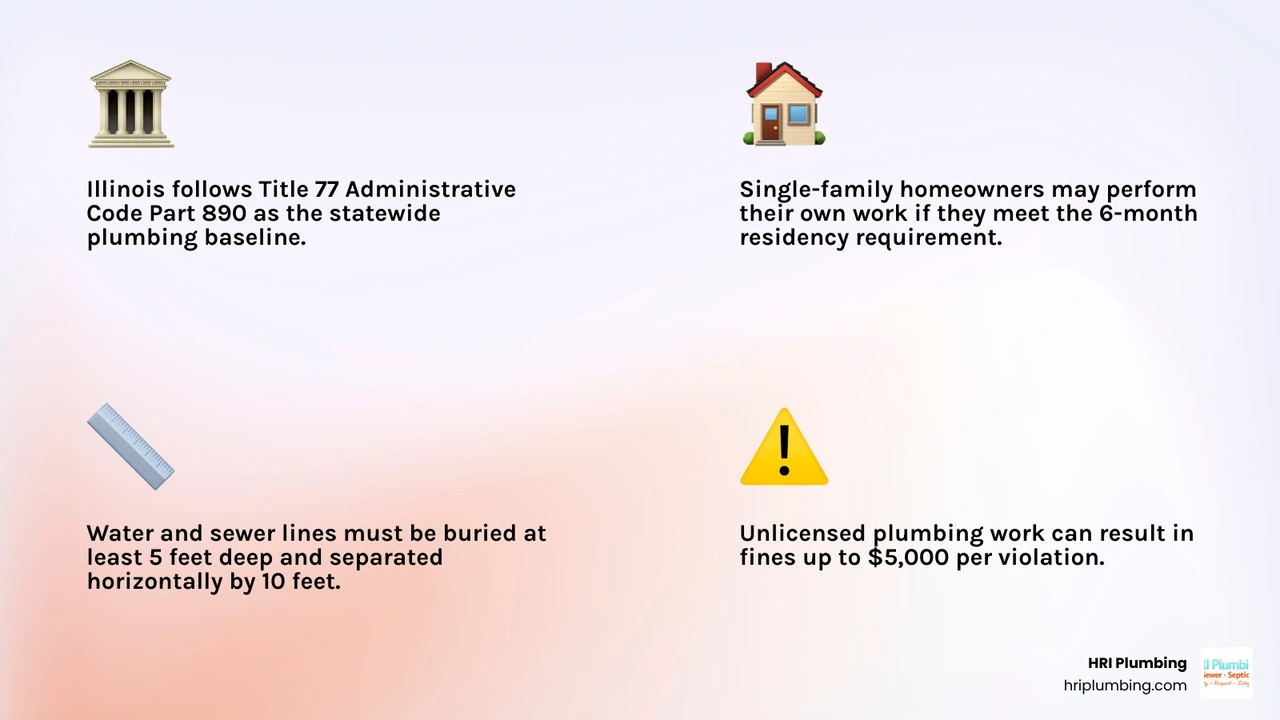
- Minimum service depth: Water and sewer lines must be buried at least 5 feet deep
- Separation distance: Water and sewer services must be at least 10 feet apart horizontally
- Minimum drain size: 4 inches for single-family residential building drains
- Fixtures: All new fixtures must carry the WaterSense label when available
- Penalties: Unlicensed plumbing work can result in fines up to $5,000
Illinois adopted its statewide plumbing code under Title 77 of the Illinois Administrative Code, Part 890. But here is the catch — local municipalities like the Village of Lisle, as well as cities across central Illinois including Jacksonville, Springfield, and Rushville, can layer on their own stricter amendments. That means what is acceptable in one town may not pass inspection in another.
Whether you are dealing with a plumbing emergency, planning a renovation, or trying to figure out if your existing system is up to code, this guide walks you through everything you need to know.
Understanding the illinois plumbing code requirements for homeowners
At its core, plumbing regulation in our state is governed by the Illinois Department of Public Health (IDPH) under Title 77 Illinois Administrative Code Part 890, commonly known as the Illinois Plumbing Code. This state-level code serves as the baseline for protecting public health, preventing water contamination, and ensuring sewer gases don't find their way into your living room.
However, local jurisdictions have the authority to adopt the state code with their own custom amendments. For instance, the Village of Lisle, along with cities in central Illinois, adds localized rules that specify everything from the exact distance of a floor drain to the prohibition of specific materials.
When dealing with older properties, you will frequently hear the term existing legal non-conforming plumbing system. This refers to a plumbing system that was completely legal when it was originally installed but does not meet current, updated codes. Under Illinois law, you do not have to rip out and update these systems unless you alter or remodel them, change the building’s use, or if the system creates an active health or safety hazard.
Another definition to keep in mind is a strip mall. In plumbing terms, this refers to a commercial multi-tenant building. If you own a mixed-use property, be aware that local amendments often mandate strict commercial requirements for these setups—such as requiring a dedicated 6-inch sanitary waste line installed 36 inches below the finished floor with a cleanout in the last tenant space.
To give you an idea of how state baselines compare to localized municipal amendments, take a look at this comparison table:
| Plumbing Feature | Statewide Illinois Code Baseline | Common Local Amendments (e.g., Lisle / Municipalities) |
|---|---|---|
| Underground Water Pipe | Approved plastic, copper, or ductile iron | Type K copper or ductile iron only; plastic prohibited |
| Basement Floor Drain | Required in basements near mechanicals | Must be within 5 feet of a furnace, boiler, or water heater |
| Water Softener Discharge | Standard backwash routing | Max 75 gallons per cycle; max 3 cycles per week |
| Urinals | Standard flushometers | Tank-type urinals completely prohibited |
Who Can Legally Do the Work Under illinois plumbing code requirements for homeowners?
Can you roll up your sleeves and tackle a major repiping project on your own? The answer is: it depends.
Under the Illinois Plumbing License Law Section 320/3, all planning, designing, and installation of plumbing systems must be performed by a licensed Illinois plumber or a registered apprentice under direct supervision. However, there is a specific exception for homeowners: the single-family owner-occupant exemption.
If you own and occupy a single-family detached or attached dwelling as your primary residence, you are legally permitted to plan and perform your own plumbing installations and repairs. But there are major catches to prevent house flippers from abusing this loophole:
- You must complete the work yourself without hiring unlicensed help.
- You must comply with all local permitting and inspection rules.
- Many municipal codes enforce a 6-month residency requirement, meaning you must retain ownership and live in the property for at least six months after the permitted work is completed. If you do not, local authorities can place a hold on your real estate transfer stamps.
If you hire an unlicensed individual to do plumbing work in your home, or if you attempt to do it yourself on a property you don't live in, you are violating the law. Unlicensed plumbing work can result in a fine of up to $5,000 per violation.
Before starting any DIY project, read through our Plumbing Permit Guide Illinois 2026 to see if your project requires a permit. If you decide a professional is a safer bet, protect yourself by reviewing these Questions to Ask Before Hiring a Plumbing Company and watch out for these Red Flags When Hiring a Plumber.
Permitted Materials and Sizing for Water Supply and Sewer Lines
The materials you use inside and outside your home are strictly regulated to prevent leaks and contamination. Here is what the code says about your piping:
- Underground Water Supply: For water service lines running from the municipal main to your water meter, the code requires Type K copper or ductile iron. Many local amendments require this copper line to be a continuous, one-piece line from the service stop to the water meter to minimize joint failure. Polyethylene plastic pipe is generally restricted and only allowed for private wells.
- Above-Ground Water Supply: Inside the home, you are permitted to use Type L copper, Type M copper, or PEX piping.
- PVC Restrictions: While PVC is excellent for drainage, waste, and vent (DWV) systems, it is strictly prohibited for indoor water supply lines.
- Service Line Depth: To prevent freezing during harsh Illinois winters, all water and sewer service lines must be buried at a minimum depth of 5 feet.
- Separation Distances: To avoid cross-contamination in the event of a pipe break, water lines and sanitary sewer lines must maintain a minimum of 10 feet horizontal separation when buried.
- Sizing Requirements: A single-family residential building drain must be a minimum of 4 inches in diameter, while the main incoming water service line must be a minimum of 1 inch.
- Structural Protection: Where plumbing lines pass through wood studs, joists, or rafters, you must install metal nail guards or stud guards to protect the pipes from accidental nail or screw punctures.
Key Fixture and System Rules Under illinois plumbing code requirements for homeowners
When replacing or adding new fixtures, you must pay attention to water conservation and specific installation rules:
- WaterSense Labeled Fixtures: All newly installed plumbing fixtures—such as showerheads, faucets, and toilets—must bear the WaterSense label if an EPA-approved model is available.
- Urinal Restrictions: In municipal areas, tank-type urinals are prohibited. Urinals must use approved flushometer valves.
- Residential Water Softeners: To protect local municipal wastewater treatment facilities from excessive salt and water loads, residential water softeners are often restricted. They must not use more than 75 gallons of water during the entire regeneration cycle, and they are limited to a maximum of 3 cycles per week.
- Basement Floor Drains: If you have a residential basement, you must have a floor drain. Furthermore, local codes often dictate that this floor drain must be located within 5 feet of your furnace, boiler, or water heater to handle condensation and relief valve discharge.
- Grease Interceptors: If you are planning a grease-producing setup (such as a commercial kitchen or a highly active home-based catering business), you must install a properly vented outside grease interceptor.
- Septic Systems: If your home is not connected to a municipal sewer system, your private waste disposal must comply with strict environmental rules. Learn more in our guide: Do I Need a Permit for Septic Work in Illinois.
Local Amendments and Handling Non-Conforming Systems in Lisle and Central Illinois
Local amendments vary wildly depending on where you live. For example, in the Village of Lisle, private wells are strictly prohibited within village boundaries wherever municipal water is available, and any existing wells must be sealed upon connection to the public water supply. Lisle also enforces strict rules regarding water recycling systems for commercial operations like car washes, requiring them to recycle a high percentage of their water.
If you live in central Illinois—such as Jacksonville, Springfield, or Rushville—local municipal codes will dictate your specific permit processes, material allowances, and inspection timelines.
What should you do if you discover unpermitted or non-conforming plumbing in a home you recently purchased?
- Don't panic: An "existing legal non-conforming" system is allowed to remain as long as it is safe and you aren't remodeling that specific area.
- Get an inspection: Have a licensed local plumber evaluate the system to ensure there are no immediate health or safety hazards (like sewer gas leaks or cross-connections).
- Correct hazards first: If there is an active risk, make it your priority to bring that specific section up to current code.
- Permit your remodels: When you do decide to upgrade, make sure to work with local experts who understand municipal code amendments inside and out.
To make sure your project goes smoothly, read about What to Look for in a Local Plumbing Contractor and understand the Benefits of Choosing a Local Plumbing Company.
Local Enforcement, Permits, and Next Steps for Your Home
Local plumbing inspectors are certified under the Illinois Plumber’s Licensing Code and have the legal right to inspect any residential or commercial property to enforce compliance. For minor repairs that do not exceed a certain dollar amount (often $499) or simple tasks like clearing a clogged drain or replacing a basic faucet, you generally do not need a permit. However, for water heater replacements, repiping, or sewer line work, pulling a permit is non-negotiable.
If you reside in Jacksonville, Springfield, or Rushville, IL, our team at HRI Plumbing is here to help. We specialize in residential and commercial plumbing, offering expert drain cleaning, sewer repair, water heater installations, leak detection, and comprehensive pipe repiping. We understand local municipal codes and will ensure your project is completed safely, on time, and fully compliant with the law.
When you choose a local partner, you get fast response times and technicians who live in your community. To learn more, check out Why Choose a Local Plumber Over a National Chain and discover How Local Plumbing Companies Provide Better Service.
Ready to get started on your next home improvement project or need a professional code compliance inspection? Schedule professional plumbing services with HRI Plumbing today, or call us for 24/7 emergency support!


