

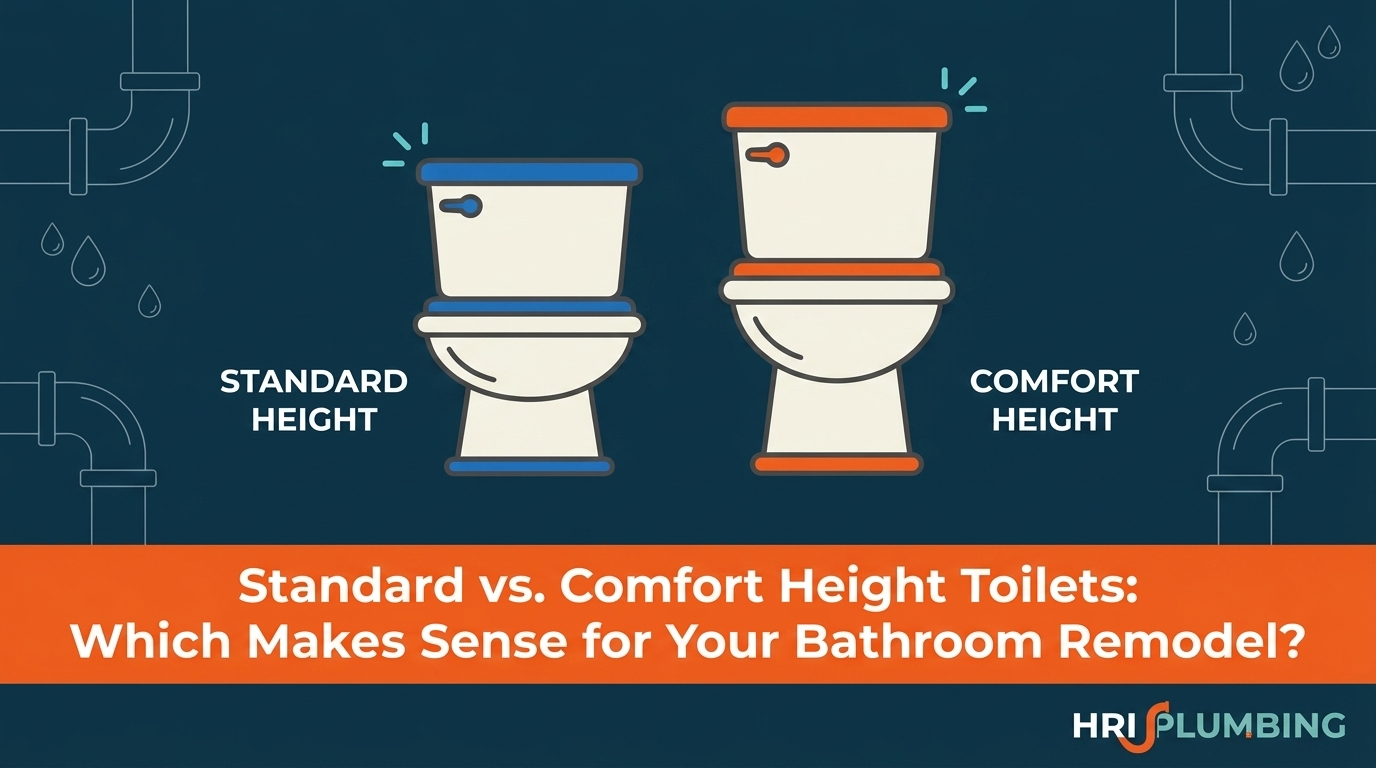


Are You Overlooking the Most Important Measurement in Your Remodel?
When upgrading your home, you will inevitably face a crucial question: standard vs. comfort height toilets: which makes sense for your bathroom remodel? Homeowners often spend weeks agonizing over tile colors, vanity styles, and lighting fixtures, completely overlooking the biomechanics of their daily routines. Choosing between different toilet heights is a critical decision point, especially for multi-generational homes where the needs of aging adults clash with the needs of young children.
The choice you make impacts both the long-term aging-in-place benefits of your home and the immediate accessibility for toddlers who are potty training. Understanding the precise measurements—like the traditional 15 inches (standard height bowl to floor)—is the first step to a successful bathroom upgrade. If you want to ensure your space is functional for everyone, evaluating these options is just as important as selecting the right plumbing services for your project.
Understanding the Traditional 15-Inch Standard Height Toilet
Historically, the standard toilet bowl measurement has been remarkably consistent across most residential builds. For decades, the baseline measurement has sat right at 15 inches (standard height bowl to floor). This traditional height was established long before modern accessibility standards were written, and it remains a staple in new construction today.
There are distinct anatomical reasons why this height has persisted for so long. A lower bowl naturally encourages a different posture, which many people find beneficial for their daily routine. Here is why the standard height still holds a strong place in modern homes:
• Natural squatting position: The 15-inch height allows the user's knees to sit slightly higher than their hips. This creates a natural squatting angle that can significantly aid in digestion and reduce straining.
• Child-friendly accessibility: This height is highly accessible for households with toddlers and young children. A standard height bowl makes potty training much easier and reduces the reliance on bulky step stools.
• Comfort for shorter adults: Shorter individuals often find standard height toilets more comfortable because their feet can rest perfectly flat on the floor, preventing the legs from dangling or falling asleep.
The Role of Standard Height in Your Home
If your household consists primarily of younger parents and small children, a 15-inch bowl often feels like the most logical choice. It eliminates the immediate hurdles that children face when using the restroom independently. When planning a toilet installation, it is vital to weigh these immediate family needs against how long you plan to stay in the home. While the standard height is excellent for digestion and early childhood, it does present challenges for individuals with limited mobility.
What Is a Comfort Height Toilet and How Does It Relate to ADA Compliance?
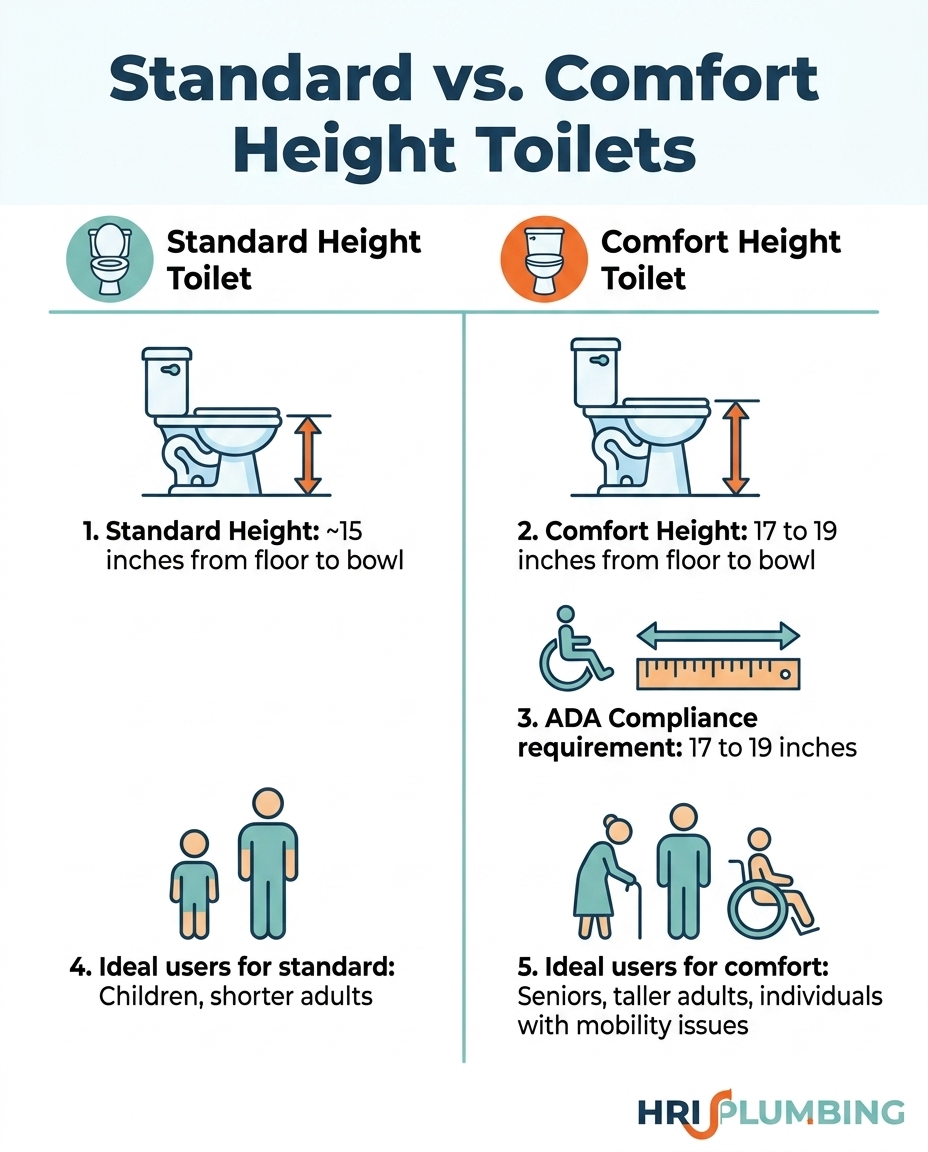
As the population ages and homeowners look for ways to age in place, the plumbing industry has adapted by introducing taller fixtures. Comfort height models are specifically designed to mimic the height of a standard dining room chair. Instead of the traditional 15 inches, these fixtures measure 17 to 19 inches (comfort height bowl to floor). This added elevation significantly reduces the physical effort required to sit down and stand back up.
Decoding Manufacturer Terminology
When shopping for a new fixture, you will quickly notice that different brands use different marketing terms to describe the exact same concept. You might see labels like "Chair Height," "Right Height," or "Universal Height." Regardless of the proprietary name printed on the box, all of these terms refer to a bowl that sits taller than the 15-inch standard.
The ADA Connection
To meet Americans with Disabilities Act (ADA) compliance for accessibility, a toilet bowl must fall within a strict height range. Specifically, the measurement must be 17 to 19 inches (comfort height bowl to floor), including the seat. The ADA established this standard because it closely matches the height of an average wheelchair, making lateral transfers much safer and easier for individuals with physical disabilities.
It is important to note that while all ADA-compliant toilets are comfort height, not all comfort height toilets are strictly ADA-compliant in a commercial sense (as commercial compliance also involves grab bars and clearance space). However, for residential remodeling purposes, installing a fixture in the 17- to 19-inch range provides the exact same biomechanical benefits, reducing joint strain and increasing daily safety for seniors and taller adults.
Standard vs. Comfort Height: A Side-by-Side Comparison
To make the best decision for your upcoming remodel, it helps to look at the hard facts side by side. The differences may seem minor on paper—just two to four inches—but those few inches dramatically alter how the fixture functions for different demographics. Below is a direct comparison to help you evaluate which option aligns with your household's needs.
• Floor to Bowl Measurement — Standard Height Toilets: Approximately 15 inches (standard height bowl to floor). — Comfort Height Toilets: 17 to 19 inches (comfort height bowl to floor).
• Ideal User Demographics — Standard Height Toilets: Toddlers, young children, and shorter adults. — Comfort Height Toilets: Seniors, taller adults, and individuals with limited mobility.
• Impact on Joint Strain — Standard Height Toilets: Requires deeper knee bending and more core strength to stand. — Comfort Height Toilets: Significantly reduces the strain on knees, hips, and lower back.
• Digestive Posture — Standard Height Toilets: Promotes a natural squatting angle for better digestion. — Comfort Height Toilets: Can cause dangling feet for shorter users, requiring a footstool.
• Wheelchair Accessibility — Standard Height Toilets: Difficult for lateral transfers; sits lower than most wheelchairs. — Comfort Height Toilets: Matches standard wheelchair height for seamless, safe transitions.
Reviewing this comparison highlights that there is no single "perfect" toilet. The right choice depends entirely on who will be using the bathroom most frequently over the next decade.
The Biomechanics of Daily Use: Why Two Inches Matter
It is easy to dismiss a two- or three-inch height difference as trivial, but the physics of standing up from a seated position tell a different story. The act of rising from a low seat requires significant knee, hip, and core strength. When you sit on a traditional 15-inch bowl, your knees are bent at a sharper angle. Returning to a standing position from this deep angle forces your quadriceps and knee joints to bear the bulk of your body weight.
The Impact on Knees and Hips
For individuals with arthritis, joint deterioration, or those recovering from knee and hip replacement surgeries, a lower bowl is more than just inconvenient—it is a daily physical hurdle. A higher bowl measuring 17 to 19 inches (comfort height bowl to floor) provides crucial joint relief. By keeping the knees at or below hip level while seated, the mechanical disadvantage is removed. The user can simply slide forward and stand up with minimal exertion.
While Central Illinois experiences varied seasons—from hot, humid summers to freezing winters—proper biomechanical support is an evergreen indoor comfort issue. Ensuring year-round safety in the bathroom is not dependent on the weather outside; it is dependent on the fixtures you choose during your remodel.
Evaluating Daily Safety
When planning bathroom remodeling in Jacksonville, safety should be at the forefront of the design. A comfort height toilet reduces the risk of slips and falls associated with struggling to stand. It also reduces the likelihood of muscle strains in the lower back. For taller individuals (typically those over 5'8"), the taller bowl simply feels more natural, preventing the uncomfortable sensation of dropping too low when sitting down.
Navigating Multi-Generational Household Needs
One of the most common challenges homeowners face during a remodel is designing a space that works for everyone. Multi-generational households—where grandparents, parents, and young children all share the same living space—require a delicate balance of competing needs.
The Problem: Competing Needs
Families often struggle to balance the immediate needs of toddlers with the future needs of aging parents. A 15-inch standard height bowl is perfect for a three-year-old learning to use the restroom, but it can be a daily struggle for a seventy-year-old grandparent with arthritis. Choosing one extreme over the other leaves a portion of the family at a severe disadvantage.
The Cause: Different Stages of Life
The root of this problem lies in the timeline of human development and aging. Children grow quickly. The phase where a child needs a lower toilet is incredibly short-lived—often just a few years. Conversely, mobility issues in aging adults tend to progress and worsen over time. A slight knee ache today can become a significant mobility challenge five years from now.
The Solution: The 10-Year Timeline Rule
Evaluating your household's 10-year timeline is a practical way to finalize this decision. If you are planning a remodel that you expect to last for the next decade or more, prioritizing long-term mobility is usually the safer investment. The need for a lower toilet is a temporary phase easily solved by placing a small, removable step stool in front of a comfort height toilet. The need for a higher toilet, however, is a permanent, escalating requirement. You cannot easily make a 15 inches (standard height bowl to floor) toilet taller without complete replacement or clunky seat risers.
Long-Term Planning: Integrating Toilet Selection into Your Remodel
Selecting the right toilet height is not a decision made in a vacuum. It must integrate seamlessly into the broader scope of your bathroom renovation. A practical consultation framework helps homeowners finalize their choice while considering the technical and aesthetic aspects of the room.
Complementary Accessible Features
Your toilet height should complement other accessible features in the room. If you are installing a walk-in shower with a low threshold, or adding reinforced blocking in the walls for future grab bars, a comfort height toilet measuring 17 to 19 inches (comfort height bowl to floor) naturally fits this forward-thinking design philosophy. The goal is to create a cohesive space where every element works together to prevent falls and reduce physical strain.
Understanding Plumbing Rough-Ins
Homeowners often worry that changing the height of their toilet will require extensive plumbing modifications. Fortunately, this is rarely the case. The plumbing rough-in—the distance from the finished wall to the center of the floor drain—typically remains the same regardless of bowl height. The industry standard rough-in is 12 inches. Whether you select a 15-inch standard bowl or a 17-inch comfort bowl, it will almost certainly fit your existing 12-inch floor flange without requiring you to move the underground pipes.
The Value of Professional Guidance
Expert consultation helps families avoid costly post-remodel modifications. At HRI Plumbing, we have direct experience consulting with families during bathroom remodels in the Jacksonville and Springfield areas, ensuring the right fit for their specific household needs. Professional guidance ensures the chosen fixture fits the specific layout of the room. If you are considering Springfield bathroom remodeling, having an expert evaluate your space can clarify these demographic trade-offs and ensure your new bathroom serves you well for decades.
Make the Right Choice for Your Household's Future
Selecting the right toilet height is a foundational element of a successful, future-proof bathroom. By understanding the key differences between standard vs. comfort height toilets: which makes sense for your bathroom remodel becomes a much easier question to answer. Balancing immediate accessibility for children with the long-term mobility needs of adults ensures lasting comfort for everyone under your roof. Consulting with a local expert can clarify these demographic trade-offs and take the guesswork out of your renovation. Reach out to discuss your specific remodeling needs and ensure your space works flawlessly for your family's current and future needs.
Frequently Asked Questions
What is a comfort height toilet?
A comfort height toilet is a bathroom fixture designed to sit taller than traditional models, mimicking the height of a standard dining room chair. These toilets typically measure between 17 to 19 inches from the floor to the top of the seat. The added height makes it significantly easier to sit down and stand up, reducing strain on the knees and lower back. They are highly recommended for taller individuals, seniors, and anyone with mobility challenges.
What is standard toilet height?
Standard toilet height refers to the traditional measurement that has been used in residential construction for decades. These bowls typically measure about 15 inches from the floor to the rim. This lower height promotes a more natural squatting posture, which can aid in digestion. Standard height is also generally preferred for households with small children and adults of shorter stature.
Is comfort height the same as ADA compliant?
Yes, in terms of bowl height, comfort height and ADA compliant generally mean the same thing. The Americans with Disabilities Act requires a toilet seat to be between 17 and 19 inches from the floor to be considered compliant. Therefore, any toilet marketed as "comfort height," "chair height," or "right height" that falls within this measurement range meets the ADA height requirements for accessibility.
Which toilet height is best for seniors?
Comfort height toilets are widely considered the best option for seniors. Because they measure 17 to 19 inches from the floor, they require much less bending at the knees and hips. This minimizes the physical exertion needed to stand up, making the bathroom safer and reducing the risk of falls for older adults or those dealing with arthritis.
Does changing toilet height require moving the plumbing rough-in?
No, changing the height of your toilet bowl does not usually require moving the plumbing rough-in. The rough-in measurement is the distance from the wall to the center of the drain hole in the floor, which is standardly 12 inches for most homes. Both standard and comfort height toilets are manufactured to fit this same 12-inch floor footprint, allowing for a straightforward swap during a remodel.


