



Evaluating Toilet Heights for the Whole Family
Are you wondering, is a comfort height toilet right for shorter family members? When upgrading a shared family bathroom, choosing between a standard 15-inch toilet and a taller comfort height model often creates an unexpected decision point. Balancing the ergonomic needs of taller adults with the comfort of children and shorter household members requires careful consideration of how the space is actually used. If the fixture is mismatched to the user's physical dimensions, it can easily disrupt smooth August back-to-school morning routines when multiple people are trying to share the space efficiently. Navigating these choices does not have to be a guessing game. For homeowners looking to optimize their daily routines, consulting with experts in professional plumbing services ensures you receive clear ergonomic measurements to guide your decision and create a bathroom that works for everyone.
What Exactly Is a Comfort Height Toilet?
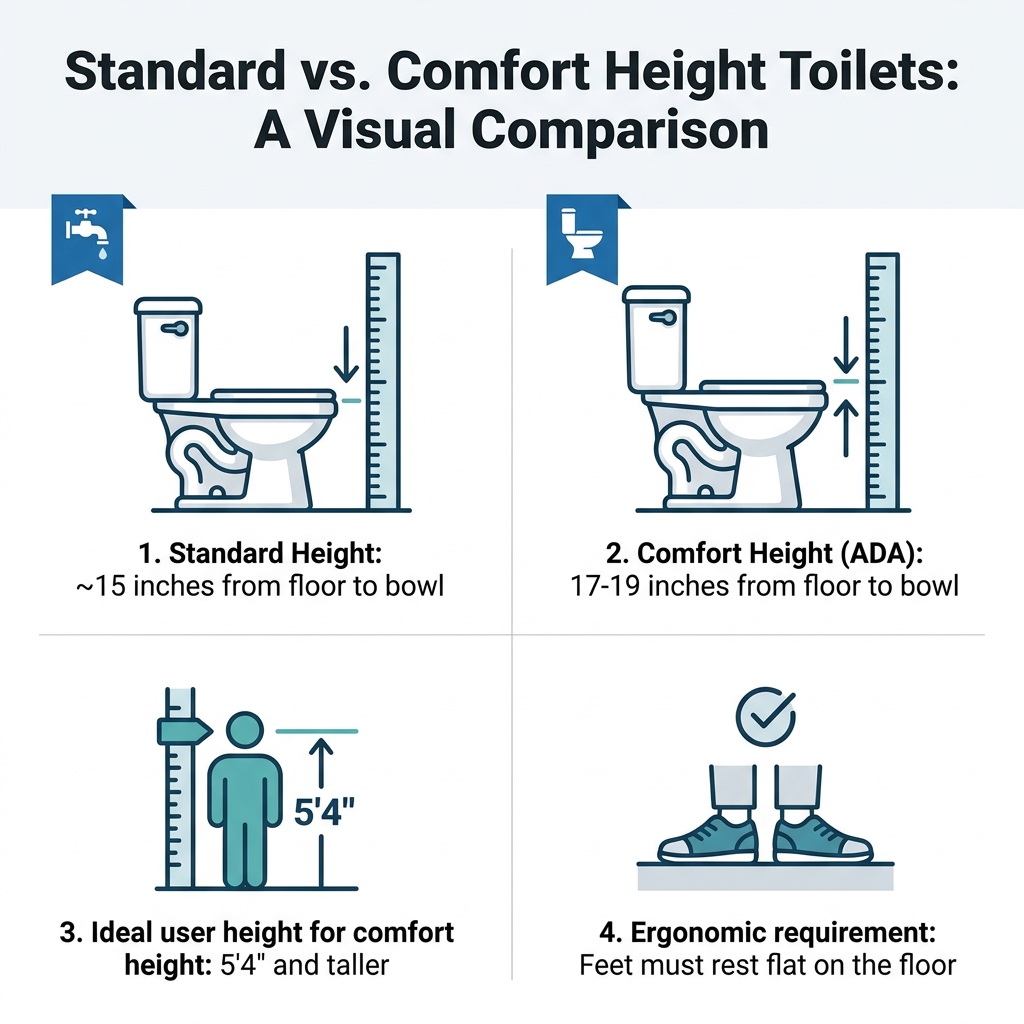
A comfort height toilet is a bathroom fixture designed with a taller bowl than traditional models, specifically engineered to make sitting down and standing up easier for adults. To understand the distinction, it is helpful to look at the exact measurements. A comfort height toilet features a bowl that measures between 17 and 19 inches from the floor to the top of the seat. This measurement aligns with the accessibility standards set by the Americans with Disabilities Act (ADA). Because of this compliance, these fixtures are frequently referred to as ADA-compliant toilets or simply "right height" toilets by various manufacturers.
The historical context of these taller fixtures helps explain their widespread popularity in modern residential homes. Originally, the 17-19 inch ADA comfort height vs 15 inch standard height debate did not exist in standard home building. Taller toilets were primarily installed in commercial buildings and healthcare facilities to accommodate individuals with mobility challenges, wheelchair users, and the elderly. Over time, as the aging-in-place movement grew and homeowners realized the knee-saving benefits of a higher seat, manufacturers began marketing these taller bowls to the general public. Today, they are often presented as a premium upgrade in new constructions and bathroom remodels.
However, while they are excellent for seniors, individuals with joint pain, and taller adults, they are not universally ideal for every demographic. Assuming that a taller toilet is automatically a better toilet is a common misconception. When considering standard vs. comfort height toilets, it is critical to evaluate the physical stature of the people who will be using the fixture daily.
Standard vs. Comfort Height Measurements
To make an informed decision, homeowners need to understand the exact dimensional differences between the two primary toilet styles on the market today. The discrepancy might seem small on paper, but a few inches drastically alter the biomechanics of using the fixture.
• Standard Height — Bowl Height (Floor to Seat): Approximately 15 inches — Ideal User Profile: Children, users under 5'4" — Primary Benefit: Promotes a natural squatting posture for healthy digestion
• Comfort Height (ADA) — Bowl Height (Floor to Seat): 17 to 19 inches — Ideal User Profile: Adults over 5'4", seniors, mobility-impaired — Primary Benefit: Reduces strain on knees and hips when sitting and standing
The standard 15-inch measurement has been the residential norm for decades, providing a low center of gravity that naturally accommodates the average human frame. The 17 to 19-inch measurement for comfort bowls adds the equivalent of a thick telephone book to the height, which completely changes the angle of the user's legs.

The Hidden Ergonomic Challenges for Users Under 5'4"
While the benefits of a taller toilet are heavily marketed, the physical consequences of using a toilet that is too tall for a user's frame are rarely discussed. For individuals who are shorter than 5'4", the 17-19 inch ADA comfort height vs 15 inch standard height difference becomes a significant daily hurdle. The most immediate and obvious challenge is dangling feet. When a shorter person sits on a comfort height toilet, their feet may barely graze the floor or hover completely above it. This lack of grounded foot support is more than just a minor annoyance; it fundamentally compromises the user's physical comfort and long-term ergonomic health.
When feet do not rest flat on the floor, the edge of the toilet seat presses firmly against the back of the user's thighs. This concentrated pressure restricts blood flow, frequently leading to a sensation of pins and needles or complete leg numbness during extended bathroom visits. Furthermore, the lack of foot support forces the user to balance themselves using their core and lower back, leading to poor posture and unnecessary muscle strain.
The Biomechanics of Bathroom Ergonomics
Beyond simple comfort, the extra two to four inches of a comfort height toilet can actually hinder healthy bodily functions. Human anatomy is designed to eliminate waste most efficiently in a squatting position.
• Altered Hip and Knee Angles: A standard 15-inch toilet keeps the knees slightly elevated above the hips for most adults, mimicking a mild squat. A taller toilet drops the knees below the hips for shorter users, which pinches the digestive tract.
• Muscle Relaxation: The puborectalis muscle, which controls bowel movements, only fully relaxes when the body is in a squatting posture. Dangling feet prevent this relaxation, leading to straining.
• Circulation Issues: Continuous pressure on the sciatic nerve and femoral arteries from a high seat edge can cause lingering discomfort even after leaving the bathroom.
Daily comfort is heavily compromised when plumbing fixtures do not match the user's physical dimensions. If your family is experiencing these issues, a professional assessment for toilet repair and installation can help you swap out an improperly sized fixture for one that supports healthy posture.
Strategic Fixture Placement in Multi-User Bathrooms
Because households are rarely composed of people who are all the exact same height, applying a one-size-fits-all approach to plumbing fixtures often backfires. A common mistake during home renovations is using comfort height toilets as a universal, whole-house upgrade. While it might seem cohesive to have matching fixtures in every room, this strategy ignores the practical reality of how different family members use different spaces.
The solution lies in strategic fixture placement based on room function and primary users. Standard 15-inch toilets are strongly recommended for children's bathrooms, hallway bathrooms, and main floor powder rooms that see a wide variety of guests. Keeping standard-height fixtures in these spaces helps streamline August back-to-school morning routines, as children can use the facilities independently without needing step stools or risking a fall from a taller bowl. Conversely, reserving the 17-19 inch ADA comfort height toilets for master suites or private guest baths primarily used by adults ensures that taller individuals and aging parents have the joint support they need where they need it most.
Accessible and comfortable indoor plumbing is a year-round priority for Central Illinois families, especially when spending more time indoors during seasonal weather shifts. HRI Plumbing takes a family-centric approach to these upgrades, guiding homeowners to the right fixture for the right bathroom based on household demographics rather than just pushing product specifications. A tailored approach ensures every family member has an accessible and comfortable option within the home.
Real-World Problem Solving
Addressing plumbing needs often provides an opportunity to rethink the entire functionality of a space. One local homeowner recently dealt with a bad leak underneath their home on a slab. During the emergency service call, the technicians walked the customer through all their options to fix the major plumbing problem. The outcome was highly successful: the customer had all new plumbing, an exhaust fan, and properly fitted toilet fixtures installed. Because the technicians took the time to discuss options, the final bathroom remodeling in Jacksonville resulted in a space that was not only leak-free but ergonomically suited to the family's daily needs.
Balancing Needs in a Multi-Generational Household
The most complex ergonomic challenges arise in multi-generational households where seniors and small children share the exact same bathroom facilities. Acknowledge the difficulty of this situation: an aging parent with arthritis desperately needs the joint relief provided by a 17-19 inch ADA comfort height vs 15 inch standard height fixture, while a five-year-old child will struggle to safely climb onto that exact same toilet.
When strategic placement across multiple bathrooms is not an option due to space constraints, families must rely on practical workarounds to bridge the height gap. Upgrading older plumbing can sometimes reveal hidden complications in older homes. In one instance, a homeowner faced a plumbing problem that ended up being worse than initially thought. The technician patiently explained the worsening situation to the customers, ensuring the problem was addressed with honesty and professionalism. This level of clear communication is exactly what families need when navigating complex, multi-generational bathroom layouts.
Practical Workarounds for Shared Spaces
If you must install a comfort height toilet in a bathroom used by shorter individuals or children, there are several ways to mitigate the ergonomic drawbacks:
1. High-Quality Footstools: Introduce a sturdy, non-slip footstool specifically designed for bathroom use. This allows shorter users to rest their feet flat, relieving pressure on the back of the thighs and restoring proper circulation.
2. Squatty Potties: These specialized ergonomic stools wrap around the base of the toilet. They elevate the feet and knees, perfectly mimicking the natural squatting posture required for healthy bowel movements, regardless of the bowl's height.
3. Convertible Toilet Seats: Install a family-friendly toilet seat that features a built-in, flip-down child ring. This reduces the diameter of the opening, helping smaller users feel secure on a taller bowl.
4. Grab Bars: For children navigating a taller bowl, securely anchored grab bars provide safe handholds for climbing up and down.
Ultimately, highlighting the importance of a professional plumbing assessment is crucial. An experienced technician can help you find a compromise that prioritizes safety, accessibility, and ergonomic health for all ages under your roof.
Frequently Asked Questions About Comfort Height Toilets
What is a comfort height toilet?
A comfort height toilet is a bathroom fixture measuring 17 to 19 inches from the floor to the top of the seat. It is specifically designed to comply with ADA accessibility standards, making it easier for adults to sit down and stand up. By raising the bowl height higher than traditional models, it reduces the physical strain placed on the knees and hips.
Are comfort height toilets bad for your bowels?
They can be if the user is too short to rest their feet flat on the floor while seated. Dangling feet alter the natural squatting posture required for healthy bowel movements, preventing the puborectalis muscle from fully relaxing. For shorter users, this unnatural angle can lead to straining and long-term digestive discomfort.
How tall should you be for a comfort height toilet?
Generally, users who are 5'4" or taller find comfort height toilets ergonomically suitable without experiencing dangling feet. At this height, the user's feet can typically rest flat on the floor, providing necessary stability and core support. Shorter individuals usually fare better with standard-height fixtures to maintain proper posture.
What is the difference between standard and comfort height toilets?
The primary difference is the bowl height measurement from the floor to the seat. Standard toilets are about 15 inches tall, providing a lower center of gravity that naturally accommodates children and shorter adults. In contrast, comfort height models are 17 to 19 inches tall, offering an elevated seat geared toward taller adults and seniors.
Can you modify a standard toilet to make it taller for adults?
Yes, raised toilet seats or specialized base pedestals can temporarily add height to a standard toilet without permanently replacing the fixture. These modifications are excellent for individuals recovering from knee or hip surgery who need temporary assistance. Once the user has recovered, the seat or base can be removed to return the toilet to its standard height for the rest of the family.
Get Expert Guidance on Your Bathroom Fixture Upgrades
Ultimately, the choice between a 17-19 inch ADA comfort height and a 15-inch standard height depends entirely on who uses the bathroom daily. There is no universally perfect fixture, only the perfect fixture for your family's unique physical needs. Navigating these ergonomic choices is much easier when you have a local expert to help you map out the perfect fixture strategy for your home. By taking the time to assess your household demographics, you can ensure that every bathroom provides safety, comfort, and proper posture. Schedule an assessment today to discuss your specific family plumbing needs and secure clear ergonomic measurements that guarantee long-term daily comfort.


