



The Hidden Cost of a Dripping Hose Bib During Peak Heat
A single dripping spigot can waste thousands of gallons of water over the course of a year, which is why fixing a leaky outdoor faucet before it ruins your summer water bill is a critical task for any homeowner. During the intense heat of the July peak watering season, a small drip outside often goes completely unnoticed. Between running the sprinklers, washing the car, and topping off the pool, the area around your outdoor faucet is almost always wet anyway. This constant moisture masks the reality that your plumbing fixture is slowly but continuously leaking treated municipal water straight into the ground.
Many homeowners simply ignore a minor outdoor drip because it happens outside the living space. Unlike a dripping kitchen sink that echoes through the house and demands immediate attention, an outdoor hose bib operates out of sight and out of mind. However, ignoring this issue forces you to face unexpectedly high utility waste by the end of the month. The longer the fixture drips, the more municipal resources are drained unnecessarily. For comprehensive support with your home's systems, exploring professional plumbing services ensures that even the most easily overlooked issues are addressed promptly.
The core decision point for any homeowner dealing with a leaky outdoor spigot is determining the severity of the malfunction. You need to know if the fixture merely requires a simple washer tightening or if the internal mechanisms are compromised, necessitating professional replacement. Understanding the difference between a minor nuisance and a major structural threat is the first step in protecting your home and your utility usage during the busiest watering months of the year.
Quantifying the Waste: How Fast a Slow Drip Multiplies
To truly understand the impact of a compromised hose bib, you have to break down the math of a dripping faucet. A leak that produces just one drip per second might look harmless when you walk past it. However, that single drip equates to roughly five gallons of water wasted every single day. When you scale that daily waste into monthly totals, the compound effect becomes staggering. A seemingly insignificant trickle can easily waste hundreds of gallons a month, running your water meter continuously while you sleep, work, and go on vacation.
Beyond the direct impact on your property, there is a significant environmental impact to consider. The water flowing from your outdoor spigot has been pumped, treated, and pressurized by the municipal water facility. Wasting this resource means wasting the energy and infrastructure required to deliver clean water to your neighborhood. In regions where summer droughts and water conservation efforts are common, allowing hundreds of gallons to seep into the soil without purpose places an unnecessary burden on the community's supply.
The most deceptive part of an outdoor leak is that it happens silently, 24 hours a day, 7 days a week. It does not matter if you only attach the garden hose once a week to water the tomatoes; the pressure behind the valve remains constant. If the seal is broken, the water escapes continuously. When you realize the sheer volume of water being lost, scheduling professional leak detection and repair becomes an obvious priority to halt the constant drain on your home's efficiency.
Diagnostic Triage: Drip When Off vs. Leak When On
Diagnosing an outdoor faucet requires knowing exactly what you are looking at. Much like when a local homeowner called us out last fall for a confusing sink leak—once we explained the underlying mechanics, the right solution became obvious. The same logic applies to your outdoor plumbing. A standard hose bib consists of a handle, a stem, a packing nut, and a rubber washer that seats against a metal valve to stop the flow of water. Where and when the water escapes tells you exactly which component has failed.
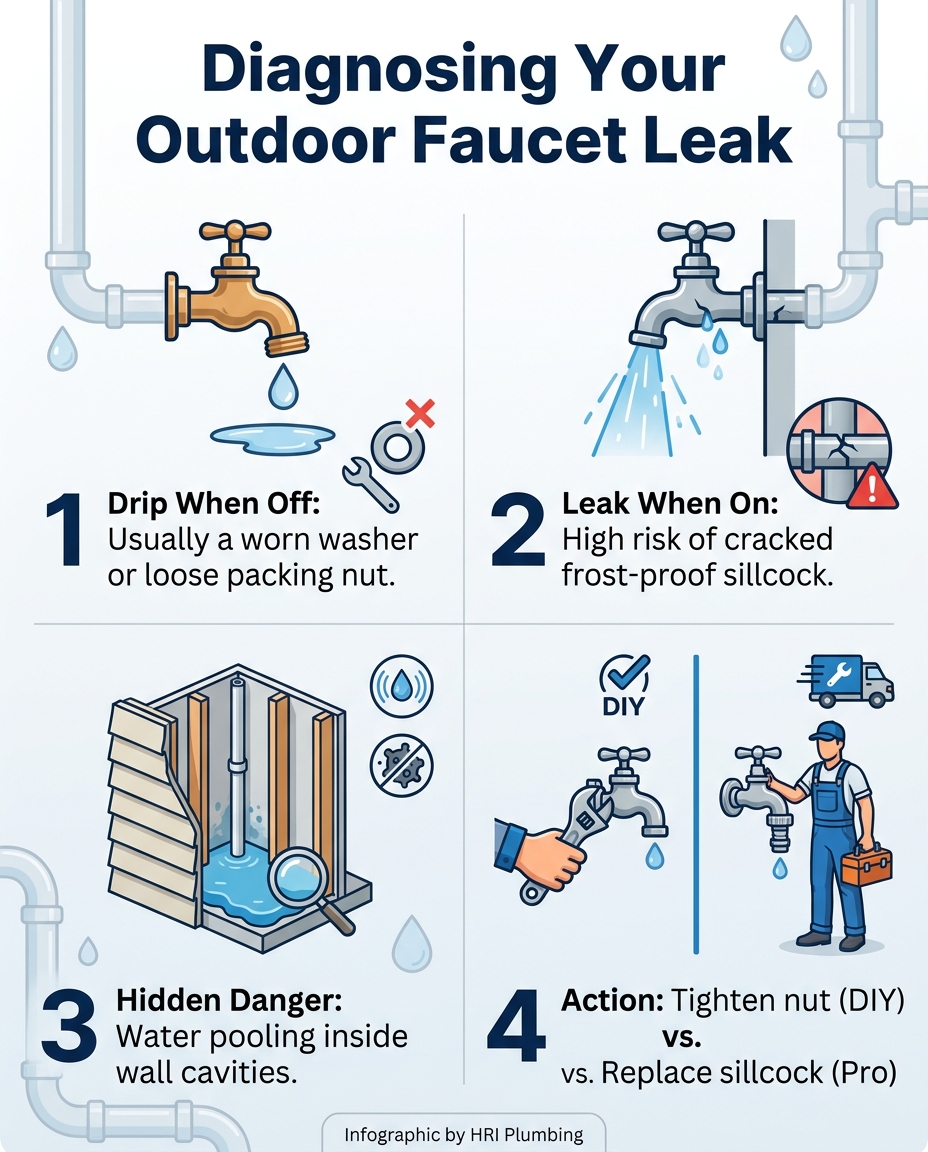
• Drip from the spout — When It Happens: When the valve is fully closed — Common Cause: Worn rubber washer or loose packing nut — Severity Level: Low to Moderate (Water Waste)
• Leak from behind the handle — When It Happens: When the water is turned on — Common Cause: Degraded packing string or loose nut — Severity Level: Moderate (Component Wear)
• Water running down siding — When It Happens: Only when the hose is running — Common Cause: Cracked internal pipe or stem — Severity Level: High (Structural Threat)
Defining 'Drip When Off': This occurs when water continues to leak from the main spout even after you have turned the handle as far clockwise as it will go. The valve is fully closed, but the water pushes through anyway. This is almost always a failure of the internal seal.
Defining 'Leak When On': This is a completely different scenario. The faucet appears perfectly dry when closed. However, the moment you turn the handle to use the hose, water begins spilling from the handle stem, spraying backward, or running down the exterior siding of your home. A leak that only appears when the hose is running is a major red flag for severe internal damage.
Identifying a Worn Packing Nut or Washer
If your diagnostic triage points to a "drip when off" scenario, you are likely dealing with a degraded rubber washer or a loose packing nut. Every time you open and close the faucet, the rubber washer grinds against the metal valve seat. Over years of heavy use in Jacksonville IL, normal wear and tear degrades this rubber seal. It becomes brittle, flattened, or torn. When the seal is no longer perfectly flush, municipal water pressure forces small amounts of water past the barrier, resulting in a continuous drip from the spout.
Spotting the Symptoms of a Cracked Stem
If you experience a "leak when on," the diagnosis is much more serious. This symptom usually means the long copper tube that extends into your home has split open. When the valve is closed, the water stops behind the break, so you see no leak. But when you open the valve, water pressure forces water into the tube, and it violently escapes backward through the crack in the pipe. You might notice water pooling near the foundation when the hose is active, or worse, you might notice dampness inside your home. This specific failure requires immediate attention.

The Winter Ghost: How Freeze Damage Appears in Summer
To understand why a faucet suddenly leaks when turned on during the July peak watering season, you have to look backward to the previous winter. Modern homes in our region are typically equipped with frost-proof sillcocks. Unlike older spigots where the water stops right at the exterior wall, a frost-proof sillcock features a long copper stem. The actual shut-off valve sits 8 to 12 inches deep inside the warm interior of the house. When you turn the handle outside, a long rod turns the valve inside, shutting off the water where it is protected from freezing air.
Central Illinois experiences extreme temperature swings, from sub-zero winters to 90-degree summers, making outdoor plumbing fixtures particularly vulnerable to expansion and contraction damage. If a homeowner leaves a garden hose attached to the spigot during the first deep freeze of winter, the design of the frost-proof sillcock is defeated. The attached hose traps water inside the long copper tube. When the sub-zero temperatures arrive, that trapped water freezes and expands, generating immense pressure that easily splits the copper pipe right down the middle.
Because the main valve is seated deeper inside the home behind the split, no water escapes during the winter. The crack goes completely unnoticed all spring. The delayed consequence only reveals itself when the homeowner finally turns the water on for heavy summer use. Suddenly, water rushes into the cracked tube and sprays violently out of the split. The true danger here is that the resulting leak often sprays water directly inside the wall cavity, not just outside on the lawn.
Why Internal Wall Leaks Are a Structural Threat
When a cracked frost-proof sillcock sprays water inside your home, the damage escalates from a simple plumbing nuisance to a severe structural threat. Every time you water the garden, wash the car, or let the kids play in the sprinkler, you are simultaneously pumping water into the space between your exterior siding and interior drywall. This water quickly saturates fiberglass insulation, turning it into a heavy, soggy sponge that loses all of its insulating properties.
The humid summer conditions in our region dramatically accelerate mold growth inside these damp wall cavities. Once drywall and wood framing become saturated in a dark, warm environment, mold and mildew spores multiply rapidly. This not only compromises the indoor air quality of your home but also creates a hazardous environment that requires extensive remediation to properly remove.
If the internal leak is allowed to continue every time the hose is used, structural wood rot inevitably develops. The sill plates, rim joists, and wall studs that support your home will soften and decay when exposed to repeated soaking. The cost and disruption of tearing out exterior siding, replacing rotted structural wood, and remediating mold far exceeds the effort of proactive plumbing maintenance. Working with trusted local experts means you have professionals who can proactively identify these hidden internal leaks before they cause massive structural rot, saving your home from devastating hidden water damage.
When to Attempt a Quick Fix vs. When to Call a Professional
Homeowners often wonder which plumbing tasks are safe to tackle on a Saturday afternoon and which require a licensed expert. When dealing with a leaky outdoor faucet in Jacksonville IL, the line between a quick adjustment and a complex repair is very clear. Understanding this boundary protects your home from accidental flooding and ensures the fixture operates safely through the next winter season.
• Check the packing nut: Tightening a loose packing nut behind the handle is a safe, simple step for homeowners. Sometimes, the nut that secures the handle stem simply vibrates loose over time. Using an adjustable wrench to give it a quarter-turn clockwise can often stop a minor leak originating from the handle stem.
• Evaluate the internal components: If tightening the packing nut does not stop the drip, or if the faucet is dripping continuously from the main spout when turned off, the internal rubber washers and seals are compromised. While replacing a washer is possible, older corroded fixtures often break during disassembly.
• Do not attempt sillcock replacement: Strongly avoid the DIY replacement of a cracked frost-proof sillcock. This is not a simple threaded attachment. Replacing this fixture requires accessing pipes inside the wall cavity, cutting out the damaged copper, and properly soldering or fitting the new connections in tight, combustible spaces.
• Ensure proper drainage pitch: Professional replacement ensures the correct pitch is established. A frost-proof sillcock must be installed with a slight downward angle toward the exterior. This allows residual water to drain out after the valve is closed. If installed perfectly level or tilted backward by an amateur, water will pool inside the tube and freeze the following winter, completely defeating the purpose of the frost-proof design.
When you encounter a leak that occurs only when the water is turned on, or if simple tightening fails, reaching out to a residential plumber in Jacksonville guarantees the internal pipes are inspected, replaced, and pitched correctly for long-term reliability.
Proactive Outdoor Plumbing Maintenance for the Season
Protecting your home's water efficiency goes beyond fixing a single dripping spigot. Establishing a routine for outdoor plumbing maintenance ensures that all your exterior water systems function flawlessly during the July peak watering season. A few proactive steps can prevent hidden leaks, extend the lifespan of your fixtures, and keep your utility usage optimized.
1. Inspect all outdoor connections: At the start of the season, walk the perimeter of your home. Inspect all outdoor spigots, sprinkler system connections, and irrigation lines. Look for pooling water, unusually green patches of grass near the foundation, or visible drips from the hose bibs.
2. Perform a water meter test: Monitor the water meter for a few hours when no water is being used inside or outside the home. Write down the dial reading, ensure nobody flushes a toilet or runs a tap, and check the meter two hours later. If the dial has moved, you have a hidden leak on the property that requires immediate professional detection.
3. Disconnect hoses after every use: Always disconnect your garden hoses after you finish watering. Leaving a hose attached keeps the water pressure loaded against the internal valve and prevents the spigot from draining properly. Relieving this pressure extends the life of the rubber seals and prevents accidental freeze damage if an unexpected cold snap occurs late in the season.
4. Check seasonal high-volume systems: Remind yourself to check other seasonal plumbing systems that handle high water volumes. For example, ensuring your basement drainage systems are ready for summer storms is just as important as managing outdoor water use. Understanding why your sump pump won't trigger during a heavy summer rainstorm can save your basement from catastrophic flooding while you are focused on yard maintenance.
Frequently Asked Questions About Leaky Hose Bibs
How much water does a dripping outside faucet waste?
A single drip per second can waste thousands of gallons of water over a year. Continuous leaks compound rapidly during peak usage months, turning a minor annoyance into a massive drain on municipal resources. Because the leak runs 24 hours a day, the monthly accumulation often catches homeowners by surprise when the utility statement arrives.
Why does my outdoor faucet leak only when turned on?
This usually indicates a cracked stem or pipe inside the wall cavity. It is a serious warning sign of freeze damage from the previous winter, caused by leaving a hose attached during freezing temperatures. When you open the valve, water rushes into the split copper tube and sprays backward into your home's structure.
Can a leaky outdoor faucet cause a high water bill?
Yes, because the leak runs continuously, 24 hours a day, regardless of how often you actively use the hose. Even a small trickle adds up to significant municipal water waste over a billing cycle. Identifying and stopping these silent leaks is one of the fastest ways to restore normal utility usage.
How do I know if my frost-free faucet is broken?
Look for water leaking from the handle stem or running down the siding when the water is running. You should also check for damp spots on the interior drywall, insulation, or basement ceiling directly behind where the spigot is mounted. If water is escaping backward into the house, the internal frost-proof tube has failed.
Should I cap a leaking outdoor faucet as a temporary fix?
Capping the spout traps pressure inside the fixture and is highly discouraged. If the valve is cracked or compromised internally, capping the end will force the pressurized water to leak backward inside the wall instead. This turns a visible exterior drip into a hidden interior flood, accelerating structural wood rot and mold growth.
Stop the Drip and Protect Your Home This Summer
Addressing a small drip promptly prevents massive water waste and protects your property from hidden structural damage. When you understand the mechanics of your outdoor plumbing, you realize that a leaky hose bib is rarely just a cosmetic issue. Wasting hundreds of gallons a month strains local resources and hints at deeper mechanical failures that threaten the integrity of your wall cavities.
Taking action now provides the peace of mind that comes from knowing your home's plumbing is secure, efficient, and ready to handle the demands of peak summer heat. If you suspect your fixture has suffered freeze damage, or if you cannot stop a continuous drip by tightening the packing nut, schedule a professional inspection immediately. Fixing a leaky outdoor faucet today is the smartest way to safeguard your property and keep your summer water usage exactly where it belongs.


