



The Late-Summer Slow Drain Dilemma: Quick Fix or Looming Disaster?
A common myth among homeowners is that a heavy-duty bottle of liquid drain cleaner is a harmless, permanent fix for a sluggish sink or tub, but the reality is that the hidden costs of chemical drain cleaners on older Central Illinois plumbing can turn a minor inconvenience into a massive infrastructure failure. As the late summer back-to-school transition arrives, household plumbing usage naturally spikes. Families go from staggered summer schedules to everyone needing the bathroom at the exact same time in the early morning. Showers run back-to-back, sinks are constantly in use, and suddenly, that drain that was draining just a little slowly in July is completely backed up by August.
If you are dealing with persistent clogs during this high-traffic season, reaching out for professional plumbing services is the safest way to protect your home's infrastructure. The decision point you face is critical: do you pour another bottle of harsh chemicals down the drain in hopes of a quick fix, or do you have your aging pipes professionally inspected? For homes built decades ago, choosing the chemical route is a gamble with the structural integrity of your entire wastewater system.
The underlying issue: Slow drains are rarely just a simple blockage of hair or soap scum near the surface. In older systems, a slow drain is often a symptom of narrowing pipe walls, heavy mineral scale, or deteriorating cast iron. When you introduce highly reactive liquids into that fragile environment, you are not just dissolving a clog—you are actively dissolving the pipe itself. Understanding how these over-the-counter solutions interact with aging plumbing is the first step in protecting your property from unexpected, catastrophic leaks.
The Illusion of Convenience: Why Chemical Cleaners Fall Short
Liquid drain cleaners are marketed heavily on the promise of instant gratification. The commercials show a thick gel powering through a clog in seconds, leaving behind a perfectly clear, free-flowing pipe. This creates a dangerous false sense of security. While the chemicals might temporarily clear a small pathway through a minor blockage, they leave the vast majority of the heavy buildup completely untouched.
In older Jacksonville IL neighborhoods with original cast iron plumbing, this illusion of convenience masks a destructive reality. Homes built before the 1980s are currently in a high-risk window for structural plumbing failure, as cast iron has an expected lifespan of 50 to 100 years. Subjecting these already vulnerable systems to intense chemical stress accelerates their degradation exponentially.
Here is exactly why relying on chemical cleaners is a flawed approach:
1. The Initial Pour: When you pour the cleaner into a slow drain, it does not immediately flush away. Because the drain is sluggish, the highly toxic liquid sits in the pipe, banking against the clog and the pipe walls.
2. The Incomplete Clearing: The chemicals are designed to burn through organic matter. They might burn a tiny hole through the center of a hair clog—just enough to let water slowly drain—but they do not remove the sludge coating the interior walls.
3. The Toxic Residue: After the water drains, a highly acidic or caustic residue remains coated on the inside of your aging pipes. This residue continues to react long after the clog appears to be "fixed."
4. The Environmental and Safety Impact: Beyond damaging your pipes, these products are incredibly toxic. They pose severe risks to groundwater systems, can cause severe skin and eye burns upon contact, and release noxious fumes into your indoor air.
Evaluating the true impact of these products involves weighing the perceived upfront convenience against the reality of compounding plumbing issues. For a deeper understanding of how these two approaches compare, learning about calling a professional drain service vs. using chemical cleaners reveals why mechanical clearing is the only sustainable choice for historic homes.
Exothermic Reactions: The Invisible Threat to Cast Iron and PVC
To truly grasp why liquid drain cleaners are so destructive, you have to look at the underlying science. The active ingredients in most over-the-counter drain cleaners are either sodium hydroxide (lye) or high-concentration hydrochloric acid. When these chemicals come into contact with water and organic matter, they do not just dissolve the blockage—they create an intense exothermic reaction.
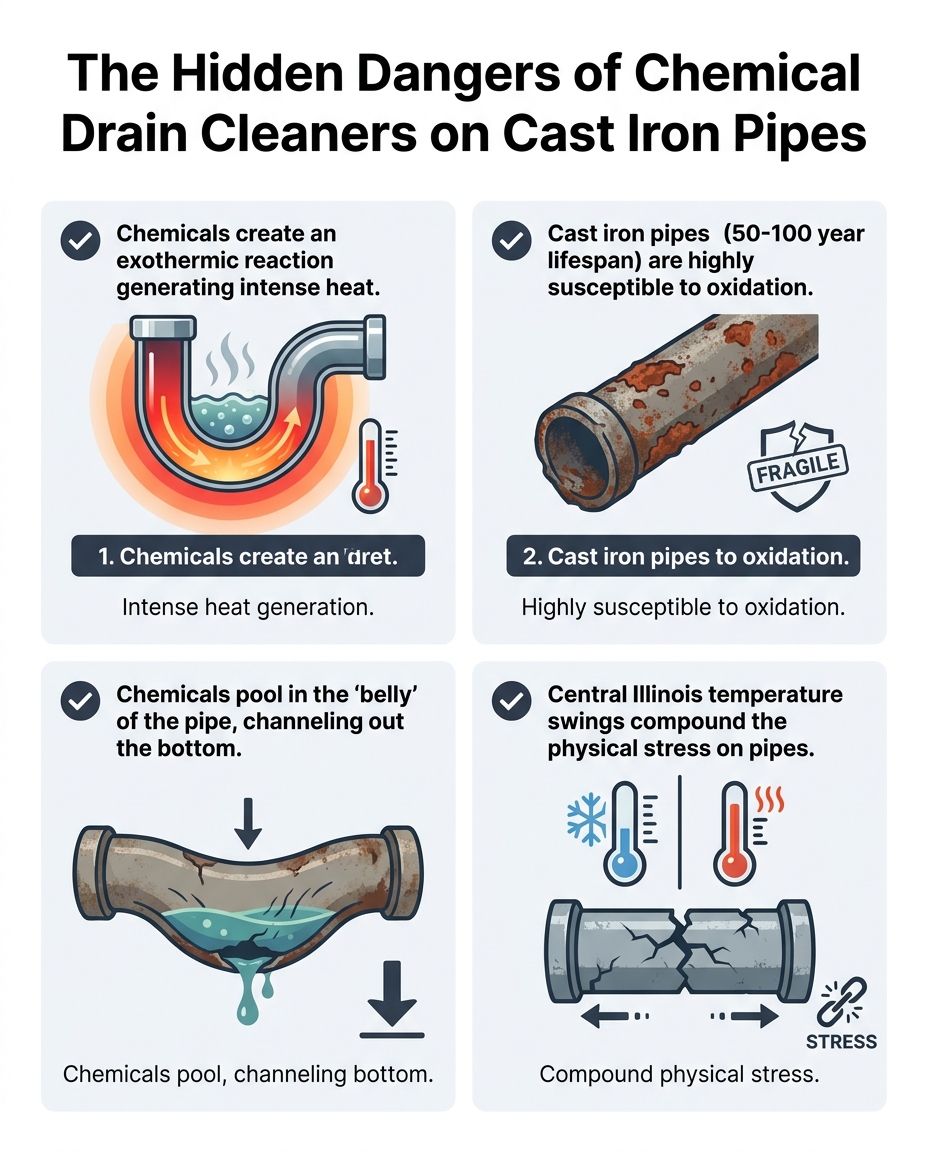
An exothermic reaction is a chemical process that releases energy in the form of extreme heat. When you pour lye or acid into a drain, the liquid physically boils inside your pipes. If you are scheduling professional drain cleaning, technicians use mechanical tools precisely to avoid introducing this kind of violent temperature spike into your home's infrastructure.
The impact on cast iron: Cast iron is incredibly strong, but it is highly susceptible to oxidation (rust). The intense, localized heat generated by an exothermic reaction rapidly accelerates the oxidation process. The heat causes the metal to expand unnaturally, while the caustic chemicals strip away any protective patina on the inside of the pipe. Repeated use of these cleaners literally eats away the iron layer by layer, turning a solid pipe into a brittle, flaky shell.
The impact on early-generation PVC: Many mid-century renovations in older Jacksonville IL neighborhoods with original cast iron plumbing included splicing in early-generation PVC pipes to replace failing sections. While modern PVC is highly durable, older plastic piping was not designed to withstand the boiling temperatures generated by chemical cleaners. The exothermic heat can easily warp, melt, or weaken the joints of these plastic pipes, causing the glued seals to fail completely.
The most dangerous part of this process is that it happens completely out of sight. You might think the drain cleaner did its job perfectly, completely unaware that the structural integrity of your wastewater system has been severely compromised behind your walls or beneath your floors.
Compounding the Stress: Dramatic Temperature Swings and Fragile Pipes
The physical toll on your plumbing system is not just about the chemicals themselves; it is about how those chemicals interact with the unique environmental stressors of the region. Central Illinois is known for its dramatic seasonal temperature swings. We experience blistering hot summers and freezing, bitter winters. These environmental extremes place an enormous amount of natural physical stress on older infrastructure.
The Problem: As the seasons change, the ground around your home shifts, freezes, thaws, and settles. This causes your underground sewer lines and the plumbing within your home's crawlspaces to naturally expand and contract. Over decades, this constant microscopic movement weakens the joints and structural walls of aging cast iron pipes.
The Cause of Failure: When you introduce a heat-generating chemical cleaner into a pipe that is already physically stressed by Central Illinois' dramatic seasonal expansion and contraction, you drastically increase the risk of a blowout. Imagine a cast iron pipe that is cold from the winter ground or air-conditioned summer basement. Suddenly, an exothermic chemical reaction introduces boiling heat to a concentrated section of that cold metal. The rapid, uneven expansion creates micro-fractures in the iron.
The Solution: The combination of shifting ground and boiling chemical reactions creates a perfect storm for pipe failure. The only way to safely clear clogs without compounding this environmental stress is through physical, mechanical extraction. Professional care is not just a luxury; it is a structural necessity for protecting weather-stressed infrastructure from premature collapse.
The Vulnerable 'Belly' of Your Plumbing System
One of the most misunderstood aspects of home plumbing is that pipes are rarely perfectly straight and consistently sloped, especially in homes that have settled over fifty or sixty years. Over time, horizontal sewer lines and drain pipes develop low spots known as "bellies."
What is a pipe belly? A belly is a sag in the plumbing line where water, waste, and debris naturally pool instead of flowing smoothly toward the municipal sewer. Because gravity cannot pull the water up and out of the sag, these low spots become constant collection points for clogs.
When a drain is running slowly, any highly corrosive chemical you pour down the sink does not flush through the system. Instead, it travels down to the belly of the pipe and sits there, completely stagnant. This is where the most severe damage occurs. Instead of dissolving a clog, the stagnant acid literally channels out the bottom of the iron pipe. It eats away at the lowest point of the metal until the pipe wall becomes paper-thin and eventually gives way, dumping raw wastewater directly into your crawlspace, basement, or foundation.
One local homeowner experienced a variation of this pattern last fall when a persistent sink issue required professional diagnosis. After attempts to clear the line failed to restore proper flow, a technician came out the same day to investigate. The prompt assessment revealed that the ongoing sink problems were tied to deeper structural issues that needed honest, clear explanation and professional intervention to resolve correctly.
For historic housing stock in our area, protecting the homeowner's long-term property investment means recognizing that seemingly minor plumbing problems often reveal far worse underlying damage when professionally inspected. Treating a symptom with chemicals while ignoring the failing belly of a pipe is a guaranteed path to major property damage.
Chemical Cleaners vs. Professional Mechanical Clearing
To make the best decision for your home's infrastructure, it helps to see exactly how chemical applications stack up against professional mechanical clearing methods. When you schedule drain cleaning in Jacksonville, technicians use specialized tools like motorized augers and hydro-jetters that physically remove the obstruction without relying on destructive heat or acidity.
Here is a clear breakdown of how the two approaches compare:
• Immediate Effect — Chemical Drain Cleaners: Generates boiling exothermic heat to burn through organic matter, often leaving heavy sludge behind. — Professional Mechanical Clearing: Physically breaks apart and extracts the entire blockage, restoring the full diameter of the pipe.
• Impact on Pipe Integrity — Chemical Drain Cleaners: Accelerates oxidation in cast iron and can warp or melt older PVC joints due to extreme localized heat. — Professional Mechanical Clearing: Safe for aging infrastructure; structural preservation is maintained without chemical degradation.
• Handling of Pipe Bellies — Chemical Drain Cleaners: Chemicals pool in low spots, stagnating and literally channeling out the bottom of the pipe over time. — Professional Mechanical Clearing: Clears debris from low spots and allows technicians to identify sags using camera inspections.
• Long-Term Results — Chemical Drain Cleaners: Recurring clogs are highly likely, ultimately accelerating the need for total pipe replacement. — Professional Mechanical Clearing: Restored flow, extended pipe lifespan, and a clear understanding of your system's overall health.
Emphasizing mechanical clearing is about much more than just getting the water to drain today; it is about protecting the longevity of the home's infrastructure so you aren't forced into emergency renovations tomorrow.

Transitioning from Quick Fixes to Long-Term Pipe Preservation
There comes a point in the lifespan of every older home where quick fixes are no longer viable. If you have been relying on chemical cleaners to keep your sluggish drains moving, you may have already pushed your aging cast iron or galvanized pipes past their breaking point. Recognizing when pipes are beyond simple clearing and require structural repair is crucial for preventing devastating indoor floods.
Here are the signs that your plumbing infrastructure is severely damaged and failing:
• Frequent, recurring backups: If you clear a drain and it slows down again just weeks later, the pipe is likely collapsing or heavily scaled.
• Foul sewer odors indoors: A persistent smell of sewage indicates that the pipe wall has completely breached, allowing sewer gases to escape into your living space.
• Unexpected leaks or foundation moisture: Unexplained puddles in the basement, damp spots on the drywall, or a sudden spike in your water bill all point to compromised lines.
• Gurgling sounds: If your toilet gurgles when you run the bathroom sink, you have a severe venting or main line issue that chemicals cannot touch.
When these symptoms appear, heavily corroded lines may require partial or full replacement to protect the property. Assessing a failing sewer line involves running a high-definition camera down the pipes to visually inspect the damage without tearing up your lawn unnecessarily. If the line is broken, professional sewer line repair and replacement is required to restore the home's sanitation system.
A typical pattern we see during the busy summer months involves sudden, catastrophic failures of weakened lines. In one instance, a local homeowner experienced a severe sewer backup that required immediate attention. Because the line was fundamentally compromised, a large portion of the sewer line had to be excavated and replaced. By taking a comprehensive, professional approach, the massive job was completed in less than a day, permanently resolving the backup issue.
When to Consider Whole-Home Repiping
Homes with plumbing systems that are over fifty years old are often reaching the very end of their functional lifespan. At this stage, fixing one leak often just transfers the water pressure to the next weakest point in the line. Proactive repiping prevents catastrophic water damage, permanently resolves chronic drainage issues, and brings your home up to modern building standards. Instead of waiting for a pipe belly to rot out completely, addressing the entire system at once secures the home for decades to come.
Frequently Asked Questions About Aging Pipes and Drain Cleaners
If you are considering whole-home repiping or major plumbing repairs, you likely have questions about how your system reached this point. Here are the most common inquiries regarding aging pipes and chemical cleaners.
Are chemical drain cleaners safe for old pipes?
No, chemical drain cleaners are exceptionally dangerous for older plumbing systems. The harsh acids and lye create extreme heat that accelerates the degradation of aging cast iron and galvanized steel. In older homes, these chemicals frequently cause brittle pipes to crack or dissolve entirely, leading to severe leaks.
Do drain cleaners ruin cast iron?
Yes, drain cleaners actively ruin cast iron pipes by accelerating the oxidation process. The exothermic reaction strips away the interior of the pipe, causing the iron to rust and flake off in large chunks. Over time, this repeated chemical exposure will eat a hole straight through the bottom of the cast iron line.
What happens if you leave drain cleaner in too long?
Leaving drain cleaner in a sluggish pipe for an extended period allows the highly corrosive chemicals to pool and stagnate. Instead of moving through the system, the stagnant acid continuously eats away at a single concentrated area of the pipe. This prolonged exposure is a leading cause of sudden pipe blowouts and massive indoor water damage.
How do you unclog a cast iron pipe safely?
The only safe way to unclog a cast iron pipe is through mechanical clearing methods used by professionals. Technicians use specialized plumbing snakes, augers, or carefully calibrated hydro-jetting to physically break up and remove the blockage. This restores the flow of water without introducing destructive heat or caustic chemicals to the aging metal.
Why do my slow drains seem worse during late summer?
Late summer back-to-school transitions cause a sudden, dramatic spike in morning household plumbing usage. With multiple family members using showers and sinks simultaneously, the increased water volume overwhelms pipes that are already partially restricted by scale or minor clogs, making slow drains glaringly obvious.
Can chemical drain cleaners cause leaks in a slab foundation?
Yes, if the plumbing lines running beneath your concrete slab are corroded by chemical cleaners, they will eventually leak wastewater directly under your home. Slab leaks are incredibly destructive, often requiring the foundation to be jackhammered to access and repair the melted or rusted pipe.
Protect Your Home's Infrastructure with Expert Guidance
Understanding exactly how chemical cleaners react with old cast iron pipes empowers you to make better, safer home maintenance decisions. The hidden costs of chemical drain cleaners on older Central Illinois plumbing always vastly outweigh the short-term convenience of a temporarily cleared sink. Pouring caustic acid down a slow drain is a gamble that your aging infrastructure simply cannot afford to lose.
If you live in a historic home or a mid-century property, preserving your plumbing means prioritizing professional care over quick fixes. We encourage homeowners to consult with local professionals to assess the health of their pipes before a major failure occurs. By scheduling an inspection and mechanical clearing before the freezing winter weather hits, you can rest easy knowing exactly when to call a professional and how to protect your property's long-term value.


