



The Hidden Danger in the Hardware Store Aisle
A common myth among homeowners is that a heavy bottle of liquid drain cleaner is a harmless, permanent fix for a backed-up sink. At HRI Plumbing, our team typically sees that knowing when to call a professional drain service vs. using chemical cleaners often comes down to protecting your home's infrastructure. When a sink refuses to drain or a bathtub leaves standing water for hours, the instinct is to grab the cheapest, fastest option available. The hardware store aisles are packed with brightly colored bottles promising to dissolve clogs in minutes. However, these quick fixes carry significant hidden risks that go far beyond a simple plumbing annoyance.
The reality is that your home's plumbing system is a delicate network. In our years of serving the Jacksonville area, we've noticed that during peak summer (July) with full households stressing the plumbing, the sudden influx of houseguests, frequent showers, and heavy water usage can quickly turn slow drains into full-blown emergencies. When the system is under this kind of load, pouring harsh industrial chemicals down the drain is often the catalyst that turns a minor blockage into a catastrophic pipe failure. The core decision you face is choosing between a quick, potentially destructive chemical reaction and a safe, methodical clearing process.
True professional plumbing services do much more than just temporarily open a pathway for water to flow. They protect the structural integrity of your home's infrastructure. By understanding exactly what happens inside your pipes when you pour that bottle down the drain, you can make an informed choice that preserves your plumbing system for decades to come.
The Science of Exothermic Reactions Inside Your Drains
To understand why liquid drain cleaners are so hazardous, you have to look at the chemistry happening out of sight. Chemical cleaners do not magically dissolve clogs into thin air. Instead, they rely on violent chemical processes to break down organic matter. Most commercial drain cleaners are formulated with highly reactive ingredients like sodium hydroxide (lye) or sulfuric acid. When these chemicals meet the water and sludge in your pipes, they trigger a severe exothermic reaction.
Understanding Thermal Shock
An exothermic reaction is a chemical process that releases energy in the form of intense heat. Inside the confined space of a plumbing pipe, these reactions can generate temperatures approaching the boiling point of water. This sudden, extreme spike in temperature creates thermal shock. A pattern we see often in modern PVC pipes is this level of heat causing the plastic to warp, soften, and lose its structural integrity, leading to sagging lines and separated joints.
The danger is even more pronounced for aging cast iron or galvanized pipes. With the extreme Midwest temperature swings we experience—from freezing winters to hot, humid summers—older pipes naturally expand and contract over the years. This constant thermal cycling leaves them brittle and highly vulnerable. When you introduce sudden, intense exothermic heat from a chemical cleaner into a brittle, thermally stressed metal pipe, the rapid localized expansion can cause the pipe to crack straight down the middle.
The physical alternative: Contrast this violent, heat-generating chemical reaction with the physical removal of blockages. Mechanical clearing methods do not rely on heat or corrosive acids. Instead, our technicians safely extract or push the blockage through the system without subjecting the pipe walls to extreme temperature fluctuations or chemical burns.
Why Liquid Cleaners Only Provide Temporary Relief
Beyond the structural dangers, chemical cleaners are notoriously ineffective at providing long-term solutions for stubborn, deep-set clogs. When you pour a bottle of thick liquid gel down a slow drain, you might hear bubbling and eventually see the water start to recede. It is easy to assume the problem is solved, but the reality inside the pipe tells a completely different story.
The "Burn a Hole" Reality
Chemical cleaners follow the path of least resistance. When they encounter a massive blockage of hair, grease, and soap scum, they typically burn a tiny, pencil-thin pathway right through the center of the sludge. This small hole allows standing water to drain, giving the illusion of a cleared pipe. However, the vast majority of the blockage remains securely attached to the inner walls of the pipe.
Because the pipe walls are still coated in a sticky, uneven layer of sludge, the newly created pathway will not last. The remaining debris acts like a net, quickly catching new hair, fresh soap scum, and food particles. Within a matter of weeks, or sometimes days, the drain is backed up again. This leads to a frustrating cycle of pouring multiple bottles of expensive chemicals down the drain with diminishing returns, never actually solving the root cause of the issue.
This temporary relief is especially problematic for the Jacksonville IL older housing stock, where decades of buildup already restrict the flow of water. Just last fall, our HRI Plumbing technicians helped a local homeowner dealing with a bad leak underneath their home on a slab. After struggling with recurring issues, they reached out to us for help. Our technician walked through their options, helped them make the correct decision, and fixed the major plumbing problem by installing all new plumbing and fittings within the promised timeframe. If you find yourself constantly wondering why your bathtub drain keeps clogging, it is highly likely that chemical cleaners are only melting a temporary hole rather than removing the actual obstruction.
The Hidden Threat of Stagnant Acid in Your Plumbing
While burning a tiny hole through a clog is frustrating, the worst-case scenario occurs when the chemical cleaner fails to breach the blockage entirely. Some clogs are entirely solid, formed by years of hardened grease or intruding tree roots. When a liquid drain cleaner hits an impenetrable barrier, the chemical reaction stops moving forward.
When Clogs Fight Back
Because commercial drain cleaners are heavily viscous and denser than water, they sink to the lowest point possible. If they cannot pass through the clog, this highly corrosive acid sits completely stagnant directly on top of the blockage. Instead of eating away at the organic matter, the concentrated chemicals begin actively eating away at the pipe walls.
This is a catastrophic situation for aging cast iron or galvanized pipes. The stagnant acid will steadily corrode the bottom of the metal pipe, thinning the material until it eventually gives way. What started as a simple, inexpensive clog removal rapidly transforms into a major leak, potential water damage, and a highly costly pipe replacement project.
Our team at HRI Plumbing responded to a call last spring where a customer found out their plumbing problem was worse than initially thought because stagnant acid worsened a severe blockage. Our technician patiently explained everything to the customer, illustrating how the trapped chemicals had compromised the line, and helped them understand the necessary steps to safely resolve the issue. Fast, professional diagnosis is always safer and more cost-effective than waiting hours for dangerous chemicals to work while they silently destroy your plumbing.
Scouring vs. Burning: The Mechanics of Professional Hydro-Jetting
When chemical cleaners fail or pose too great a risk, professional intervention is the only viable path forward. At HRI Plumbing, we recommend professional hydro-jetting over chemical cleaners because it completely changes the approach to clearing a pipe, moving from a chemical burn to a physical scour.
How Hydro-Jetting Protects Your Pipes
Hydro-jetting is the use of highly pressurized, specialized water jets to physically scour the entire interior circumference of the plumbing pipe. Unlike a traditional drain snake that simply punches a hole through a blockage, our hydro-jetting equipment uses a multi-directional nozzle. It blasts water forward to break apart the primary clog while simultaneously spraying high-pressure streams backward to scrub the pipe walls completely clean.
This complete removal of sludge stands in stark contrast to the partial, temporary melting caused by chemicals. By scouring the pipe walls, hydro-jetting restores the inner diameter of the pipe to its near-original state. It removes the sticky residue that catches new debris, effectively resetting your plumbing system and preventing future backups.
High-pressure water is inherently safer for the structural integrity of older plumbing systems than corrosive acids. The pressure is precisely calibrated by our trained technicians to ensure it is strong enough to cut through grease and tree roots, but gentle enough to protect aging cast iron or galvanized pipes from damage. HRI Plumbing prioritizes the long-term integrity of your home's pipes, offering safe, thorough solutions like hydro-jetting services that completely clear blockages rather than using corrosive chemicals that risk permanent plumbing damage. Professional clearing should be viewed as a preventative maintenance step that extends the life of your home, not just an emergency reaction to a clogged sink.
Side-by-Side Comparison: Chemical Cleaners vs. Professional Drain Service
When you are weighing your options during peak summer (July) with full households stressing the plumbing, seeing the facts laid out clearly can help you make the best decision for your home. The differences between a hardware store quick-fix and a professional intervention are stark, particularly when it comes to the safety and longevity of your pipes.
• Effectiveness — Chemical Drain Cleaners: Melts a temporary, narrow pathway through the center of the sludge. — Professional Drain Service (Hydro-Jetting): Physically scours the entire inner circumference of the pipe wall clean.
• Safety Mechanism — Chemical Drain Cleaners: Relies on violent exothermic heat and produces toxic, noxious fumes. — Professional Drain Service (Hydro-Jetting): Utilizes safe, highly controlled, and calibrated water pressure.
• Impact on Pipes — Chemical Drain Cleaners: Corrodes and weakens aging metal; can warp or melt modern PVC joints. — Professional Drain Service (Hydro-Jetting): Preserves infrastructure and extends the functional lifespan of the plumbing.
• Long-Term Value — Chemical Drain Cleaners: Requires repeated purchases and carries a high risk of causing major leaks. — Professional Drain Service (Hydro-Jetting): Provides lasting peace of mind and prevents recurring blockage cycles.
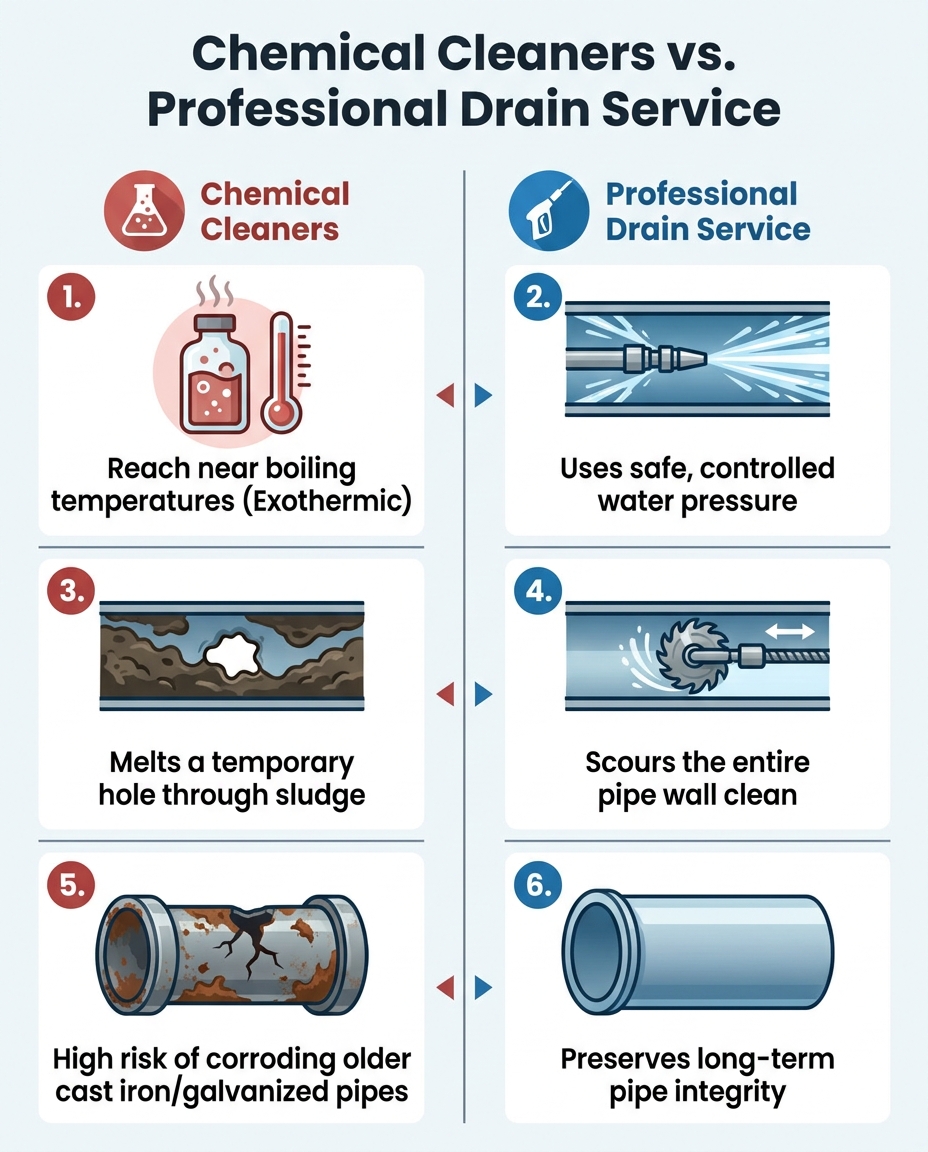

As the comparison shows, the initial convenience of a chemical cleaner is heavily outweighed by the hidden costs of property damage and recurring plumbing failures. Investing in a professional solution treats the actual disease, rather than just masking the symptoms.
Recognizing the Signs of Chemical-Induced Pipe Failure
If you have already used chemical cleaners in the past, or if you recently poured a bottle down the drain and the water still isn't moving, you need to know what to look for. Chemical-induced pipe failure doesn't always happen with a dramatic burst; it often starts as a slow, insidious problem hidden behind your walls or beneath your floors.
Warning Signs to Watch For
Homeowners with the Jacksonville IL older housing stock should be particularly vigilant. Our plumbers frequently warn customers to look for the following primary indicators that chemical corrosion has compromised your plumbing:
• Unexplained leaks under sinks: If you notice damp spots, warped cabinet bases, or pooling water directly beneath a P-trap where chemicals were used, the acid may have eaten through the metal or melted the PVC seals.
• Foul, persistent odors: A compromised pipe allows sewer gases to escape into your living space. If a room smells distinctly musty or like sewage, there is a breach in the line.
• Sudden drops in water pressure: While less common with drain lines, severe structural shifts caused by failing pipes can impact the surrounding plumbing network.
• Water stains on ceilings or drywall: Discoloration on the ceiling below an upstairs bathroom is a major red flag that a drain line is actively leaking every time the fixture is used.
Severe chemical damage in older homes often requires targeted replacement of the compromised pipe sections. Our crew at HRI Plumbing recently helped a homeowner last summer who faced a severe sewer backup issue into their house after years of plumbing stress. The underlying cause required our professionals to replace a large portion of the sewer line and a water line. Fortunately, the job was completed in less than a day, professionally and timely, restoring the home's sanitation.
If you suspect damage, our professionals will inspect the line using high-definition camera equipment to determine if the structural integrity has been breached. Even if the line is severely damaged, professional sewer line repair can restore the system safely, removing the corroded sections and integrating durable, modern materials.
Frequently Asked Questions About Drain Clearing and Pipe Safety
Do chemical drain cleaners damage old pipes?
In our experience, yes. Chemical drain cleaners are highly damaging to old pipes due to thermal shock and acid corrosion. The exothermic reaction generates extreme heat that can crack brittle aging cast iron or galvanized pipes, while stagnant acid will actively eat away at the metal walls if it fails to clear the clog. Over time, this leads to severe leaks and requires full pipe replacement.
Why does my bathtub drain keep clogging after using chemicals?
Your bathtub keeps clogging because chemical cleaners typically only burn a tiny, pencil-thin hole through the center of the sludge. This allows water to drain temporarily, but leaves the vast majority of the sticky hair and soap scum attached to the pipe walls. This remaining debris acts as a net, rapidly catching new debris and causing the drain to back up again in a matter of weeks.
What is the safest way to unclog a main drain?
The safest way to unclog a main drain is through professional hydro-jetting or mechanical snaking. These methods rely on physical force to scour the pipe walls clean or extract the blockage, completely avoiding the extreme heat and corrosive acids that threaten the structural integrity of your plumbing infrastructure.
Is it better to snake a drain or use chemicals?
We always advise that it is better to snake a drain than to use chemicals. Snaking physically breaks up or pulls out the blockage without introducing toxic fumes, extreme temperatures, or corrosive materials into your plumbing system, making it significantly safer for the long-term health of your pipes.
How long does it take for stagnant acid to ruin a galvanized pipe?
The timeline depends heavily on the pipe's age and existing condition, but stagnant acid can cause irreversible damage very rapidly. In older, already weakened galvanized pipes, concentrated sulfuric acid or lye sitting on a stubborn clog can compromise the structural integrity and cause a leak in a matter of hours or days.
Make the Safe Choice for Your Home's Infrastructure
Protecting your Jacksonville IL older housing stock is worth far more than the temporary relief of a chemical fix. The extreme heat and corrosive acids found in hardware store bottles pose a severe threat to aging plumbing systems. Instead of risking a catastrophic leak, trust the experienced team at HRI Plumbing and schedule a professional drain cleaning to permanently clear those stubborn summer blockages safely and effectively.


