



The Overlooked Pre-Vacation Security Check
Water damage is one of the most frequent homeowner insurance claims across the country, accounting for a massive percentage of property losses each year. If you are wondering why you should shut off your main water valve before that last summer vacation, the answer lies in the sheer volume of water a modern plumbing system holds under constant pressure. Homeowners spend hours meticulously preparing for a late summer / Labor Day weekend getaway. You lock the doors, double-check the first-floor windows, set the security alarm, and perhaps even put the living room lights on a timer. Yet, the most destructive force in the home is often left completely unchecked: a fully pressurized plumbing network.
Leaving the house without addressing the water supply is a significant oversight. When you are home, a sudden leak is an immediate nuisance that you can stop within minutes. When the house is empty, an aging supply line bursting turns into days of continuous, unchecked flooding. The critical decision to locate and shut off your main water valve before leaving is a simple, non-technical step that provides the ultimate peace of mind while you travel.
Securing the water supply ensures that a minor mechanical failure does not escalate into a catastrophic event. Maintaining a resilient, leak-free system year-round often requires professional plumbing services, but proactive homeowner habits are just as important. When preventative steps are skipped before a long trip, homeowners frequently find themselves returning to a disaster zone, requiring immediate emergency plumbing repair just to stop the ongoing destruction.
The Hidden Danger of Constant Municipal Pressure
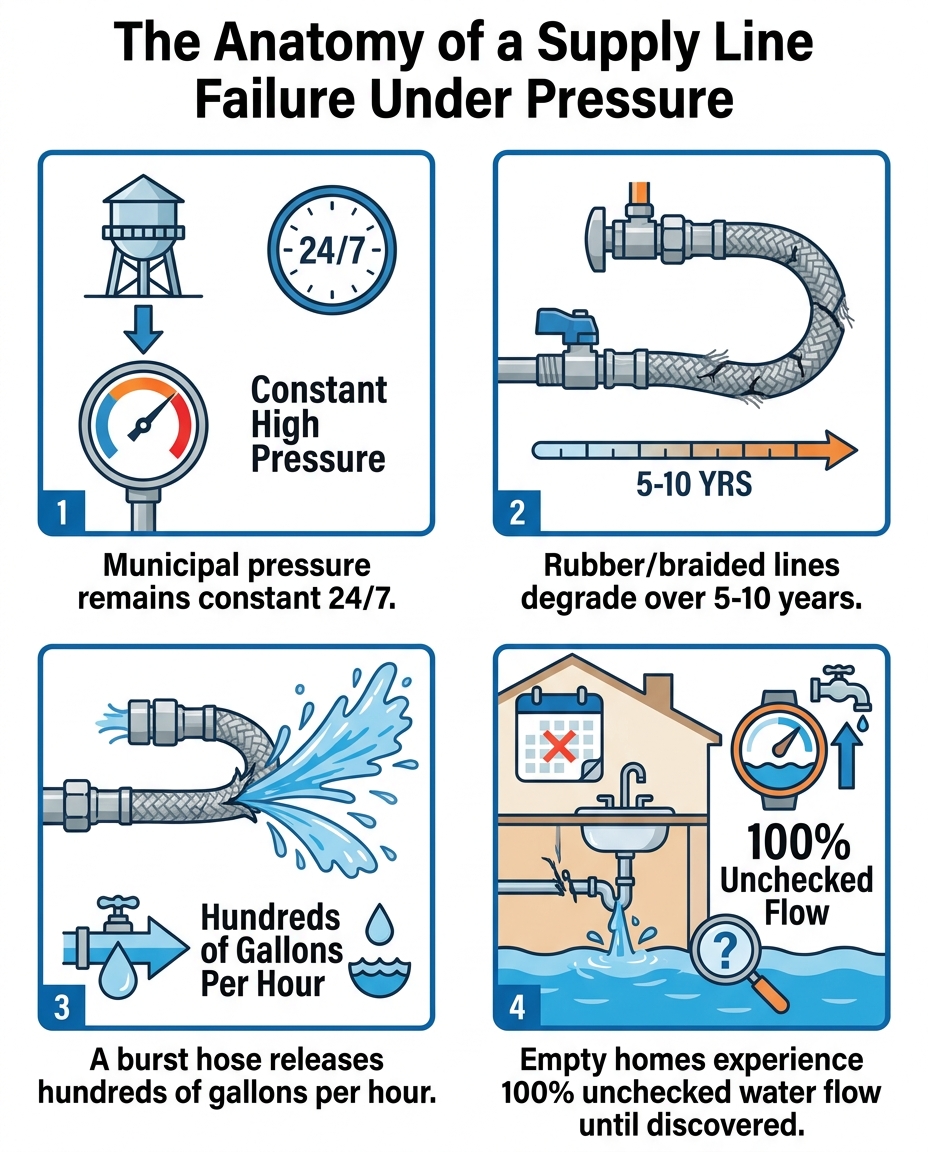
Municipal water systems are designed to deliver water to your home reliably, meaning they maintain constant, high pressure on every pipe, valve, and fixture in your house twenty-four hours a day, seven days a week. This relentless force is necessary for comfortable showers and efficient appliances, but it also means your plumbing system is always under stress.
The weakest links in this pressurized network are rarely the thick copper or PEX pipes running through your walls. Instead, the most vulnerable points are the rubber or braided fixture supply lines connecting your toilets, washing machines, dishwashers, and sinks to the main system. These flexible hoses are subjected to the exact same municipal pressure as the heavy-duty pipes, but they are made of materials that degrade much faster.
Why Supply Lines Fail
Supply line failures rarely happen entirely without cause, but the warning signs are often completely hidden from view. The combination of constant pressure and material breakdown creates a ticking clock for these vital connections.
1. Material degradation over time: Rubber hoses dry out, lose their elasticity, and become brittle over years of use. Even stainless steel braided lines have internal rubber cores that degrade invisibly from the inside out.
2. Fluctuations in municipal water pressure: Sudden spikes in city water pressure—often occurring at night when overall neighborhood usage drops—can put immense strain on weakened supply lines, pushing them past their breaking point.
3. Hidden wear and tear behind appliances: Hoses shoved behind heavy washing machines or tucked tightly under bathroom vanities are frequently kinked or crimped. This physical stress accelerates the breakdown of the hose material.
When a home is occupied, a failing line usually presents as a small puddle or a sudden spraying sound that prompts immediate action. An empty home offers no such warning, allowing the municipal pressure to push endless gallons of water through the rupture.

Why Late Summer Vacations Carry Unique Plumbing Risks
Late summer and the approaching Labor Day weekend mark the traditional end of the travel season. Families take advantage of the final weeks before the back-to-school rush, resulting in a high volume of homes left vacant and unmonitored for extended long weekends. While most homeowners are highly conditioned to worry about winter plumbing risks—specifically frozen and bursting pipes—late-summer mechanical failures remain a massive blind spot.
Warmer temperatures do not protect a plumbing system from mechanical degradation. An aging washing machine hose or a brittle toilet connector can burst at any time, under standard pressure, regardless of the weather outside. The specific climate context of Jacksonville, IL, makes this oversight particularly risky. Late summer here means homes are sitting empty and unmonitored during hot, humid weeks. When water escapes into a closed, un-air-conditioned home during peak August humidity, standing water quickly causes severe secondary damage, including rapid mold and mildew growth.
The Perfect Storm for Water Damage:
• Extended Vacancy: Long weekend trips mean the house is empty for 72 to 96 hours, providing ample time for a leak to spread.
• Peak Humidity: High late-summer temperatures combined with indoor standing water create a greenhouse effect inside the home.
• False Security: Because freezing isn't a threat, homeowners completely forget to consider their plumbing before departing.
An empty home during a final summer getaway creates the perfect environment for a minor, easily fixable leak to transform into a catastrophic, whole-house flood.
The Anatomy of a Supply Line Emergency
Understanding the mechanics of a supply line failure highlights exactly why preventative measures are so critical. A washing machine hose or toilet connector failure often starts deceptively small—perhaps as a microscopic pinhole leak or a slight bulge in the rubber casing. However, under constant municipal pressure, that weak point can experience a sudden, complete blowout.
According to Environmental Protection Agency (EPA) data, a burst washing machine supply hose can release hundreds of gallons of water per hour into a home. That is the equivalent of leaving several garden hoses running on full blast directly onto your living room floor. While routinely checking washing machine supply lines should absolutely be part of your seasonal home maintenance, shutting off the main valve is the ultimate, foolproof fail-safe when you are out of town.
The Reality of a Major Leak
When a major leak occurs underneath a home or from a heavy appliance, the resulting plumbing replacement and structural repair are extensive. One local homeowner experienced a severe plumbing failure when a major leak developed underneath their slab foundation home during the fall. Resolving the issue required a professional to walk through all available options and ultimately install entirely new plumbing, exhaust fans, and toilet fittings. The problem was fixed with honesty and quality within the discussed timeframe, but the disruption of a major slab leak or supply line blowout is immense.
When hundreds of gallons of water escape per hour, it does not just stay in the laundry room or bathroom. It flows under baseboards, saturates subflooring, and cascades through ceiling joists if the leak is on a second floor. The sheer volume of water involved in a full mechanical blowout makes the simple act of turning a single valve before your trip incredibly valuable.
How Water Damage Multiplies in an Empty Home
The severity of water damage is entirely dependent on time. Without a homeowner present to hear the rush of water and shut off the localized fixture valve, the water will continue to run unabated until the municipal supply is severed or a neighbor notices water pouring out of the front door.
The Problem: A supply line ruptures while the family is away on a late summer / Labor Day weekend trip. No one is present to intervene.
The Cause: Constant municipal pressure pushes water through the break continuously. In the first hour, the immediate area floods. By hour 24, water has wicked up the drywall, warped hardwood floors, and saturated carpets across multiple rooms. By hour 48, the structural integrity of ceilings and subfloors is compromised, and in a hot, closed house, mold spores begin to colonize.
The Solution: Prevent the flow entirely by utilizing the main shut-off valve. If a failure does occur while the water is on, extensive mitigation is required, often involving tearing out flooring, replacing drywall, and running industrial dehumidifiers for weeks.
• 1 to 2 Hours — Extent of Water Damage in an Empty Home: Localized flooding. Carpets saturate, and water begins seeping under baseboards and into subflooring.
• 24 Hours — Extent of Water Damage in an Empty Home: Drywall wicks water upward. Hardwood floors begin to cup and warp. Furniture legs sustain permanent damage.
• 48 to 72 Hours — Extent of Water Damage in an Empty Home: Mold and mildew growth accelerates rapidly in hot weather. Structural materials weaken. Ceiling collapses may occur if the leak is upstairs.
When water enters a home unchecked—whether from a burst pipe or, as we saw with one local customer whose entire basement flooded after a massive fall storm—the timeline of destruction is rapid. In that storm-related instance, a technician arrived within two hours to identify the problem and fix it, resolving the flooding quickly. However, an empty house on vacation doesn't have the luxury of a quick call for help. Professional leak detection and repair is crucial for finding hidden damage and fixing broken pipes, but preventing the flood entirely is always the better strategy. While rapid response is critical when severe flooding occurs, HRI Plumbing's primary goal is educating Jacksonville homeowners on preventative steps to avoid these disasters altogether.
Locating and Operating Your Main Water Shut-Off Valve
Taking control of your home's water supply is a straightforward process, but it requires knowing exactly where your main shut-off valve is located before you are rushing to pack the car for the airport. Every homeowner should be familiar with this vital component.
• Locate the valve: The main shut-off is typically located where the municipal water line enters the house. Common locations include inside utility closets, in basements near the front foundation wall, on exterior walls in warmer climates, or directly next to the water meter.
• Identify the valve type: You will generally find one of two types. A gate valve looks like a circular spigot handle and must be turned clockwise multiple times to stop the flow of water completely. A ball valve features a straight lever handle; to shut off the water, you simply turn the lever 90 degrees so it sits perpendicular to the pipe.
• Test before you travel: Do not wait until the morning of your trip to touch the valve for the first time. Test it a few days prior. Turn it off, then open a faucet in the kitchen to ensure the water flow stops completely.
• Never force a stuck valve: If the valve is incredibly stiff, visibly leaking, or heavily corroded, do not force it with a wrench. Snapping a corroded main valve will cause an immediate, high-pressure flood. A stuck or failing main valve requires a licensed professional to repair or replace safely.
Bridging Vacation Safety with Back-to-School Readiness
Returning from a final late summer / Labor Day weekend trip should be a smooth, relaxing transition into the busy back-to-school routine. The last thing any family needs is a chaotic scramble to manage a flooded house, deal with insurance adjusters, and coordinate emergency restoration crews while trying to pack school lunches.
The simple act of turning your water back on upon your return actually provides an excellent opportunity for a quick plumbing health check. When you slowly reopen the main valve, take a few minutes to visually inspect all exposed plumbing. Check under the kitchen and bathroom sinks, look behind the washing machine, and inspect the base of the toilet and the water heater.
If you notice any drips, hear hissing sounds, or realize that your main shut-off valve was exceptionally difficult to operate during your vacation prep, use the transition into fall to address it. Scheduling a routine plumbing inspection for the autumn months ensures that any aging rubber or braided fixture supply lines, stiff valves, or hidden vulnerabilities are resolved before the holiday hosting season begins. Proactive prevention keeps your home safe, dry, and ready for the busy months ahead.
Frequently Asked Questions
Should I turn off my main water valve when going on vacation?
Yes, shutting off the main water valve is highly recommended whenever your home will be unoccupied for more than a couple of days. This simple step completely eliminates the risk of an aging supply line or pipe bursting and causing continuous, unchecked flooding while you are away. It is one of the most effective preventative measures a homeowner can take to protect their property.
Will turning off the water damage my pipes or water heater?
Turning off the main water supply will not damage your pipes. However, if you have a traditional tank water heater, it is best practice to turn the heater's energy supply to "vacation mode" or shut off its breaker. This prevents the heating elements from turning on and potentially burning out if the tank's water level were to somehow drop while the main supply is off.
What happens if a washing machine hose bursts while I'm away?
If a washing machine hose bursts while the main water supply is on, it can release hundreds of gallons of water into your home every hour. Because the house is empty, the water will run continuously until someone discovers the flood and shuts off the municipal supply. This results in catastrophic damage to drywall, flooring, and structural framing.
How long can you safely leave a home's water shut off?
You can safely leave a home's water shut off indefinitely. Whether you are leaving for a three-day weekend or closing up a property for several months, having the water off poses no threat to the plumbing infrastructure itself. In fact, for long-term vacancies, shutting off the water is an absolute necessity.
Should I drain my pipes after shutting off the main valve in the summer?
Draining the pipes is generally not necessary for a short summer vacation, as there is no risk of the standing water inside the pipes freezing and expanding. Simply turning off the main valve removes the active municipal pressure from the system, which is sufficient to prevent a major blowout from supply lines or appliance connections.
Secure Your Home Before You Travel
Don't let a hidden plumbing failure ruin your end-of-summer transition. Locating and operating your main shut-off valve takes only seconds, but it provides unparalleled peace of mind while your house sits empty. If you discover a stuck valve, corroded pipes, or aging hoses during your pre-trip checks, reach out for professional guidance. Schedule your inspection today so you can travel with confidence, knowing your home is fully protected.


