


Has Your Water Heater Been Struggling to Meet Your Needs?

A tankless vs tank water heater comparison comes down to a few key differences that affect your daily comfort, energy bills, and long-term budget:
| Factor | Tank Water Heater | Tankless Water Heater |
|---|---|---|
| How it works | Stores and reheats 20-80 gallons continuously | Heats water on demand as you use it |
| Hot water supply | Limited to tank capacity | Continuous, as long as demand doesn't exceed flow rate |
| Energy efficiency | 40-60% efficient | 80-99% efficient |
| Lifespan | 10-15 years | 20+ years |
| Best for | High simultaneous demand, lower upfront budget | Staggered usage, space-saving, long-term savings |
| Installation complexity | Simpler, lower cost | More complex, may need upgrades |
Your water heater is one of the hardest-working appliances in your home. It powers your morning shower, runs your dishwasher, and keeps your laundry cycle going — often all at the same time. Yet most homeowners in central Illinois don't think about it until something goes wrong — a cold shower mid-rinse, a puddle on the basement floor, or a utility bill that keeps climbing.
If your current system is showing its age or simply isn't keeping up, you're likely weighing whether to replace it with the same type or make the switch to tankless. Both options have real advantages, and the right choice depends on how your household actually uses hot water day to day.
Has Your Water Heater Been Struggling to Meet Your Needs? This guide walks you through everything you need to know — from how each system works to which one fits your home, your habits, and your budget — so you can make a confident, informed decision.
Tankless vs Tank Water Heater Comparison: Understanding the Mechanics
To make an informed choice, we first need to look under the hood. While both systems have the same end goal—delivering steaming water to your tap—they go about it in completely different ways.
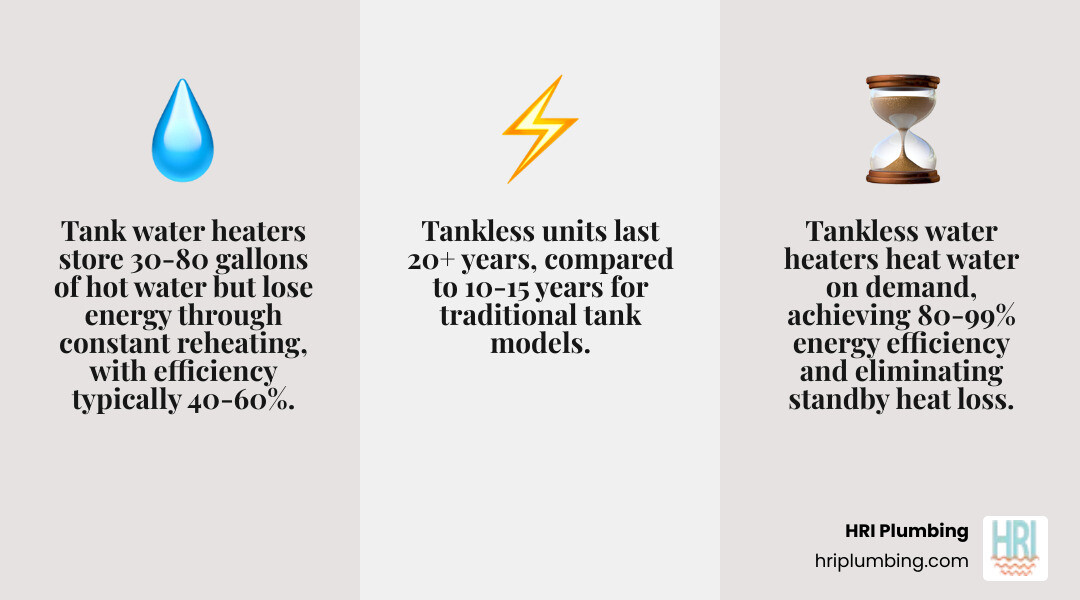
Traditional storage tank water heaters are the "old reliable" of the plumbing world. They work by keeping a large reservoir of water (usually between 30 and 80 gallons) at a constant, pre-set temperature, typically between 120°F and 140°F. Whether you are sleeping, at work, or on vacation, that tank is burning fuel to keep that water hot. This leads to what we call "standby heat loss." Think of it like keeping a pot of water boiling on the stove all day just in case you want a cup of tea at 4:00 PM. It’s convenient, but it’s not exactly efficient.
On the flip side, tankless water heaters—often called "on-demand" heaters—don't store a single drop of hot water. Instead, when you turn on a hot water faucet, cold water travels through a pipe and into the unit. A gas burner or an electric element flashes on, heating the water instantly as it passes through a heat exchanger.
This method eliminates standby loss entirely. You only pay to heat the water you actually use. However, this high-intensity heating requires a lot of power all at once. For gas models, this often means needing a Direct Vent Water Heater setup to safely exhaust the more powerful burner.
Performance and Flow Rate in a Tankless vs Tank Water Heater Comparison
When we talk about performance, we aren't just talking about how hot the water gets; we're talking about how much of it you can get at once. This is where the tankless vs tank water heater comparison gets interesting.
The Tank Advantage: Simultaneous UseA storage tank is like a battery. It has a massive "charge" of hot water ready to go. If you have a large family where three people need to shower at the same time while the dishwasher is running, a properly sized tank can handle that massive "dump" of demand without a drop in pressure or temperature—at least until the tank runs out. Once it's empty, however, you face "recovery time," which is the period you have to wait while the tank refills and reheats.
The Tankless Advantage: Endless SupplyTankless units are rated by Gallons Per Minute (GPM). Most residential units provide between 2 and 5 GPM. The beauty here is that the hot water never runs out. If you want to take a three-hour shower (though your skin might not thank you), the water will stay hot the entire time.
However, tankless units have a "flow limit." If you try to run too many fixtures at once—say, two showers and a washing machine—the unit might not be able to heat the water fast enough. This can lead to a Water Heater Not Producing Hot Water at the desired temperature, or a noticeable drop in water pressure.
The "Cold Water Sandwich" and ClimateIn our central Illinois climate, groundwater temperatures can drop significantly in the winter. A tankless unit has to work much harder to raise 40°F water to 120°F than it does for 70°F water. This can reduce the effective GPM in the winter months.
You might also experience the "cold water sandwich." This happens when you turn the water off and then back on quickly. A small pocket of unheated water stays in the pipes between the two bursts of hot water. While modern high-end units have small buffer tanks to prevent this, it's a common quirk of older or entry-level tankless models.
Energy Efficiency and Lifespan Differences
If you're looking at the long-term math, tankless systems often come out on top. According to the U.S. Department of Energy, tankless water heaters can be 24%–34% more energy efficient than conventional storage tank water heaters for homes that use 41 gallons or less of hot water daily. Even for high-use homes (around 86 gallons a day), they remain 8%–14% more efficient.
The Energy Saving Benefits Tankless Water Heaters offer can translate to roughly $100 or more in savings on your annual utility bills. Over a 20-year lifespan, a family of four could save as much as $1,800.
Speaking of lifespan, that is another major victory for the tankless side.
- Traditional Tanks: Usually last 8 to 12 years. Because they constantly hold water, the metal tank eventually corrodes. In fact, nearly 75% of tank heaters eventually burst or leak, which can mean 30 to 80 gallons of rusty water flooding your basement.
- Tankless Units: These are built with replaceable parts and don't store water, meaning they can easily last 20 years or more.
Maintenance Requirements for Long-Term Reliability
Neither system is "set it and forget it," though the maintenance tasks differ.
For traditional tanks, the biggest enemy is sediment. Minerals in our Illinois water settle at the bottom of the tank, creating an insulating layer that makes the burner work harder and eventually damages the tank. We recommend a professional flush at least once a year to clear this out. You also have to keep an eye on the anode rod—a sacrificial magnesium or aluminum rod that "attracts" corrosion so the tank doesn't have to. When that rod dissolves (usually every 3–5 years), the tank is next on the menu.
Maintaining Tankless Water Heater systems involves a different process. Because they use high-heat exchangers, scale (calcium buildup) can accumulate quickly, especially if you have hard water. To keep a tankless unit running efficiently, it needs to be "descaled" or flushed with a vinegar solution annually. Many homeowners in Springfield and Jacksonville also choose to pair their tankless unit with a water softener to protect their investment and ensure the warranty remains valid.
Making the Right Choice for Your Home
Choosing between these two isn't about which technology is "better" in a vacuum; it’s about which one is better for your specific house and lifestyle.
To help you decide, consider this Should I Repair or Replace My Water Heater guide. If your current tank is over 10 years old and starting to struggle, a replacement is likely in your near future.
| Comparison Point | Tank Water Heater | Tankless Water Heater |
|---|---|---|
| Space Required | Large footprint (approx. 24" x 60") | Small (size of a suitcase) |
| Hot Water Supply | Instant, but finite | Slight delay, but infinite |
| Upfront Cost | Lower | Higher |
| Installation | Simple "plug and play" | Requires venting/gas/electric upgrades |
| Reliability | High (fewer sensors) | High (if maintained annually) |
Space and Installation in a Tankless vs Tank Water Heater Comparison
One of the most immediate benefits homeowners notice when switching is that Tankless Water Heaters Free Up Storage Space. A traditional 50-gallon tank is a behemoth that takes up significant real estate in a utility room or basement. A tankless unit is roughly the size of a carry-on suitcase and mounts directly to the wall. This can open up room for a new utility sink, extra shelving, or even a more spacious laundry area.
However, the installation of a tankless unit is more involved than a simple tank swap. Because tankless units require a high volume of gas to heat water instantly, your existing gas line might need to be upsized. Furthermore, they produce hotter exhaust, which often requires specialized Category III stainless steel or PVC venting rather than the standard chimney vent used by older tanks. If you are going electric, you may need an upgrade to your home's electrical panel to handle the massive amperage draw (sometimes up to 150 amps).
When to Choose a Traditional Storage Tank
Despite the "cool factor" of tankless technology, there are many reasons Why Some People Still Buy Traditional Water Heaters.
- Lower Initial Investment: If you need a water heater today and the budget is tight, a traditional tank is much more affordable to purchase and install.
- Simplicity: There are fewer electronic sensors and computer boards in a standard tank. This often makes repairs simpler and faster.
- High Simultaneous Demand: If your household routine involves everyone showering at exactly 7:00 AM, a large 80-gallon tank might actually serve you better than a single tankless unit, which might struggle to keep up with three simultaneous showers.
- Emergency Replacements: 90% of water heater replacements happen during an emergency. If your tank bursts on a Tuesday night, a standard tank can usually be installed the next morning with zero modifications to your plumbing or gas lines.
Conclusion and Professional Installation in Illinois
At HRI Plumbing, we believe in honesty and integrity. We aren't here to push you toward the most expensive option; we're here to find the solution that keeps your showers hot and your bills low. Whether you are in Jacksonville, Springfield, or Rushville, we understand the local water conditions and the specific needs of Illinois homes.
If you value an endless supply of hot water, want to reclaim space in your basement, and plan on staying in your home for at least 5 to 10 years to recoup the energy savings, a tankless system is a fantastic investment. We offer specialized services for a Tankless Water Heater Springfield IL to ensure your new system is sized and vented perfectly.
On the other hand, if you have a large family with high simultaneous water needs and prefer a lower upfront cost, a modern, high-efficiency storage tank remains a reliable and effective choice.
Not sure which path to take? Our team is available 24/7 to help you navigate the tankless vs tank water heater comparison for your specific property. We offer affordable rates, flexible options, and the expertise to handle everything from gas line upgrades to annual descaling.
For More info about water heater services, or to schedule a consultation with one of our friendly technicians, give us a call today. Let’s make sure your home stays comfortable for years to come.


