




The Hidden Drought Response: When Trees Target Your Septic System
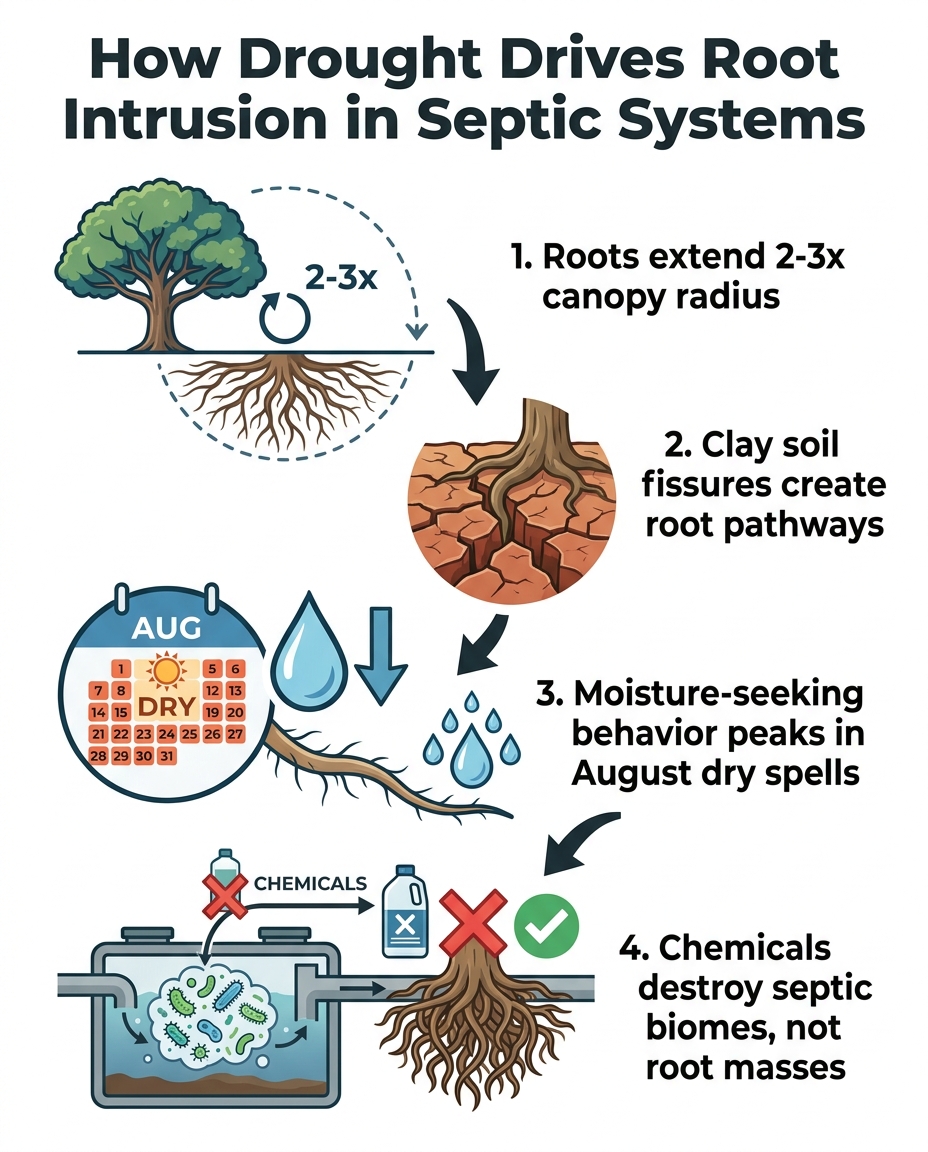
Nearly 75% of homeowners underestimate how far a mature tree's root system actually extends underground. Protecting Your Septic Drain Field from Late Summer Root Intrusions begins with understanding one startling fact: mature tree roots naturally extend up to two to three times the radius of their canopy, easily reaching areas of your yard thought to be completely safe. When the intense heat of the season arrives, surface moisture evaporates rapidly, triggering a biological survival mechanism in the landscaping around your home. Trees that normally rely on shallow rainwater are forced to send their root systems deeper and wider to find reliable water sources.
During August / late summer dry spells, your septic drain field becomes the ultimate target for drought-stressed landscaping. The constant supply of nutrient-rich wastewater flowing through your leach field is an oasis for thirsty roots. Identifying the early warning signs of this intrusion is critical. Waiting until a total yard backup occurs can lead to catastrophic system failure. Trusting professional plumbing services to diagnose these hidden biological intrusions ensures your property remains safe. Specialized septic services provide the necessary solutions to address root infiltration long before it destroys your underground infrastructure.
The Biological Urgency of Late Summer
Trees are highly efficient survival organisms. When soil moisture drops below a certain threshold, chemical signals within the tree prioritize root expansion over canopy growth. This means that while the leaves on your oak or maple might look slightly wilted, a massive amount of energy is being directed underground. The roots become aggressive, seeking out any available moisture gradient in the soil. Because a septic drain field is designed to slowly percolate liquid into the surrounding earth, it creates an artificial moisture zone that roots can detect from surprisingly long distances. This biological urgency peaks precisely when rainfall is at its lowest, making late summer the most dangerous time for your underground pipes.
The Biology of Root Intrusion: How Thirsty Landscaping Breaches Pipes
Understanding how roots find and penetrate your septic system requires looking at the microscopic processes happening beneath your lawn. The process is not random; it is highly targeted and driven by the biological needs of the plant during August / late summer dry spells.
1. Sensing the vapor trail: Wastewater flowing through a leach field emits warm, nutrient-rich water vapor. This vapor escapes through loose pipe joints, microscopic cracks, or the intentionally perforated pipes of the drain field. Tree roots possess hydrotropic capabilities, meaning they actively grow toward these moisture vapor gradients in the soil.
2. The initial breach: Once a root tip reaches the source of the vapor, it searches for an entry point. These roots are initially hair-like and microscopic, allowing them to slip through the tiniest imperfections in concrete, PVC joints, or standard perforated leach lines.
3. Explosive expansion: The environment inside a septic pipe is perfect for root growth. It offers constant moisture, oxygen, and essential nutrients like nitrogen and phosphorus. Once inside, that microscopic root experiences rapid, explosive growth, expanding into a thick, fibrous mass.
4. Creating the blockage: As the root mass expands, it acts like a biological net. It begins catching solid waste, toilet paper, and grease that flow through the system. What starts as a minor partial obstruction quickly compounds into a severe, impenetrable blockage.
Why Alternative Water Sources Matter
During a rainy spring, trees have plenty of surface water to draw from, and their roots have no reason to expend the energy required to force their way into underground plumbing. However, when those alternative water sources disappear during prolonged dry periods, the constant, reliable flow of a septic trench becomes the only viable option. This is why a drain field that has functioned perfectly for a decade can suddenly become overwhelmed by root intrusion in a single, exceptionally dry season.

How Central Illinois Soil Conditions Accelerate the Threat
The interaction between regional soil composition and extreme weather creates a unique set of challenges for local homeowners. In this region, heavy clay soils dominate the landscape. While clay is excellent at holding moisture during wet seasons, it reacts violently to extreme heat and lack of rain. As the moisture evaporates from the clay, the soil physically shrinks, creating deep, extensive fissures and cracks throughout the ground.
These soil fissures act as subterranean highways. Instead of having to push through dense, compacted earth, moisture-starved roots can now travel rapidly through these paths of least resistance. The cracks often lead directly toward the constant moisture of a septic trench. Because of our deep understanding of Central Illinois soil types and native tree root behaviors, we frequently see how late-summer high heat and dry spells cause clay-heavy soils to crack, providing these easy channels for roots.
The Unique Vulnerability of Local Landscaping
Jacksonville IL properties with mature landscaping are particularly vulnerable to this specific soil-root dynamic. Older homes often feature large, established shade trees that were planted decades ago, long before the full extent of their root systems could be anticipated. When the clay soil fractures, the massive root networks of these older trees exploit the openings immediately.
• Spring (Saturated Clay) — Root Behavior: Roots remain shallow to absorb abundant surface water. — Septic System Impact: Low risk of intrusion; pipes remain undisturbed.
• Early Summer (Drying Clay) — Root Behavior: Surface roots begin to dry; deeper roots activate. — Septic System Impact: Roots begin moving toward artificial moisture zones.
• Late Summer (Fissured Clay) — Root Behavior: Roots travel rapidly through deep soil cracks. — Septic System Impact: High risk of infiltration through pipe joints and perforations.
Understanding this local soil dynamic is crucial. It means that evaluating the risk to your septic system isn't just about how close a tree is to the tank; it is about how the soil between the tree and the tank behaves during a drought.
Early Warning Signs of Drain Field Compromise
Catching a root intrusion early can mean the difference between a routine clearing and a total system replacement. The symptoms often appear gradually, masking themselves as minor annoyances before escalating into major failures. Knowing what to look for during August / late summer dry spells is your best defense against a catastrophic yard backup.
• Unusually lush grass: If you notice bright green, rapidly growing patches of grass directly over your drain field while the rest of your yard is brown and dormant, it indicates that wastewater is being pushed to the surface instead of percolating downward.
• Slow-draining fixtures: When roots begin to block the main line leading to the tank, or the outflow lines leading to the drain field, you will notice sinks, showers, and toilets draining sluggishly.
• Gurgling sounds: As water struggles to push past a root mass, it creates air pockets. These air pockets bubble back up through the water in your toilet bowls or sink traps, causing a distinct gurgling noise.
• Faint sewage odors: A compromised drain field cannot properly filter wastewater. If you detect a persistent, foul odor around your property, especially near the tank or leach field, the system is failing to process waste efficiently.
Distinguishing General Clogs from Systemic Failure
These signs are frequently misdiagnosed by homeowners as a simple, localized clog in a single bathroom. However, if multiple fixtures are affected simultaneously, or if the issue persists after plunging, the problem is likely systemic. It is also helpful to understand how summer heat triggers septic tank failures, as temperature extremes fundamentally alter the rate of waste breakdown, exacerbating the symptoms of a blocked line.
The Hidden Dangers of DIY Chemical Root Killers
When faced with a slow drain, many homeowners reach for over-the-counter chemical solutions. While these products are heavily marketed as quick fixes, they are inherently dangerous and largely ineffective for septic systems, particularly for Jacksonville IL properties with mature landscaping where the root masses are highly established.
The Problem: Many popular chemical root killers rely on harsh, caustic compounds like copper sulfate or heavy foaming agents. Homeowners pour these toxic solutions down their toilets, hoping to dissolve the blockage hidden deep in the yard.
The Cause of Failure: A septic system relies on a delicate, naturally occurring bacterial biome to break down solid waste into liquid effluent. When harsh chemicals enter the tank, they indiscriminately destroy this beneficial bacteria. Without the biome, solid waste rapidly accumulates, filling the tank and eventually pushing raw sludge into the drain field lines, causing permanent, irreversible damage to the soil's ability to absorb water.
Why Chemicals Don't Solve the Root Issue
The Solution: Beyond destroying the bacterial balance, chemicals are physically ineffective against mature intrusions. A chemical wash might burn off the microscopic tips of the roots, but it cannot dissolve the dense, woody mass that is already blocking the pipe. The dead roots remain in place, continuing to trap debris and cause backups. True resolution requires professional drain cleaning in Jacksonville. Mechanical removal physically extracts the obstruction without introducing biome-destroying toxins into your delicate septic environment.
Professional Diagnostics vs. Reactive Emergency Repair
When roots infiltrate a drain field during August / late summer dry spells, guessing at the location of the blockage often leads to unnecessary digging and property damage. Professional diagnostics remove the guesswork, allowing for precise, targeted interventions.
The standard professional approach begins with a high-resolution camera inspection. A specialized, waterproof camera is fed through the plumbing lines, providing real-time video feedback from inside the pipes. This allows technicians to pinpoint the exact location, size, and severity of the root mass without ever touching a shovel. Once the intrusion is mapped, professionals utilize advanced techniques like mechanical augering or hydro-jetting. Hydro-jetting uses highly pressurized water to slice through thick root masses and scour the pipe walls clean, safely clearing the line without harming the essential septic biome.
The Cost of Ignoring the Problem
Contrasting early mechanical clearing with the consequences of ignoring the problem highlights the importance of proactive care. If left unchecked, roots will continue to expand until the pressure literally crushes or snaps the underground pipes.
A typical pattern we see involves major blockages escalating rapidly when ignored. In one recent case during the summer, a local property experienced a severe sewer backup that required replacing a large portion of the sewer line and an adjacent water line. While the extensive excavation and replacement were completed professionally in less than a day, it serves as a stark reminder that severe, unchecked blockages often require extensive sewer line repair and replacement. What could have been a routine maintenance visit can easily turn into a major excavation project.
Proactive Landscaping and System Monitoring for Fall
As the intense heat of late summer begins to wane, transitioning into fall is the ideal time to evaluate your landscaping and fortify your septic system against future biological intrusions. Managing the environment around your drain field is an ongoing process, especially for Jacksonville IL properties with mature landscaping.
1. Follow safe planting distances: Adhere to EPA SepticSmart guidelines when adding new landscaping. As a general rule, trees should be planted at a distance equal to their estimated mature height away from the edge of the drain field. For aggressive root species like willow, maple, or elm, that distance should be doubled.
2. Choose septic-safe plants: If you want to landscape the area directly over your leach field, opt for shallow-rooted, herbaceous native plants. Grasses, shallow-rooted perennials, and native wildflowers can safely grow near septic systems. They help prevent soil erosion and manage surface water without threatening the underground pipes.
3. Schedule a transitional inspection: Advise scheduling a professional inspection as summer transitions to fall. Ensuring the system is completely clear of summer root growth before the winter ground freezes is crucial. Frozen ground makes excavation significantly more difficult and complex if a backup occurs in January.
4. Maintain ongoing monitoring: Keep a detailed log of your septic maintenance. Note when the tank was last pumped, when the lines were last inspected, and any minor symptoms you observe. Ongoing monitoring is the absolute best defense for properties surrounded by established, mature trees.
Frequently Asked Questions
How do you know if roots are in your septic lines?
The most common indicators are slow-draining fixtures throughout the house and gurgling sounds coming from your toilets. You may also notice unusually lush, bright green patches of grass directly over the drain field while the surrounding yard is dry. Faint sewage odors around the property are another strong signal that wastewater is not flowing properly.
Why do tree roots grow into septic drain fields?
Tree roots naturally seek out moisture and nutrients, especially during dry seasons. A septic drain field provides a constant, reliable source of warm, nutrient-rich water. Roots can detect the vapor escaping from the pipes and will actively grow toward it to sustain the tree during a drought.
Can a septic drain field be repaired after severe root damage?
Yes, but the extent of the repair depends on the severity of the damage. If caught early, the roots can be mechanically cleared, and the pipes may remain intact. However, if the roots have crushed or shattered the perforated leach lines, those specific sections—or sometimes the entire field—will need to be professionally excavated and replaced.
What is the safest way to kill tree roots in a septic system?
The safest method is professional mechanical removal, such as hydro-jetting or augering. Chemical root killers should be avoided entirely, as they destroy the beneficial bacteria inside the septic tank that are necessary for breaking down solid waste. Mechanical removal clears the physical blockage without harming the system's biological balance.
Why is my drain field unexpectedly wet in the late summer?
An unexpectedly wet drain field during a dry season usually indicates that the underground pipes are blocked, forcing wastewater to the surface. This is frequently caused by root masses clogging the leach lines, preventing the water from percolating downward into the soil as designed. It requires immediate professional diagnosis.
How far away should trees be planted from a septic leach field?
As a general rule, a tree should be planted at a distance at least equal to its expected mature height away from the drain field. For species known to have highly aggressive root systems, such as willows, poplars, or silver maples, you should double that distance to ensure the roots cannot reach the artificial moisture zone of the septic trench.
Securing Your Drain Field for the Changing Seasons
Protecting your property from the hidden threat of drought-driven root expansion requires vigilance and timely action. By recognizing the early warning signs, you can prevent a minor intrusion from becoming a major excavation. If you suspect your landscaping is interfering with your plumbing, reach out to a licensed professional for safe, non-destructive root removal and comprehensive system diagnostics.


