




The Hidden Threat Beneath Rochester's Historic Lawns
You run the washing machine, and a few minutes later, the basement floor drain starts bubbling. At HRI Plumbing, our team often fields emergency calls for unexplained slow drains and gurgling fixtures just as the temperatures drop in November. Navigating Rochester's fall tree root intrusion in older clay sewer pipes is a seasonal reality that catches many homeowners off guard. What seems like a sudden clog is rarely a coincidence in historic neighborhoods; it is usually a symptom of mature trees aggressively seeking moisture before the frost sets in.
Determining if these symptoms are simple blockages or severe root intrusion requires professional diagnosis before the impending winter ground freeze complicates access. Whether your home ultimately requires comprehensive sewer line repair and replacement or targeted rooter services in Rochester, having our experienced technicians identify the exact nature of the blockage is the critical first step.
The Shift in Central Illinois Weather
As Central Illinois transitions from dry late-fall weather to the harsh reality of winter, the soil undergoes significant changes. The lack of consistent rainfall in October and November leaves the ground parched. Meanwhile, the plumbing infrastructure beneath older Rochester properties with mature trees and clay sewer lines continues to flow with warm, nutrient-rich wastewater. Our crews frequently observe how this stark contrast between the dry, cooling earth and the warm, moist environment inside the sewer pipe creates an underground dynamic that heavily favors root intrusion.
The quick fix: There is no quick chemical fix for this biological process. Homeowners must rely on mechanical clearing and visual inspections to understand what is happening beneath their lawns. In our experience, waiting for the problem to resolve itself usually results in a complete backup just as the holiday season begins.
The Biology Behind Aggressive Late-Fall Root Growth
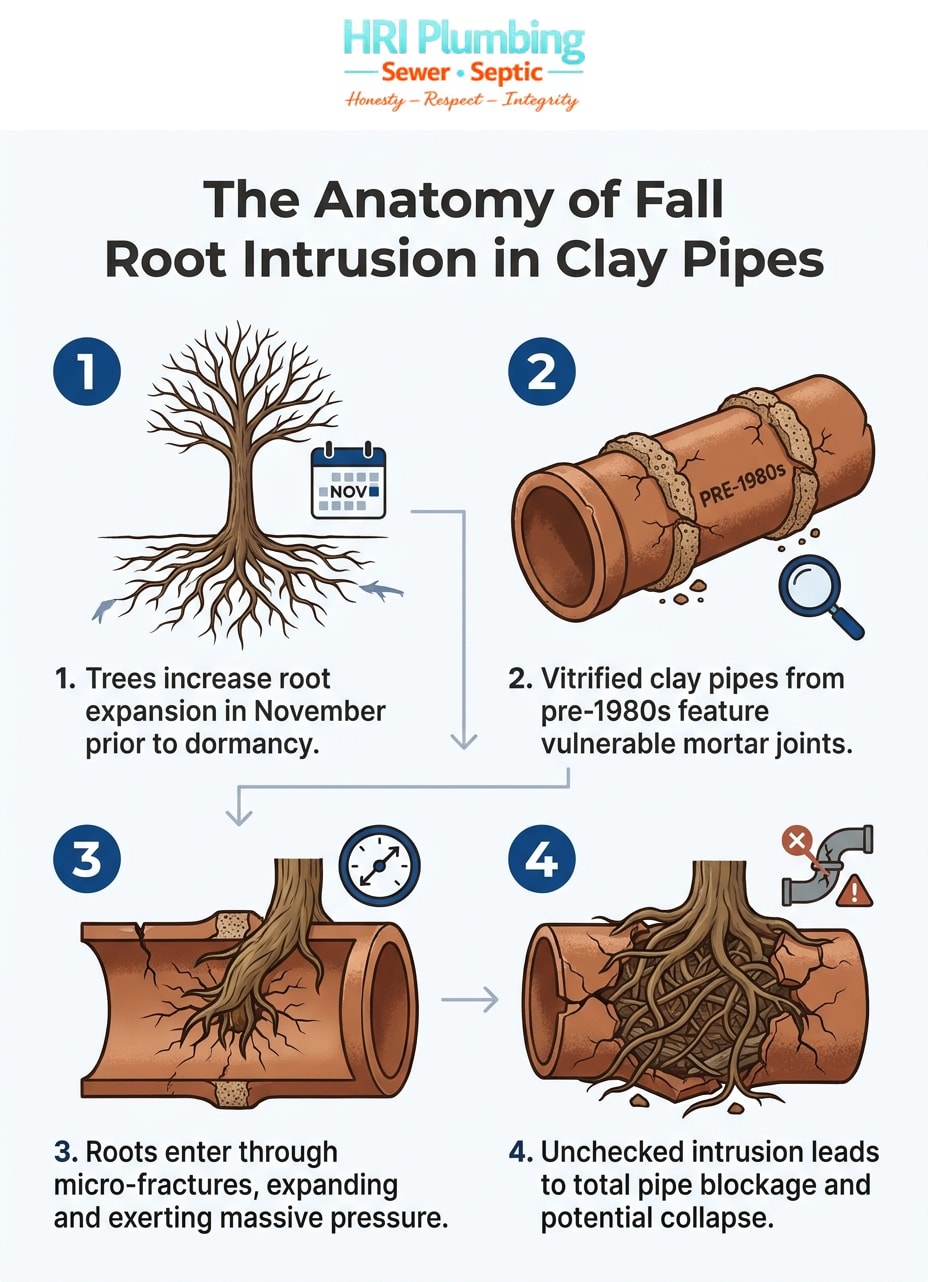
Trees are highly responsive to environmental changes, and their root systems act as massive sensory networks. During a dry late-fall (November) pre-winter dormancy phase, mature trees sense the dropping temperatures and decreasing daylight. To survive the winter, they must stockpile water and nutrients. When natural rainfall is scarce, the tree's root system actively searches for alternative hydration sources.
Residential sewer lines are the perfect target. The wastewater flowing through these pipes is consistently warm, which creates condensation on the exterior of the pipe. This moisture acts as a biological beacon for thirsty roots.
Moisture Seeking Behavior Before Winter
Trees make a final biological push for hydration right before they enter their winter dormancy. This process, known as hydrotropism, directs root growth toward areas of higher moisture concentration. Hair-like feeder roots can travel significant distances through the soil, following the moisture gradient directly to the exterior of a sewer pipe.
Once these feeder roots locate the pipe, they wrap around it, seeking any microscopic entry point. The warm condensation not only provides water but also creates a micro-climate that prevents the immediate soil surrounding the pipe from freezing as quickly as the surface dirt.
• Spring & Early Summer — Tree Root Behavior: Rapid canopy growth, surface water absorption. — Impact on Sewer Lines: Minimal new intrusion; existing roots expand slowly.
• Late Summer — Tree Root Behavior: Steady growth, relying on deep soil moisture. — Impact on Sewer Lines: Roots begin seeking deeper water sources during droughts.
• Late Fall (November) — Tree Root Behavior: Aggressive moisture stockpiling before winter dormancy. — Impact on Sewer Lines: High risk of feeder roots invading pipes for warm condensation.
• Winter — Tree Root Behavior: Dormancy, minimal active growth. — Impact on Sewer Lines: Existing root masses inside pipes catch debris and freeze.
Understanding this biological timeline explains why so many homeowners experience sudden main line backups in November. The trees are simply executing their survival strategy, and the sewer line happens to provide a constant, reliable water source when the surrounding soil is parched.
Why Legacy Clay Pipes Are Highly Vulnerable
To understand why this seasonal root growth is so destructive, you have to look at the materials buried beneath the yard. In our years excavating and repairing sewer lines throughout Jacksonville and Rochester, we've found that prior to the 1980s, vitrified clay pipes (VCP) were the standard for residential sewer lines. These pipes are incredibly resistant to chemical degradation, which is why they were used for wastewater. However, they possess significant mechanical weaknesses that become apparent over decades of use.
Clay pipes were installed in short segments, usually three to four feet long. This means a standard residential sewer lateral has dozens of joints connecting the home to the municipal main. These joints are the Achilles' heel of the system.
The Degradation of Mortar Joints
When these pipes were originally laid in older Rochester properties with mature trees and clay sewer lines, the joints were sealed with a rigid mortar or early hub-and-spigot packing materials. Over 40 to 60 years, the original mortar loses its integrity. Decades of regional freeze-thaw cycles in Central Illinois cause the soil to heave and settle, which slightly shifts the short clay segments. Because the mortar is rigid, it cannot flex with the shifting earth. It cracks, crumbles, and degrades.
These micro-fractures become the perfect entry points for aggressive feeder roots. The hair-like roots slip through the degraded mortar to reach the nutrient-rich water inside.
• Initial Entry: Feeder roots no thicker than a strand of thread penetrate the failing joint.
• Internal Expansion: Once inside the pipe, the roots absorb the wastewater and grow exponentially, forming a dense "fox tail" mass that acts like a net.
• Structural Stress: As the roots grow thicker at the entry point, they exert hundreds of pounds of hydrostatic-like pressure against the fragile clay.
• Catastrophic Failure: The pressure eventually shatters the bell housing of the clay pipe, leading to a collapsed line that can no longer be cleared by a rooter machine.
Identifying Root Intrusion vs. Standard Household Clogs
When homeowners call us about a slow drain, we always remind them that not every issue means a tree has destroyed your plumbing. However, knowing how to differentiate between a minor household clog and a systemic root blockage is vital for protecting your property. Standard clogs are usually isolated to a single fixture. If hair blocks the shower drain, the bathroom sink will still drain perfectly. Root intrusion, on the other hand, chokes the main lateral line connecting your entire home to the municipal system.
Because the main line is the exit route for all wastewater, a blockage there affects the entire house. Recognizing the early warning signs of a main sewer line blockage can save you from a major sewage backup in your basement.
Warning Signs in the Home
The symptoms of root intrusion follow the laws of gravity. Water will always back up out of the lowest opening in the plumbing system first. Pay close attention to these indicators:
• Gurgling toilets and bubbling drains: When a root mass restricts the pipe, air becomes trapped. As water tries to push past the blockage, it forces the trapped air back up through the water in your toilet bowl or sink trap, causing a gurgling sound.
• Multiple slow drains: If the kitchen sink, downstairs bathroom, and laundry tub are all draining slowly at the same time, the issue is deep in the main line.
• Water backing up into lower fixtures: The classic sign of a main line restriction is flushing an upstairs toilet and having that water back up into a basement shower or floor drain.
• Foul sewage odors: A lingering smell of raw sewage near basement floor drains indicates that wastewater is sitting stagnant in the line rather than flowing out to the street.
If you notice these signs, avoid pouring harsh chemical drain cleaners down the sink. Chemicals are entirely ineffective against dense root masses. They simply sit on top of the blockage, generating heat that can further damage weakened clay pipes or degrade the remaining mortar. Instead, you need professional drain cleaning that physically cuts and removes the root mass from the pipe interior.
The Critical Importance of Pre-Winter Diagnostics
Addressing slow drains in November is vastly different than addressing them in May. As local plumbers, we know the transition into winter brings a severe complication: frozen ground. Excavating a collapsed sewer line is always a major project, but digging through soil that has frozen solid significantly increases the complexity, duration, and disruption of the excavation.
A partial root blockage during a dry late-fall (November) pre-winter dormancy phase can easily become a complete backup during a December holiday gathering. When family is visiting and water usage spikes, that restricted clay pipe will finally reach its limit. If the pipe is broken and requires excavation in late December, the frozen Central Illinois ground makes emergency repairs incredibly difficult.
How Camera Inspections Pinpoint the Threat
The most effective way to prevent a winter disaster is to schedule a professional camera inspection before the ground freezes. This non-invasive diagnostic tool provides an exact look at the interior condition of the buried clay pipe without turning a single shovel of dirt.
1. Visual Verification: A high-definition camera is pushed through the cleanout, revealing the exact location, density, and size of the root mass.
2. Structural Assessment: The camera allows technicians to assess the remaining structural integrity of the aging clay pipe. They can see if the pipe is merely blocked, or if the roots have already shattered the bell joints.
3. Surface Locating: A transmitter in the camera head sends a signal to a surface receiver. This allows the technician to mark the exact depth and location of the problem area on your lawn.
4. Targeted Solutions: Seeing the root mass allows for targeted, professional clearing methods rather than guesswork, ensuring the right blade or hydro-jetting nozzle is used.
Navigating the specific quirks of historic Central Illinois plumbing infrastructure requires deep local expertise. As your trusted Rochester plumbing experts, the HRI Plumbing team understands exactly how these legacy clay systems behave and can provide accurate diagnostics that protect your property.
Secure Your Sewer Line Before the Winter Freeze
Late-fall root intrusion is a biological reality for older Rochester properties with mature trees and clay sewer lines. As trees make their final push for moisture, your aging mortar joints become their primary target. Ignoring the early warning signs of gurgling toilets and slow basement drains will only lead to more severe backups when the ground freezes.
Proactive diagnostics are your best defense against winter sewer emergencies. By scheduling a professional camera inspection now, you gain a clear understanding of your plumbing's condition and the opportunity to clear invasive roots before they shatter the pipe. Let the team at HRI Plumbing help you secure your sewer line today to ensure your home's infrastructure flows smoothly all winter long.
Frequently Asked Questions
Why do tree roots invade clay sewer pipes in the fall?
Tree roots invade clay sewer pipes in the fall because they are actively seeking moisture before winter dormancy. During dry autumn months, the warm, nutrient-rich condensation on the exterior of sewer lines provides a reliable water source. The roots follow this moisture gradient directly to the pipe.
How do you know if roots are in your main sewer line?
You can identify roots in your main sewer line by watching for multiple drains slowing down simultaneously on the lowest level of your home. Gurgling sounds from toilets, water backing up into basement showers, and lingering sewage odors are all strong indicators of a main line restriction.
Can tree roots completely destroy clay pipes?
Yes, tree roots can completely destroy clay pipes over time. As hair-like feeder roots enter through micro-fractures in the mortar joints, they grow into dense masses that exert hundreds of pounds of pressure. This pressure can eventually shatter the brittle clay bell housing, causing the pipe to collapse.
Why should you inspect clay sewer pipes before winter?
You should inspect clay sewer pipes before winter because excavating a collapsed line in frozen ground is highly complex and disruptive. A camera inspection in the late fall allows you to identify and clear root masses before they cause a complete backup during heavy winter water usage.
Are chemical root killers safe for old clay sewer lines?
Chemical root killers are generally ineffective and can be unsafe for old clay sewer lines. They often fail to penetrate dense root masses above the water line and can generate excessive heat or acidic reactions that further degrade the already weakened mortar joints holding the clay segments together.
How long do vitrified clay sewer pipes typically last?
Vitrified clay sewer pipes typically last between 50 and 60 years, though the pipe material itself resists chemical corrosion indefinitely. The failure point is almost always the mortar joints connecting the short segments, which degrade and crack over decades of soil movement and freeze-thaw cycles.


