



When a Gurgling Toilet Signals a Bigger Plumbing Problem
You flush the toilet, and instead of a clean sweep, you hear a strange, ominous gurgling sound echoing from the drain. Or perhaps you are running a load of laundry, and suddenly water begins pooling in the bottom of your first-floor shower. These are the unsettling moments when you have to figure out what is really going on behind your walls and under your floors. Recognizing the early warning signs of a main sewer line blockage is critical for protecting your home. As we head into September and early fall, our team at HRI Plumbing routinely sees these specific symptoms pop up across Jacksonville, leaving you at a major decision point: is this just a minor, localized drain quirk, or is a massive sewage backup developing underground?
If you are already noticing these red flags, it is time to look into professional plumbing services to evaluate the situation. Catching the problem early often means the difference between a simple clearing and extensive sewer line repair and replacement.
Many homeowners assume that a slow drain is just a standard nuisance that will resolve itself. However, your plumbing system operates under specific physical rules. When water cannot escape your home, it will find the easiest path backward. By the time raw sewage makes its way into your bathtubs or basement floor drains, we typically find that the underlying problem has been developing for months. Learning to spot the subtle, early indicators gives you the upper hand. It allows you to bring in a professional for a proper diagnosis before a manageable restriction turns into an overwhelming and messy home emergency.
The Anatomy of Your Home's Plumbing: Why Fixtures React Together
To understand why a washing machine can cause a shower to flood, you have to understand how your home's wastewater system is designed. The easiest way to visualize your residential plumbing is to compare it to a large tree. Every time you turn on a faucet, flush a toilet, or drain a tub, that water has to travel through a network of pipes that eventually merge together.
In our years of servicing Jacksonville IL area homes, we have found that many homeowners are surprised to learn that individual fixtures do not operate entirely independently. They all share the same final exit route. When that single underground pipe leading out to the municipal system or septic tank becomes compromised, the entire network feels the impact. The lowest points in your home will naturally show the symptoms first because gravity forces the backed-up water to emerge wherever it can.
The Branch Lines vs. The Main Trunk
Breaking down the "tree" analogy helps clarify exactly how blockages manifest:
• The Branch Lines: These are the smaller pipes connected directly to your individual fixtures. Your bathroom sink, your guest toilet, and your kitchen dishwasher all have their own branch lines. If a blockage happens here, only that specific fixture is affected.
• The Main Trunk: This is the primary sewer line buried beneath your yard. All the branch lines feed into this single, large-diameter pipe.
• The Pressure Effect: When the main trunk is blocked, wastewater and trapped air have nowhere to go. Because water cannot compress, it reverses direction, traveling back up the branch lines and forcing air and water out through the lowest drains in the house.
Red Flag #1: Phantom Sounds and Gurgling Drains
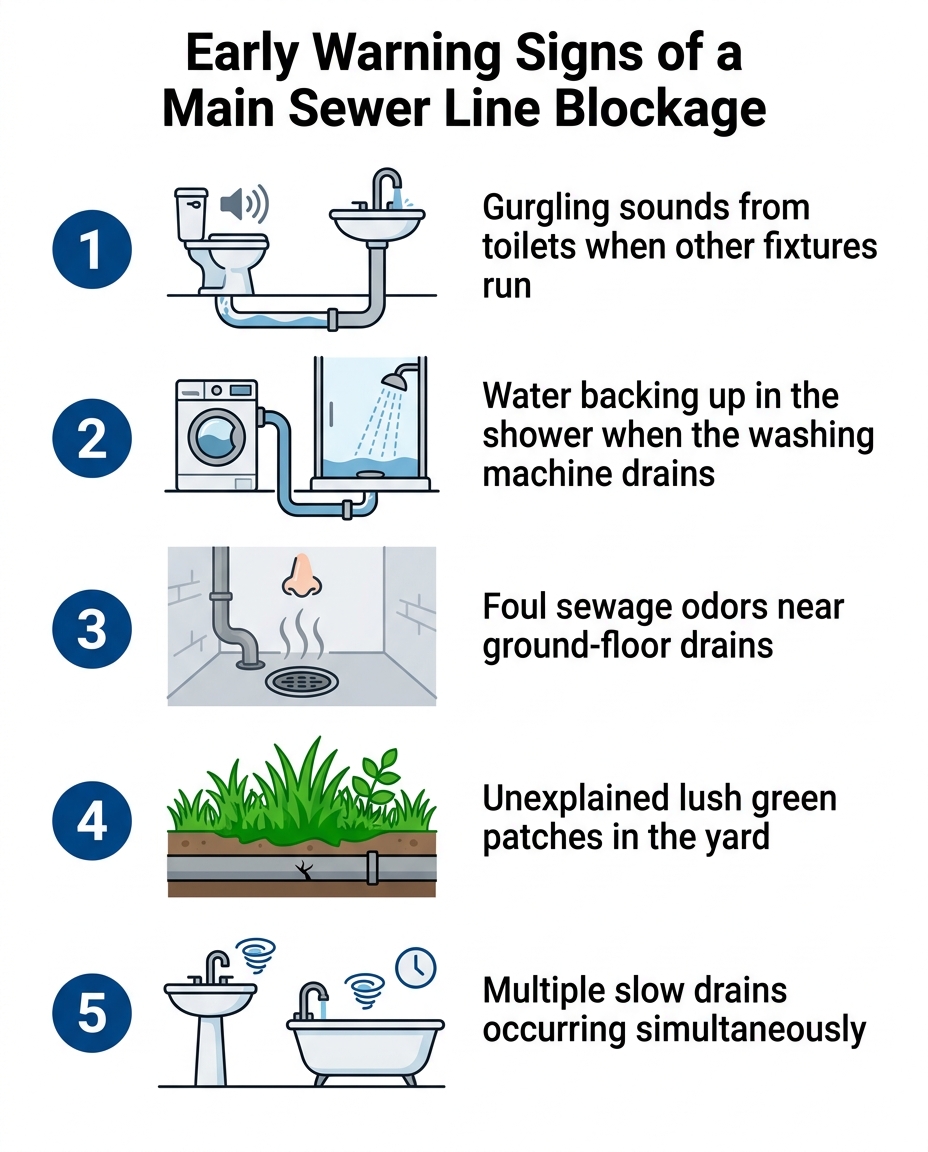
One of the earliest and most reliable indicators of a systemic plumbing issue is sound. Your drains should operate quietly. If you start hearing bubbling, sucking, or gurgling noises, your plumbing is trying to tell you that airflow is restricted.
The Problem: You hear a distinct gurgling sound coming from the toilet bowl, but nobody has flushed it recently. Alternatively, the toilet bubbles aggressively when you drain the bathroom sink.
The Cause: This happens because of trapped air. As wastewater travels down your pipes, it pushes air ahead of it. In a healthy system, this air escapes through the sewer line or the vent stacks on your roof. When there is a blockage in the main line, that air gets trapped. As water continues to flow down, it forces the trapped air backward. The air seeks the path of least resistance, which is usually the nearest water trap—most commonly your toilet bowl. The gurgling sound is literally air bubbling up through the water in the trap.
The Solution: Do not ignore these phantom sounds. If a toilet gurgles when a completely different fixture is running, the issue is systemic, not localized. While you might initially think you need a simple clogged toilet repair, our plumbers know these interconnected symptoms strongly suggest the restriction is much deeper in the main sewer line. Especially as we move into September and early fall, we often find these sounds are the very first indicator that tree roots or sediment have begun to choke off your main exit pipe.
Red Flag #2: Water Backing Up in Secondary Fixtures
While gurgling sounds indicate trapped air, physical water backups indicate a severe restriction of flow. This is the stage where the problem transitions from an auditory annoyance to a physical mess.
The classic symptom occurs when you run a high-volume appliance, like a washing machine. The washing machine forcefully pumps out dozens of gallons of water in a matter of minutes. If the main sewer line is partially blocked, it cannot handle this sudden surge of volume. The water hits the blockage, stops, and immediately begins filling the pipe backward. Because water always takes the path of least resistance, it will emerge from the lowest drains in your home—typically a basement floor drain, a ground-floor shower, or a bathtub.
Our team at HRI Plumbing recently helped a local homeowner who experienced this exact cascading issue during the late summer when their plumbing started backing up into the home. What began as a seemingly minor backup quickly revealed itself to our technicians as a major main line failure. We arrived, diagnosed the extensive damage underground, and ended up replacing a large portion of the sewer line (along with a water line that had been nicked during the initial digging). Our crew completed the entire job in less than a day, fully resolving the severe backup issue and getting the home's plumbing back online safely.
For many Jacksonville IL area homes, distinguishing between a clean water backup and a dirty water backup is crucial. If your sink backs up with relatively clean, soapy water, the blockage is likely in that specific sink's branch line. However, if your shower drain starts filling with dirty, foul-smelling water while the washing machine is running, you are looking at wastewater that has traveled back up from the main sewer line.
Red Flag #3: Foul Odors and Unexplained Yard Changes
Not all early warning signs happen inside the house. Because your main sewer line is buried in your yard, a breach or severe blockage often creates external symptoms. Paying attention to your landscaping and the air quality around your home can save you from a complete pipe collapse.
Raw sewage carries a distinct, highly unpleasant odor. If you start noticing a persistent smell of sulfur or raw sewage emanating from your ground-floor drains, your basement, or directly from your yard, it indicates a breach in the main line. A healthy plumbing system utilizes water traps and vent pipes to keep these sewer gases safely out of your living spaces. When a main line is blocked or broken, those gases are forced backward.
Beyond odors, your lawn can act as a visual indicator of underground trouble. If you notice unusually lush, bright green patches of grass in a specific area of your yard—especially if the rest of the lawn is dry—it is a strong sign of a leaking sewer pipe. Raw sewage acts as a highly effective, albeit unsanitary, underground fertilizer. The grass above a cracked pipe will absorb these nutrients and moisture, growing noticeably faster and thicker than the surrounding turf.
Furthermore, when Central Illinois experiences heavy seasonal rains, our experts frequently see the resulting soil shifts put immense stress on older underground pipes. This ground movement can open up pipe joints or exacerbate existing cracks. If water continuously leaks from a broken main line, it washes away the supporting soil around the pipe. Over time, this creates sinkholes or sudden, unexplained indentations in your yard, signaling that the pipe below has likely collapsed entirely. For Jacksonville IL area homes, monitoring the yard after heavy rainfalls is a smart preventative measure that we highly recommend.

The Seasonal Threat: Why Tree Roots Attack Sewer Lines in Early Fall
While a main line blockage can happen at any time, certain seasons carry a much higher risk. Tree roots are the leading cause of underground sewer line damage across the country, and their growth cycles heavily influence when blockages occur.
During the peak summer growing season, trees aggressively seek out moisture and nutrients to sustain their canopies, especially during periods of low rainfall. Underground sewer pipes are a perfect target. They contain a constant supply of water, oxygen, and nutrients. Even the smallest hairline fissure or slightly loose joint in an older pipe releases a tiny amount of moisture vapor into the surrounding soil. Tree roots are naturally drawn to this moisture gradient. They penetrate the tiny openings and continue to grow inside the pipe.
By September and early fall, this root intrusion reaches its maximum density before the tree enters winter dormancy. In our experience, a pipe that only had a few wispy roots in May can be completely choked by a thick, matted root ball by late September. This is exactly why our crews respond to so many sudden, severe blockages right as the seasons change.
It is important to understand the difference between temporarily clearing these roots and actually fixing the structural damage they cause. Running a heavy-duty auger through the pipe might chop away the roots and restore flow temporarily, but the roots will inevitably grow back through the same cracks. Addressing the root cause often requires evaluating traditional vs. trenchless sewer repair to permanently seal the pipe and prevent future intrusions.
Localized Clog vs. Main Line Blockage: Knowing the Difference
When you are staring at a sink that refuses to drain, deciding on the next step is crucial. Treating a main line blockage as if it were a simple localized clog is not just ineffective; it can actually cause further damage to your home's infrastructure.
Here is a straightforward comparison to help you determine which issue you are facing in your Jacksonville IL area home:
• Number of Affected Drains — Localized Clog (Branch Line): Only one fixture is slow or backing up. — Main Line Blockage (Trunk): Multiple drains, especially on the lowest floor, are affected.
• Fixture Interaction — Localized Clog (Branch Line): Running the sink does not affect the toilet. — Main Line Blockage (Trunk): Flushing a toilet causes water to rise in the shower.
• Water Quality — Localized Clog (Branch Line): Backed-up water is usually clean or soapy. — Main Line Blockage (Trunk): Backed-up water is dirty, foul-smelling, or contains sewage.
• Resolution Method — Localized Clog (Branch Line): Can often be resolved with standard drain cleaning in Jacksonville. — Main Line Blockage (Trunk): Requires heavy-duty professional equipment and inspection.
A vital warning regarding chemical drain cleaners from our licensed plumbers: If you suspect a main line issue, never pour liquid drain cleaners down your pipes. These harsh chemicals rely on exothermic reactions (heat) to melt through localized grease or hair clogs. They will not clear a massive tree root intrusion or a collapsed pipe. Instead, the highly corrosive chemicals will sit stagnant inside your compromised sewer line, eating away at older cast iron or warping PVC pipes, turning a repairable situation into a mandatory full-pipe replacement. Main line clearing requires licensed professional equipment and should never be attempted as a DIY project.
The Next Step: Why a Professional Camera Inspection is Crucial
If you have recognized one or more of these early warning signs during your September / early fall home maintenance checks, guessing at the cause is a risky gamble. The most effective way to transition from recognizing a problem to actually solving it is to schedule a professional sewer camera inspection.
At HRI Plumbing, our expertise in early diagnosis focuses on catching the issue now, saving you from catastrophic, costly sewage backups that destroy flooring and drywall. A camera inspection removes all the guesswork from the equation.
1. Visual Confirmation: A licensed technician feeds a high-resolution, fiber-optic camera attached to a flexible rod down into your main sewer line. This provides a real-time video feed of the pipe's interior.
2. Pinpointing the Exact Issue: The camera reveals exactly what is causing the restriction. The technician can see if it is a massive tree root ball, a "belly" (a sag in the pipe holding stagnant water), a buildup of grease and flushable wipes, or a structural collapse.
3. Locating the Damage: The camera equipment includes a transmitter that allows the technician to pinpoint the exact location and depth of the blockage from above ground. This means if a repair is needed, it can be targeted precisely, minimizing disruption to your yard or driveway.
By relying on concrete visual evidence, you can make an informed decision about the best course of action to protect your home's sanitation and infrastructure.
Frequently Asked Questions
How do you know if your main line is clogged?
The most definitive sign of a main line clog is multiple plumbing fixtures backing up simultaneously, particularly on the lowest level of your home. You will often hear gurgling sounds from toilets when other drains are used, or notice water pooling in the shower when the washing machine empties. Foul sewage odors inside the home or out in the yard are also strong indicators that the main exit pipe is blocked.
Why does my toilet gurgle when the washing machine drains?
Your toilet gurgles because trapped air is being forced backward through your plumbing system. When the washing machine pumps a high volume of water into a partially blocked main line, the water and air cannot escape fast enough. The trapped air seeks the path of least resistance, which is usually the water trap inside your toilet bowl, causing the bubbling sound.
Can a main sewer line unclog itself?
No, a main sewer line will not unclog itself. Blockages in the main line are typically caused by structural issues like tree root intrusion, pipe bellies, or heavy sediment buildup, none of which will wash away on their own. Ignoring the problem will only allow the blockage to worsen until a complete sewage backup occurs.
What are the signs of a collapsed sewer line?
A collapsed sewer line shares many symptoms with a severe clog, including frequent backups and foul odors, but it also presents unique external signs. You may notice sudden sinkholes or indentations in your lawn where the soil has washed into the broken pipe. Unusually lush, green patches of grass directly above the sewer line path are also common indicators of a structural failure.
How quickly can tree roots block a sewer pipe?
Tree roots can grow surprisingly fast once they find a water source inside a sewer pipe, often causing significant blockages within just a few months. During the peak summer growing season, roots aggressively seek out moisture, entering through tiny hairline cracks. By early fall, those small roots can expand into a dense, matted ball that completely chokes off the flow of wastewater.
Catching a main sewer line issue early is the absolute best way to protect your home from a messy, stressful plumbing disaster. If your fixtures are gurgling or drains are slowing down simultaneously, do not wait for a complete backup. A clear explanation of your system's health and a professional camera inspection will give you the precise answers you need to resolve the issue safely and effectively.


