


Are You Tired of Standing in Water Every Morning?
Are you constantly battling a rising tide of dirty water around your ankles during your morning shower? If you are searching for answers and wondering exactly how upgrading your drain cover prevents chronic bathtub hair clogs, you are far from alone. Here at HRI Plumbing, we hear this complaint constantly. For many homeowners, a slow-draining tub is a daily nuisance that only gets worse as the year progresses. This frustration often reaches its absolute peak during the condensed schedule of the August back-to-school morning rush. When multiple family members need to shower back-to-back within a tight one-hour window, a partially blocked drain simply cannot keep up with the water volume, leaving the last person standing in a soapy, unhygienic puddle.
Most people immediately assume the problem is their shedding hair or their choice of thick, moisturizing shampoo. However, our team typically sees that the root cause is rarely just the hair itself—it is usually a fundamental mechanical failure of the existing drain setup. Standard builder-grade fixtures are simply not designed to handle the daily debris of a busy household. Recognizing this mechanical flaw is the first step toward a permanent solution. When DIY methods fail to keep the water flowing, relying on our professional plumbing services for thorough drain cleaning is the most effective way to restore your system and prepare it for a preventative upgrade.
The True Culprit: Why Does My Tub Keep Clogging?
When our Jacksonville customers ask us, "why does my tub keep clogging?" they are usually looking for a chemical fix to what is actually a structural design flaw. To truly understand why your bathtub drain keeps clogging after every shower, you have to look closely at the hardware installed at the bottom of the tub.
The Flaw in Builder-Grade Cross-Bar Drains
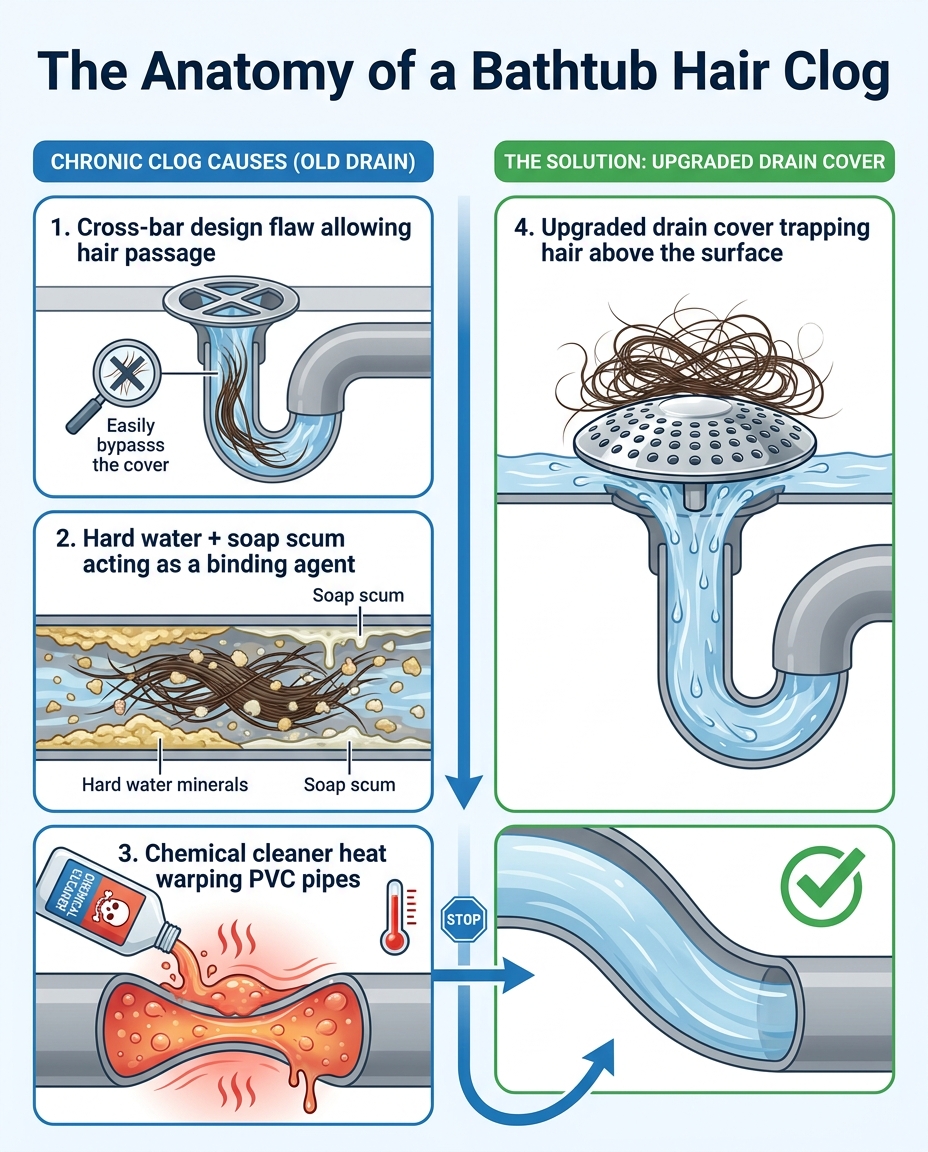
Our plumbers often find that the vast majority of bathtubs are installed with standard cross-bar drain covers. If you look down into your tub, you will likely see a metal ring with an "X" or a simple grid pattern built into the metal. These builder-grade covers are designed primarily to stop large objects—like a dropped shampoo bottle cap or a child's bath toy—from falling into the plumbing. They are absolutely not designed to catch human hair.
Because the gaps between the metal bars are so wide, long strands of hair easily slip past the surface level. As the water rushes down the drain, it creates a swirling vortex. This motion catches the long strands of hair and wraps them tightly around the underside of the metal cross-bars.
The Creation of a Debris Net
Once a few strands of hair are anchored to the cross-bars beneath the surface, they act like a lasso for everything else flowing down the drain. More hair, lint from washcloths, and dead skin cells get caught in this makeshift net. What starts as a minor accumulation quickly snowballs. Because this net forms just inches below the tub surface—right above the curved pipe known as the P-trap—it chokes off the water flow almost instantly. This design flaw turns a perfectly normal amount of shedding hair into a solid, impenetrable blockage.

How Hard Water Accelerates Bathtub Drain Blockages
The mechanical failure of the drain cover is only half of the equation. In our years of clearing drains across Jacksonville IL, we've seen firsthand how local water quality plays a massive role in how quickly a clog forms and how stubborn it becomes. The local water supply contains high concentrations of dissolved minerals, specifically calcium and magnesium. This is commonly referred to as hard water, and it has a direct, negative impact on your home's plumbing infrastructure.
The Chemistry of Soap Scum
When hard water mixes with the fatty acids found in everyday bar soaps, body washes, and shampoos, a chemical reaction occurs. Instead of lathering cleanly and rinsing away, the minerals bind with the soap to form an insoluble, sticky residue known as soap scum. In Central Illinois, water hardness levels significantly increase the likelihood of rapid, sticky soap scum buildup inside bathtub drain pipes.
The Glue That Binds the Clog
Soap scum doesn't just leave a chalky ring around your bathtub; it also coats the entire interior lining of your drain pipes. This sticky layer acts exactly like glue. When loose hair slips past the faulty cross-bar drain, it doesn't just float harmlessly away. It gets stuck to the soap scum lining the walls of the P-trap. Over time, alternating layers of sticky soap scum and tangled hair create a dense, cement-like blockage that makes clearing a clogged drain much more difficult than in soft-water regions. The combination of a failed cross-bar drain and local hard water creates the perfect storm for chronic, recurring clogs.
The Hidden Dangers of Chemical Drain Cleaners
When faced with a tub that won't drain, many homeowners instinctively reach for a brightly colored bottle of liquid drain cleaner from the local hardware store. While the marketing promises an instant fix, the reality is that these harsh chemicals are often more dangerous to your plumbing than the clog itself.
Just last fall, our team at HRI Plumbing received a frantic call from a homeowner with a persistent plumbing need after pouring multiple bottles of liquid cleaner down their tub. One of our technicians provided a helpful, straightforward, and honest assessment of the situation: the chemicals had not cleared the dense hair blockage, but they had started to compromise the integrity of the pipe fittings. As advocates for permanent, mechanical plumbing solutions over pipe-damaging chemical cleaners, we want you to understand exactly what happens when you pour these liquids down the drain.
• Mechanism of Action — Liquid Chemical Cleaners: Uses sodium hydroxide or sulfuric acid to generate intense heat and dissolve organic matter. — Mechanical Solutions (Snaking & Upgrades): Physically extracts the blockage and traps future debris above the drain line.
• Pipe Safety — Liquid Chemical Cleaners: High risk. The exothermic reaction can warp modern PVC pipes and severely corrode older metal plumbing. — Mechanical Solutions (Snaking & Upgrades): Completely safe. Restores the pipe to its original diameter without heat or corrosive action.
• Effectiveness — Liquid Chemical Cleaners: Often only burns a small, temporary hole through the center of the clog. — Mechanical Solutions (Snaking & Upgrades): Removes 100% of the bound hair and soap scum matrix.
• Long-Term Results — Liquid Chemical Cleaners: Clogs quickly return as hair catches on the remaining debris. — Mechanical Solutions (Snaking & Upgrades): Provides a permanent reset, allowing upgraded covers to do their job.
The Exothermic Threat
Chemical drain cleaners rely on an exothermic reaction—meaning they generate intense heat as they interact with the water and the clog. If the clog is particularly dense (thanks to hard water soap scum), the chemical sits in the pipe, boiling against the blockage. This trapped heat can actually warp and melt modern PVC piping, leading to catastrophic leaks behind your walls or under your floors. In older homes with cast iron or copper pipes, the acids rapidly accelerate corrosion, eating away at the metal from the inside out.
Why Upgrading Your Drain Cover is the Ultimate Preventative Fix
If standard builder-grade drains fail to catch hair, and chemical cleaners are dangerous to your pipes, the most logical solution is a mechanical upgrade. We regularly advise our clients that upgrading to an aftermarket hair-catching drain cover fundamentally changes how your drain operates. By addressing the problem at the surface level, you can permanently stop the cycle of clogs, ensuring that your plumbing flows freely even during the heavy usage of the August back-to-school morning rush.
1. Physical Interception Above the Drain Line: Upgraded covers, such as mushroom-style inserts or fine stainless-steel mesh baskets, sit either inside the drain opening or directly over it. Unlike cross-bars, these devices feature tiny perforations that allow water to pass through while physically trapping every single strand of hair above the surface.
2. Protecting the P-Trap: Because the hair is caught before it ever enters the pipe, it never has the chance to tangle with the sticky soap scum hiding in the P-trap. This protects the vulnerable curves of your plumbing infrastructure from accumulating debris.
3. Easy, Chemical-Free Maintenance: Maintaining an upgraded drain cover requires zero special tools or harsh chemicals. You simply pull the mushroom insert out or lift the mesh basket, wipe the accumulated hair off with a piece of tissue, and drop it in the trash.
4. Restoring Maximum Water Flow: By keeping the internal pipes completely clear of hair nets, water can flow at maximum capacity. This means no more standing in ankle-deep water, even during the longest showers.
This simple mechanical upgrade is the most cost-effective and permanent way to protect your home's plumbing from the daily onslaught of hair and soap scum.
When a New Cover Isn't Enough: The Role of Professional Snaking
While upgrading your drain cover is the ultimate preventative measure, it is important to understand its limitations. If your tub is already draining slowly, simply dropping a new mesh basket over the drain will not fix the problem. The new cover will catch tomorrow's hair, but it cannot reach the dense, cement-like blockage of hair and hard water soap scum already compacted inside your P-trap.
Recently, one of our local customers called HRI Plumbing requesting same-day service for a stubborn sink problem that shared a drain line with their tub. Our technician arrived quickly, explained the exact problem—a deep, compacted clog that had bypassed the surface fixtures—and fully resolved the issue using professional extraction tools. For deep clogs like this, professional intervention is mandatory.
The Power of the Professional Auger
Professional drain snaking is required to physically extract bound hair and soap scum from the depths of the plumbing system. Unlike flimsy plastic DIY zip-tools that can easily snap off inside the pipe, a professional motorized auger features a durable cable and a specialized cutting head. As the cable is fed into the drain, it breaks apart the sticky soap scum matrix and physically hooks the tangled hair.
By relying on our drain snaking services in Jacksonville IL, you ensure that the pipe is restored to its original, factory-clean diameter without the use of corrosive chemicals. Once our professional has completely cleared the existing blockage, your plumbing is given a clean slate. This is the perfect time to install your upgraded drain cover, ensuring that the freshly cleared pipe stays clear for years to come.
Frequently Asked Questions About Bathtub Clogs
Why does my tub keep clogging?
If you find yourself constantly asking, "why does my tub keep clogging?" the answer usually lies in the design of your drain. As we see in many local homes, standard cross-bar drains fail to catch long hair, allowing it to slip past and wrap around the internal metal bars. Once inside, the hair binds with sticky soap scum in the P-trap, creating a dense, recurring blockage.
How do I stop hair from clogging my bathtub drain?
The most effective way to stop hair from entering your plumbing is to mechanically trap it at the surface. At HRI Plumbing, we highly recommend upgrading to a mushroom-style insert or a fine mesh hair catcher. To keep the water flowing perfectly, advise everyone in the household to perform regular physical cleaning of the catcher after every few showers.
Are chemical drain cleaners bad for plumbing?
Yes, liquid chemical drain cleaners are notoriously bad for plumbing infrastructure. They rely on harsh acids that generate intense exothermic heat, which can warp modern PVC pipes and severely corrode older metal plumbing systems over time. Furthermore, they usually only offer temporary relief by burning a small hole through the clog rather than removing it entirely.
Do bathtub drain hair catchers actually work?
Yes, when properly installed and maintained, aftermarket hair catchers are incredibly effective. They act as a physical barrier, trapping hair and large debris safely above the drain line. They are highly effective mechanical solutions that prevent debris from ever reaching the vulnerable curves of your P-trap.
How often should I clean my bathtub drain cover?
For optimal performance, you should wipe down your bathtub drain cover after every few showers, or as soon as you notice water starting to pool around the drain. Routine mechanical maintenance takes only seconds and completely prevents the massive buildup that leads to deep pipe clogs.
Stop the Morning Shower Floods Today
You do not have to tolerate a flooded tub and dirty water around your ankles every time you step in to wash up. Whether you are dealing with the daily grind or trying to survive the chaotic August back-to-school morning rush, a reliably draining bathtub is a basic necessity, not a luxury. If your tub is already struggling to drain, do not risk your pipes with harsh chemical liquids. Reach out to our team at HRI Plumbing to safely and professionally clear the existing deep clogs from your system. Schedule a thorough drain clearing service today, and give your home the clean slate it needs for a permanent drain cover upgrade.


