


The Real Cost of Hot Water: Tankless vs. Traditional Tank Heaters

Do tankless water heaters save money over time? Yes — but how much you save depends on your household size, fuel type, how long you stay in your home, and whether your home needs upgrades to support the new system.
Here's a quick summary:
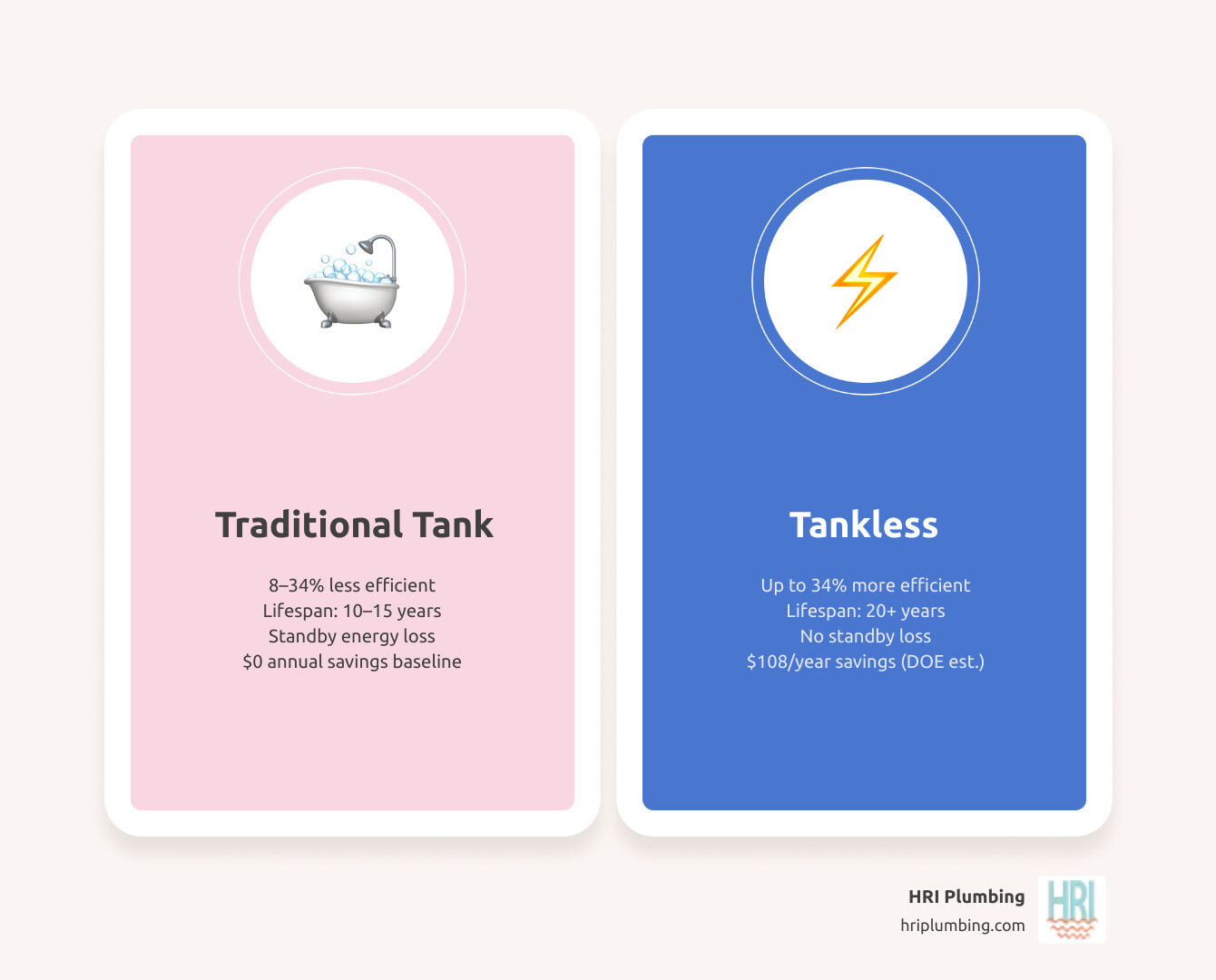
- Energy savings: Tankless units are 8–34% more energy efficient than traditional tanks, depending on daily hot water usage
- Annual savings: The U.S. Department of Energy estimates gas tankless heaters save an average of $108 per year over traditional tank models
- Lifespan advantage: Tankless units last 20+ years; traditional tanks last 10–15 years, meaning you may replace a tank twice before a tankless unit needs replacing
- Payback period: Typically 6–27 years depending on fuel type, installation complexity, and usage
- Bottom line: For most households that plan to stay in their home long-term, tankless water heaters do save money — but the full picture requires looking beyond just the energy bill
For homeowners in central Illinois, where cold groundwater temperatures and hard water are real factors, making the right call between tankless and traditional means doing the math carefully before you commit.
Water heating is the second largest energy expense in most American homes. That means even modest efficiency gains add up over a decade or two. But the upfront investment and installation requirements for tankless systems can catch homeowners off guard — and that's where many people get burned.
This guide breaks down the actual numbers, the real-world variables, and the honest trade-offs so you can make a confident decision.
Do Tankless Water Heaters Save Money Over Time?
The answer to whether do tankless water heaters save money over time is a resounding yes, provided you look at the total cost of ownership over 20 years. The primary reason these systems win the marathon is the elimination of "standby loss."
Traditional water heaters act like giant thermoses, heating 40 to 80 gallons of water and reheating it when the temperature drops—even if you are at work or asleep. Tankless models, often called "demand-type" heaters, only fire up when you turn on a tap.
Modern "condensing" models use a second heat exchanger to capture heat from exhaust gases that would otherwise be wasted. This technology allows them to achieve incredibly high Uniform Energy Factor (UEF) ratings, often 0.95 or higher, compared to the 0.60 to 0.70 ratings typical of standard tank models. In Springfield, IL, tankless water heater installations often favor these condensing models because they use cheaper venting materials like PVC, which helps offset some of the initial setup costs.
Annual Energy Savings and Efficiency Gains
The annual "operating expense" is where you see the first signs of a return on your investment. According to the U.S. Department of Energy, for homes that use about 41 gallons of hot water daily, tankless units can be 24% to 34% more energy efficient than conventional tanks. Even in high-demand homes using around 86 gallons a day, you can still expect 8% to 14% better efficiency.
Fuel type plays a massive role here:
- Natural Gas: These are the heavy hitters. A family of four switching to an ENERGY STAR certified gas tankless model can save roughly $95 per year on gas bills. Over the unit's lifetime, that totals about $1,800 in raw energy savings.
- Electric Models: While electric tankless units are nearly 99% efficient at the point of use, they don't always offer the same dramatic "bill drop" as gas models because electricity is often more expensive per unit of energy. They save an average of $44 per year.
- Ignition Systems: Modern tankless units use intermittent ignition devices (IID) rather than a standing pilot light. This prevents the constant "trickle" of gas waste that older tank models (and some older tankless versions) struggled with.
If you are looking for a tankless water heater in Jacksonville, IL, choosing a unit with a high UEF is the most direct way to ensure those monthly utility bills stay as low as possible.
How Household Size Impacts if Tankless Water Heaters Save Money Over Time
Size matters, but perhaps not in the way you think. In a very small household (1–2 people), the energy savings are consistent but the "payback" takes longer because the total volume of water heated is lower. Conversely, in a large family with high daily demand, the efficiency gap narrows slightly, but the convenience of endless hot water becomes the primary "value."
In central Illinois, we also have to account for groundwater temperature. In the winter, our water comes into the house much colder than it does in Florida. A tankless unit has to work harder to raise that water from 40°F to 120°F than it does in the summer. This can affect the "flow rate" (gallons per minute). If you have three teenagers all trying to shower at once while the dishwasher is running, a single tankless unit might struggle.
For larger homes in Rushville, IL, a tankless water heater might need to be a high-output model or even a dual-unit setup to ensure you don't experience the "cold water sandwich"—that brief blast of cold water that happens if the unit is cycled on and off too quickly.
Maximizing Lifespan to Ensure Tankless Water Heaters Save Money Over Time
The "secret sauce" to the tankless financial argument is longevity. A traditional tank is under constant stress from water pressure and heat, and its steel walls eventually corrode. Most tanks last 10 to 15 years. Tankless units are designed with replaceable parts and usually feature copper or stainless steel heat exchangers that are highly resistant to corrosion.
Most tankless heaters have a life expectancy of 20 years or more. When you calculate the 20-year cost of ownership, you have to include the fact that a "tank" homeowner will likely have to buy and install a second water heater around year 12. A tankless owner is still using their original unit.
Proper maintenance of a tankless water heater is the only way to reach that 20-year milestone, especially in areas with mineral-heavy water.
Factors That Influence Your Total Ownership Costs
To give you an honest comparison, we have to look at the "hidden" costs. If you are building a new home, tankless is a no-brainer because the venting and gas lines are designed for it from day one. In a retrofit situation, the math changes.
| Feature | Traditional Tank | Tankless (On-Demand) |
|---|---|---|
| Average Lifespan | 10–15 Years | 20+ Years |
| Energy Efficiency | 60%–70% (Gas) | 80%–99% |
| Hot Water Supply | Limited to Tank Size | Endless (within flow limits) |
| Space Required | 9–12 Square Feet | Small Wall Mount |
| Maintenance | Low (Flush/Anode Rod) | Moderate (Annual Descale) |
One of the biggest variables is installation complexity. Gas tankless units often require a larger gas line (sometimes 3/4 inch instead of the standard 1/2 inch) to provide enough fuel for that "instant" burst of heat. They also require specialized Category III stainless steel venting or, in the case of condensing models, specific PVC venting.
Electric models aren't "easier" either; they often require significant electrical panel upgrades. A whole-house electric tankless unit can demand 120 to 200 amps just for itself! Understanding the benefits and limitations of using a tankless water heater before you buy can save you from a "sticker shock" installation bill.
Maintenance Requirements and Water Quality
In central Illinois, we deal with hard water. Minerals like calcium and magnesium love to hitch a ride in our water supply, and when that water is heated, those minerals solidify as "scale." In a tank, scale just sits at the bottom. In a tankless unit, scale builds up inside the narrow passages of the heat exchanger.
If you don't perform an annual "flush" or descaling, the unit has to work harder, its efficiency drops, and eventually, the heat exchanger can fail. We recommend:
- Annual Descaling: Flushing the system with a food-grade vinegar solution to dissolve mineral buildup.
- Inlet Filter Cleaning: Checking the screen that catches sediment before it enters the heater.
- Water Softeners: If your water is particularly hard, a water softener can double the life of your tankless unit.
For our neighbors in the area, following tankless water heater repair tips for Jacksonville, IL can help you avoid a mid-winter breakdown and keep your efficiency at peak levels.
Incentives, Tax Credits, and Rebates
This is the "fast track" to a shorter payback period. Because tankless units are so much more efficient, they often qualify for federal tax credits and local utility rebates.
As of 2026, qualifying ENERGY STAR certified gas tankless models (those with a UEF of 0.95 or higher) can qualify for federal tax credits of up to $600. Some heat pump water heaters can even qualify for up to $2,000. When you factor in these credits, the "payback period"—the time it takes for the energy savings to cover the extra upfront cost—can drop by several years.
We've seen that tankless water heaters can help lower utility costs significantly when these financial "boosters" are applied. Always check with your local utility provider in Springfield or Jacksonville to see if they offer additional "instant" rebates for switching to high-efficiency equipment.
Conclusion and Final Verdict
So, do tankless water heaters save money over time?
If you plan to stay in your home for at least 10 to 15 years, the answer is a clear yes. You will save on your monthly energy bills, you will avoid the cost of a mid-cycle tank replacement, and you will gain the non-financial benefits of endless hot water and reclaimed floor space.
Tankless units are also a great way to free up storage space in small Illinois basements or utility closets. However, if you are planning to sell your home in the next two years, the high upfront cost might not be fully recouped through energy savings alone, though it may increase your home's "green" appeal to buyers.
At HRI Plumbing, we believe in honesty and integrity. We don't want you to buy a system that doesn't fit your life. If you have a massive family with six people needing showers at the same time, we might suggest a high-efficiency tank or a multi-unit tankless setup. If you’re a couple looking to lower your carbon footprint and enjoy a long, relaxing soak in the tub without the water going cold, tankless is your best friend.
Whether you need a water heater repair or replacement, our team is here to help you do the math for your specific home in Jacksonville, Springfield, or Rushville. We offer 24/7 support and flexible options to ensure you never have to suffer through a cold shower again. Give us a call, and let’s find the system that actually puts money back in your pocket.


