



The 600-Gallon Problem: When Autumn Rains Meet Falling Leaves
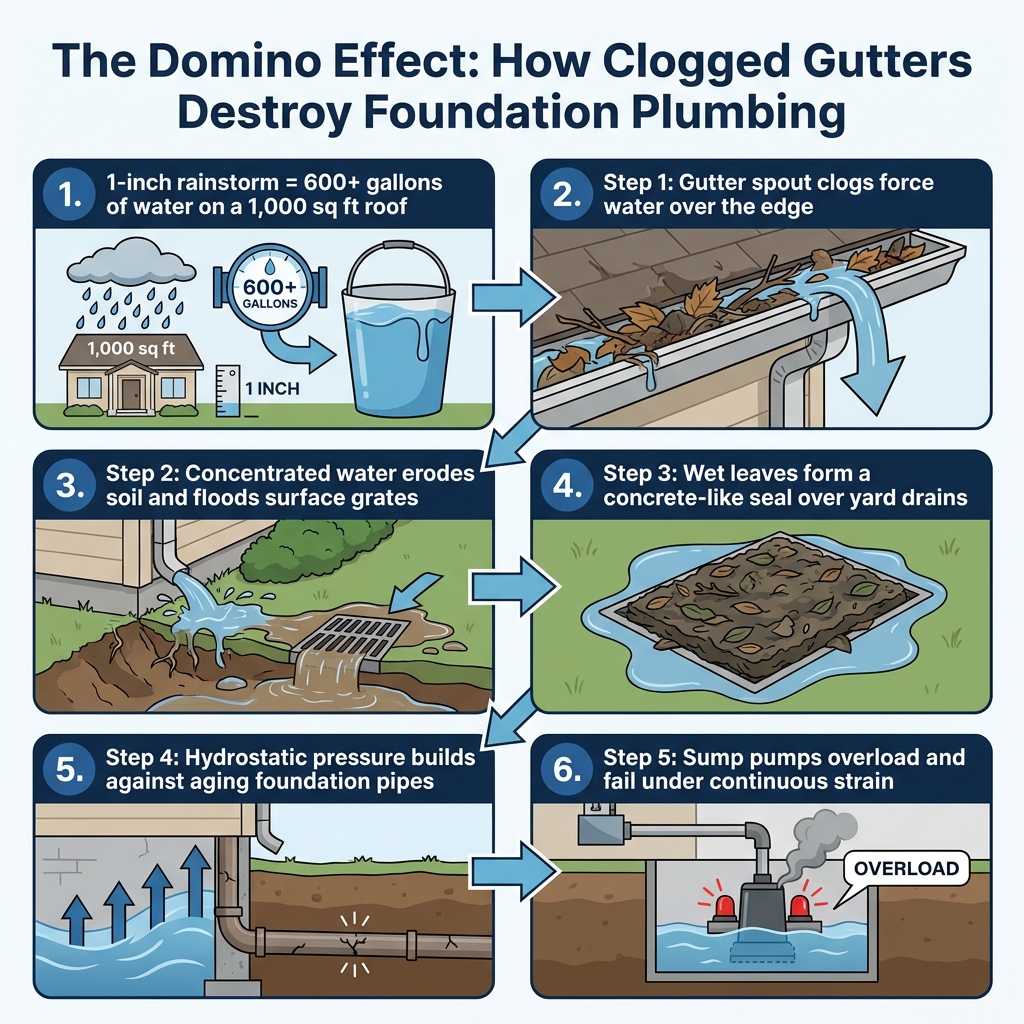
A single 1-inch rainstorm on a 1,000-square-foot roof produces over 600 gallons of water. That is roughly the equivalent of emptying fifteen standard bathtubs directly against your home's foundation in a matter of hours. When you consider how falling leaves wreak havoc on exterior drains and gutter spouts, that massive volume of water suddenly has nowhere to go. During September and early fall, homeowners face a critical decision point: proactively inspect and clear these exterior systems now, or risk severe water intrusion when the heavy autumn rains arrive.
Exterior drainage systems are engineered with a specific flow rate in mind. They rely on gravity and clear pathways to safely channel hundreds of gallons of water away from your foundation walls. However, these systems fail catastrophically when choked by organic debris. A gutter system operating at only 50% capacity due to leaf buildup will quickly overflow, dumping concentrated sheets of water directly onto the soil below. If you want to protect your property, our team at HRI Plumbing highly recommends scheduling professional drain cleaning in Jacksonville during the early fall window as the most effective way to ensure your underground pipes are ready for the seasonal shift.
The threat is not just about overflowing gutters; it is about where that water ends up. When surface systems fail, the burden shifts entirely to your underground plumbing infrastructure. By understanding the sheer volume of water your home must manage during a typical September storm, you can appreciate why keeping these pathways clear is a structural necessity, not just a landscaping chore.
The Domino Effect: From Blocked Gutter Spouts to Ground-Level Failures
A plumbing failure at the roofline rarely stays at the roofline. In our years of servicing older Jacksonville neighborhoods with mature trees, a pattern we see often is that the sheer volume of debris dropped in a short window creates a rapid chain reaction. What begins as a minor blockage in a downspout quickly escalates into a severe threat to your home's entire drainage infrastructure.
1. The Initial Gutter Spout Blockage: Leaves accumulate at the narrowest point of the gutter system—the downspout opening. As rain falls, it compacts the leaves into a dense plug, entirely blocking the primary exit route for roof runoff.
2. The Concentrated Cascade: With the downspout blocked, water seeks the path of least resistance. It spills over the edges of the gutter, falling in a concentrated, heavy sheet directly onto the ground below, rather than being safely dispersed.
3. Soil Erosion and Surface Flooding: This concentrated waterfall hits the ground with significant force, eroding the topsoil and immediately overwhelming the surface-level yard drains positioned near the foundation.
4. The Impenetrable Seal: The falling water carries wet leaves and sediment directly onto the grates of your surface drains. The weight of the water presses the wet foliage flat against the grate, creating an airtight, impenetrable seal that prevents any surface water from entering the underground pipes.

The Anatomy of a Gutter Spout Clog
Understanding why downspouts fail requires looking at the composition of the debris. It is rarely just dry leaves. Twigs, pine needles, roofing granules, and airborne dust settle into the gutters over the summer. When the first early season rains arrive, this mixture binds together. The water acts as an adhesive, turning loose foliage into a dense, heavy mat. Because the opening to a downspout is relatively small, it only takes a handful of this compacted debris to bridge the gap and block the flow completely. Once that initial bridge forms, every subsequent leaf that washes down the gutter reinforces the clog.
Surface Drain Suffocation
Standard yard drain grates are designed to filter out large debris while allowing water to pass through freely. However, they are easily defeated by wet foliage. A broad, wet maple or oak leaf can perfectly cover a section of a standard grate. When dozens of these leaves wash over the drain simultaneously, they overlap like shingles on a roof. The immediate consequence is severe surface pooling near the foundation. As part of our comprehensive plumbing services, our technicians specifically look for this exact vulnerability, knowing that once the surface grate is suffocated, the water will inevitably find its way into the home's basement or crawlspace.
How Wet Debris Chokes Surface and Yard Drains
The biology of a yard drain clog is surprisingly complex. When leaves fall into damp environments, they immediately begin to break down. Early autumn rains in Illinois combine with wet leaf debris to create a specific type of organic sludge that is highly dangerous to exterior plumbing. This isn't just a pile of dry leaves; it is a dense, heavy, concrete-like material that settles deep into the horizontal runs of your yard drain pipes before winter freezes have a chance to lock it in place.
The decomposition process releases tannins and breaks down the cellular structure of the leaves. When this organic matter mixes with the natural clay and soil washing off your yard, it forms a thick, sticky mud. This sludge is heavy enough that normal water flow cannot flush it out. Instead, it sinks to the bottom of your underground corrugated or PVC drainage pipes. Over the course of September and early fall, this layer of sludge grows thicker, drastically reducing the internal diameter of the pipe and slowing the flow of water to a trickle.
The danger of DIY clearing methods becomes apparent once this sludge has formed deep within the pipe. Many homeowners attempt to clear their yard drains by shoving a garden hose into the pipe and turning it on full blast. Unfortunately, this usually just pushes the dense clog further down the line, compacting it into an even tighter mass at an elbow joint or transition point. When the pipe is completely blocked, the risk to the home skyrockets. In fact, our team frequently responds to flooded basements caused by this exact issue, aligning with historical data showing water damage as the second most frequent homeowner insurance claim.
Professional intervention is required when organic sludge hardens inside the line. If you notice water bubbling back up out of your yard drains during a rainstorm, the blockage has already bypassed the surface grate. At this stage, professional clogged drain repair is necessary to physically break apart the organic mass and extract it from the system safely, ensuring the pipe is restored to its full capacity before the freeze cycle begins.
The Hidden Threat to Perimeter Foundation Plumbing
The concrete problem of overwhelmed surface drains directly threatens the most critical plumbing system your home has: the perimeter foundation drainage. Often referred to as drainage tiles or French drains, these underground pipes are installed alongside the footer of your foundation. Their job is to collect subsurface groundwater and channel it away from the basement walls. They are the unsung heroes of a dry home, but they are highly vulnerable to the downstream effects of clogged gutters and yard drains.
The cause of the failure stems from excess water and fine organic sediment. When surface drains are blocked by leaves, hundreds of gallons of water pool against the side of the house. This water eventually seeps down through the soil, carrying microscopic dirt and decomposed leaf particles with it. This muddy mixture infiltrates the perforated holes of the foundation drainage tiles. Over time, the fine sediment settles inside the tiles, clogging the system from the inside out. We see this vulnerability especially prevalent in older Jacksonville neighborhoods with mature trees, where aging clay or corrugated plastic drainage tiles may already be brittle or partially crushed.
The solution requires specialized knowledge. Protecting this infrastructure demands deep local knowledge of Jacksonville's mature neighborhoods and the specific expertise required to protect older regional plumbing infrastructure from these environmental stressors. When perimeter drains fail, the results are immediate and severe. One of our local customers experienced this firsthand during a massive fall storm. After their exterior drainage failed, water breached the foundation, resulting in a flooded basement. We dispatched an HRI Plumbing technician to the property within two hours, identified the overwhelmed perimeter drain as the root cause, and resolved the flooding before further structural damage occurred.
Understanding Hydrostatic Pressure
To truly grasp why foundation plumbing fails, you must understand hydrostatic pressure. When standing water pools around a foundation because surface drains are clogged, it dramatically increases the weight and pressure against the basement walls. Think of it like trying to push an inflated beach ball underwater; the deeper you push, the harder the water pushes back. The soil becomes entirely saturated, and thousands of pounds of water pressure press against the concrete block or poured walls.
Water is relentless and will always seek the path of least resistance. If the perimeter drainage tiles are clogged with leaf sediment, they cannot relieve this pressure. The water will then force its way through microscopic cracks in the foundation, through the cove joint (where the wall meets the floor), or directly up through the concrete slab. Homeowners often wonder about the differences between professional drain service vs. using chemical cleaners in these situations. The reality is that chemical cleaners are completely useless against hydrostatic pressure and organic mud, and pouring harsh chemicals into aging foundation pipes can actually eat away at the materials, causing irreversible structural damage.
Sump Pump Overload: When Underground Systems Fail
The final line of defense for your home's lower levels is the sump pump. When the perimeter plumbing is overwhelmed by the sheer volume of water cascading from clogged gutters, the sump pump is forced to work overtime. It is designed to manage normal groundwater seepage, not the entire runoff from a 1,000-square-foot roof that has been improperly dumped at the foundation line.
The mechanics of the overload are straightforward but destructive. Clogged yard drains force the sump pump to run continuously. Instead of cycling on every few hours during a storm, the pump may run non-stop for days to manage the excess water volume. This continuous operation generates immense heat within the pump's motor, dramatically shortening its lifespan and increasing the risk of a sudden motor burnout right in the middle of a heavy autumn storm.
The threat of sediment damage is equally severe. When wet leaves and mud infiltrate the perimeter drains, that sediment eventually washes into the sump pit. The sump pump is designed to pump clear water, not organic sludge. When leaf debris and mud enter the pit, they can easily get sucked into the pump's intake screen. This physically jams the impeller, stopping the pump dead in its tracks. Furthermore, floating organic debris can wedge against the mechanical float switch, either pinning it in the "on" position (causing the pump to run dry and burn out) or pinning it in the "off" position (allowing the basement to flood).
The consequences of ignoring the system are entirely avoidable. The strain on these systems doesn't just happen in autumn. For example, one of our customers reached out during the spring rains when their sump pump completely broke down after months of fighting sediment buildup. Our team provided a rapid response, diagnosed the burnt-out motor, and set them up with a reliable new unit. However, the best way to avoid this emergency is through proactive maintenance. If your pump is constantly running or making strange grinding noises, scheduling sump pump repair and replacement before the major storms hit is crucial for protecting your basement. In older Jacksonville neighborhoods with mature trees, this system is the only thing standing between a dry basement and thousands of dollars in water damage.
Proactive Protection: Why Early Fall is the Critical Maintenance Window
The timing of your maintenance dictates its effectiveness. Waiting until all the leaves have fallen from the trees in late November is simply too late. By that point, the heavy autumn rains have already pushed the early leaf drop deep into your exterior plumbing systems. September and early fall represent the critical preparation window. Acting now ensures that your surface grates, downspouts, and underground pipes are clear and ready to handle the peak volume of water and debris that follows.
Safe homeowner tasks are an important part of this seasonal preparation. Homeowners should regularly walk the perimeter of their property to inspect surface grates. Using a rake or gloved hands to clear dry leaves away from yard drain covers is highly encouraged. Ensuring that downspout extensions are properly attached and pointing away from the foundation is another safe, effective step you can take on your own.
• Clearing dry leaves from surface grates — Safe for Homeowners?: Yes — Why?: Prevents the initial surface seal and keeps water flowing into the basin.
• Checking downspout extension connections — Safe for Homeowners?: Yes — Why?: Ensures water is directed at least 4-6 feet away from the foundation wall.
• Snaking underground perimeter drains — Safe for Homeowners?: No — Why?: Standard augers can easily punch holes through aging, brittle corrugated pipes.
• Hydro-jetting foundation tiles — Safe for Homeowners?: No — Why?: Requires calibrated pressure; too much pressure will destroy historic plumbing.
• Camera inspection of yard drains — Safe for Homeowners?: No — Why?: Requires specialized fiber-optic equipment to locate exact pipe bellies or root intrusions.
Strict boundaries on DIY plumbing must be observed when dealing with underground systems. Under no circumstances should a homeowner attempt to snake or hydro-jet underground perimeter drains or foundation tiles. These pipes are often made of thin corrugated plastic or aging clay. An improper DIY snaking attempt can easily tear a hole straight through the side of the pipe, dumping water directly against the foundation and requiring a massive excavation project to repair.
The value of professional camera inspections cannot be overstated. Before the ground freezes, our experienced plumbers at HRI Plumbing can run a high-resolution fiber-optic camera down into your exterior drains. This allows us to see exactly what is happening underground. We can identify partial blockages, locate areas where the pipe has bellied (sagged) and is holding water, and verify the overall integrity of the aging pipes. Finding a crushed pipe in September allows for a controlled repair; finding it during a freezing downpour in November guarantees an emergency.
Frequently Asked Questions About Fall Exterior Drainage
What happens when exterior drains get clogged with leaves?
Water pools rapidly at the surface because it cannot enter the blocked grate. This standing water increases hydrostatic pressure against the home's foundation. Over time, the excess water forces fine dirt and organic sediment down into the underground foundation plumbing, leading to severe internal clogs.
How do clogged downspouts affect foundation plumbing?
Clogged downspouts force water to spill over the gutters, dropping in a concentrated sheet directly next to the house. This concentrates hundreds of gallons of water at the base of the home, overwhelming the perimeter drains that were designed only for dispersed, subsurface moisture. The sheer volume can easily crush or wash out aging drainage tiles.
Can blocked yard drains damage my sump pump?
Yes, blocked yard drains are a leading cause of premature sump pump failure. Excess surface water forces the pump to run non-stop to keep the basement dry, which can burn out the motor. Additionally, bypassed sediment and leaf sludge can physically jam the pump's mechanical impeller or foul the float switch.
How do you keep leaves out of exterior drains?
The most effective strategy combines regular surface clearing with professional oversight. Homeowners should manually sweep dry leaves away from yard drain grates weekly during the fall. For the underground lines, professional camera inspections and specialized drain clearing ensure proper flow and verify the catch basin's structural integrity.
Why shouldn't I use chemical cleaners on outside drains?
Chemical drain cleaners are entirely ineffective against the dense organic sludge created by wet leaves and mud. Furthermore, the harsh chemical reactions generate intense heat that can warp, melt, or severely damage aging, historic drainage pipes, turning a simple clog into a costly excavation project.
Secure Your Home's Foundation Plumbing Before the Heavy Rains
Protecting your home requires looking past the obvious debris in the gutters and understanding the vulnerability of your underground plumbing. The cascading domino effect—from a blocked gutter spout, to a suffocated yard drain, to an overwhelmed perimeter foundation pipe, and finally to a burnt-out sump pump—is a predictable and preventable sequence. By addressing the root cause early, you safeguard the structural integrity of your home's lower levels.
The window to act is closing. September and early fall provide a brief opportunity to get ahead of the severe weather. Waiting until the heavy autumn rains arrive means gambling with your foundation's drainage capacity. Secure your peace of mind by scheduling a professional inspection and thorough drain clearing today, ensuring your exterior plumbing systems are fully prepared to handle whatever the season brings.


