




Do I Need a Permit for Plumbing Work in Illinois?
If you're wondering do I need a permit for plumbing work in Illinois, the short answer is: it depends on the type of work. Most new installations, remodels, and system alterations require a permit. Simple repairs generally do not.
Quick Answer: Illinois Plumbing Permit Requirements
| Type of Work | Permit Required? |
|---|---|
| Replacing a faucet washer or fixture | No |
| Repairing a small leak (like-for-like) | Usually No |
| Installing a new water heater | Yes |
| Adding or moving plumbing pipes | Yes |
| Renovating or remodeling with plumbing changes | Yes |
| Installing backflow prevention assemblies | Yes |
| Adding new plumbing to a structure | Yes |
Illinois takes plumbing regulation seriously — and for good reason. As the Illinois Department of Public Health (IDPH) notes, improper plumbing can introduce harmful pathogens into your drinking water or release toxic gases into your home. That's why the state requires permits and licensed plumbers for most significant plumbing work.
The rules aren't always simple, though. Illinois has over 1,200 municipalities, and local requirements can vary widely — from Springfield and Jacksonville to Chicago. Whether you're a homeowner planning a bathroom remodel or dealing with a plumbing emergency, knowing what's required before you start can save you from costly fines, failed inspections, or having to redo unpermitted work.
This guide walks you through exactly what triggers a permit requirement, when homeowners can handle work themselves, and how local rules in central Illinois may affect your next project.
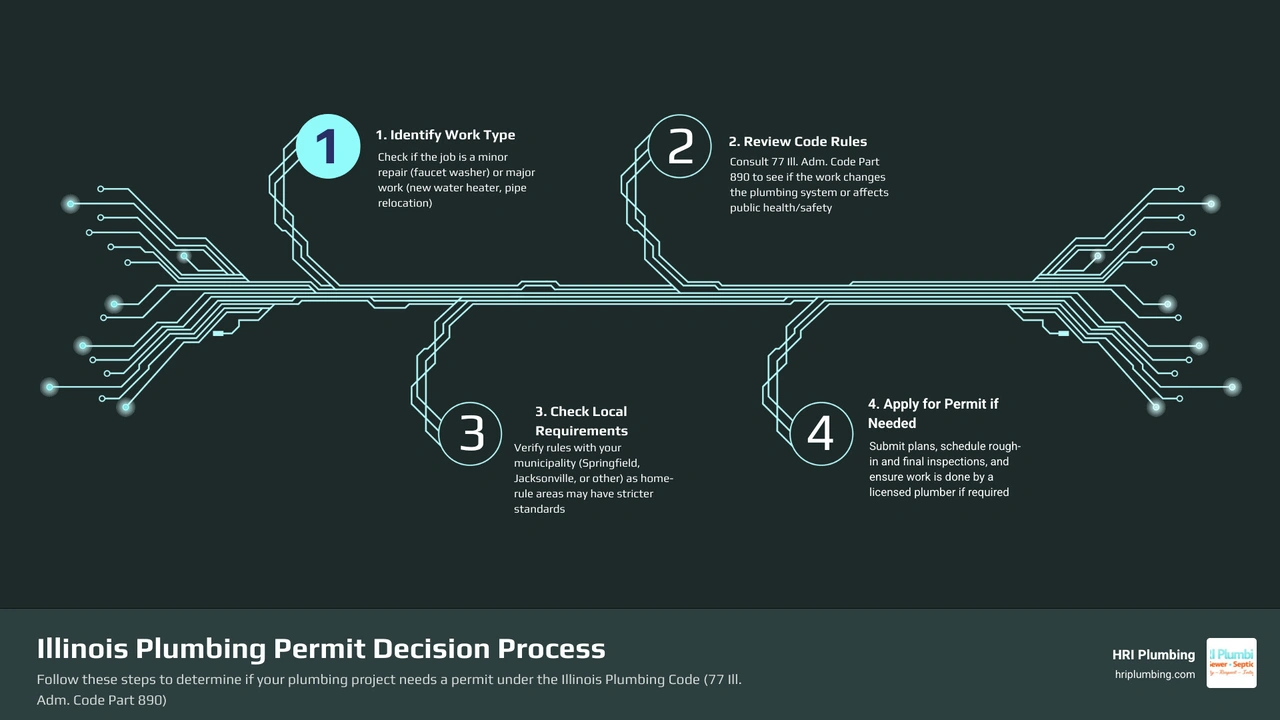
Understanding the Illinois Plumbing Code: Do I Need a Permit for Plumbing Work in Illinois?
To understand whether you need a permit, we first have to look at the statewide standard: the Illinois Plumbing Code (77 Ill. Adm. Code Part 890). This comprehensive document governs all plumbing design, materials, and installations across the state. It is designed to protect public health by ensuring clean potable water and safe waste disposal.
Under this code, there is a clear distinction between "minor repairs" and work that alters the plumbing system:
- Minor Repairs (No Permit Required): These are routine maintenance tasks. If you are replacing faucet washers, swapping out an existing toilet without changing the pipe layout, or fixing a small, localized pipe leak with like-for-like materials, you typically do not need a permit.
- System Alterations (Permit Required): If you are installing backflow prevention assemblies, adding new fixtures, extending existing lines, or replacing a water heater, a permit is mandatory.
When you start planning larger outdoor projects, the permitting rules can get even more specific. For example, if you are dealing with waste systems outside your home's foundation, you will want to read our detailed guide on Do I Need a Permit for Septic Work in Illinois? to stay fully compliant with local environmental laws.
When Can Homeowners Do DIY Work: Do I Need a Permit for Plumbing Work in Illinois?
It is a common misconception that because you own your home, you can perform any plumbing work you want without a permit or a license. Under the Illinois Plumbing License Law, there is a specific "owner-occupant exemption," but it comes with strict legal boundaries:
- Single-Family Residence Only: The DIY exemption only applies to a single-family home that is your primary residence. You cannot perform DIY plumbing on commercial properties, rental units, or multi-family buildings.
- The 6-Month Occupancy Rule: According to the Illinois Plumbing Code, if you perform your own plumbing work, you must actually occupy the single-family home for a minimum of six months. This rule prevents unlicensed individuals from flipping houses and performing uncertified plumbing installations under the guise of being "homeowners."
- The Homeowner Waiver: To obtain a residential building permit for DIY plumbing, you must sign a formal homeowner waiver. This document states that you assume full legal responsibility for ensuring the work complies with all current building, plumbing, and safety codes.
If a local code inspector visits your property and finds plumbing violations, the consequences can be stressful. Under the terms of most homeowner waivers, if code violations are found during an inspection, or if it is discovered that an unlicensed helper performed the work under your homeowner permit, all work will be stopped immediately. You will then be legally required to hire a licensed plumbing contractor to correct the violations and complete the remaining work.
Local Permit Rules and Homeowner Exceptions in Springfield and Jacksonville
While the State of Illinois sets the baseline Plumbing Code, enforcement is managed locally. Illinois is divided into home-rule and non-home-rule municipalities. Home-rule cities (like Springfield) have broader authority to adopt local building ordinances that can be even stricter than the state minimums. Non-home-rule municipalities and unincorporated county areas often rely directly on county-level inspections or the IDPH to oversee plumbing work.
Because of this, you must always check with your local building department before picking up a wrench. What is allowed without an inspection in one small township might require a full permit and plan review in Springfield or Jacksonville.
Why You Should Hire a Licensed Plumber for Remodeling Projects
When you are planning a home renovation, trying to navigate the permit and inspection process on your own can quickly become overwhelming. This is one of the primary reasons why we recommend working with professionals. For a deeper look at how a professional simplifies this process, check out our article on Why Include a Professional Plumber in Your Remodeling Process.
To protect homeowners, the IDPH maintains strict licensing standards for the industry. Currently, the IDPH licenses approximately 8,900 plumbers and 2,000 apprentice plumbers across Illinois. Becoming a licensed plumber is no easy task; it requires:
- Completing a rigorous 48 to 72 month apprenticeship period under a licensed sponsor.
- Passing a comprehensive state licensing exam.
- Completing 4 hours of continuing education annually to renew their license.
Furthermore, registered plumbing contractors must carry significant financial protections. In Illinois, contractors are required to maintain minimum general liability insurance of $100,000 per occurrence, $300,000 for bodily injury, and $50,000 for property damage, along with a $20,000 performance bond.
Hiring a professional who carries these credentials protects your home from accidental damage and ensures that the permits are pulled correctly. If you are ready to hire a team but aren't sure what to look for, read our guide on Hiring a Professional Plumbing Company. Taking this step helps you avoid the Potential Plumbing Issues When Remodeling Your Home that frequently plague DIY projects, such as improper venting, incorrect pipe sizing, or sewer gas leaks.
How to Apply for a Plumbing Permit and Schedule Inspections
If your project requires a permit, the application process generally follows these steps:
- Submit the Application: You (or your licensed plumbing contractor) must submit a plumbing permit application to your local municipal building department (e.g., in Springfield or Jacksonville). This application will require the plumbing contractor’s state registration and license numbers.
- Plan Review: For larger renovations or commercial projects, the building department will review your plumbing blueprints to ensure they meet the Illinois Plumbing Code.
- The Rough-In Inspection: Before any of your new plumbing is hidden behind drywall or under concrete, you must schedule a "rough-in" inspection. The inspector will check the slope of your drain lines, the pressure testing of your water lines, and the venting system.
- The Final Inspection: Once the drywall is up, the fixtures are installed, and the water is turned on, the inspector will return for a final walk-through to verify everything is operating safely.
When scheduling these appointments, keep in mind that plumbing inspections require coordination. Most local municipal offices require at least a 2-business-day notice for the inspector to visit your property. Failing to schedule these inspections before closing up your walls can result in the city ordering you to tear down your new drywall so they can inspect the pipes.
Conclusion: Ensuring Code Compliance for Your Next Plumbing Project
Determining whether you need a permit for plumbing work in Illinois doesn't have to be a headache. While minor repairs can often be handled without paperwork, any major remodeling, pipe relocation, or water heater installation requires official permits and inspections to keep your home safe and code-compliant.
At HRI Plumbing, we take the guesswork out of the permitting process. We provide reliable, high-quality residential and commercial plumbing solutions throughout Jacksonville, Springfield, and Rushville, IL. Whether you need Jacksonville drain cleaning, Springfield water heater repair, or Rushville emergency plumbing, our expert team is here to help. We emphasize honesty and integrity, offering comprehensive maintenance plans and 24/7 emergency support to keep your systems running smoothly.
Planning a plumbing project or facing an unexpected leak? Contact us today at https://www.hriplumbing.com/plumbing to schedule a professional consultation and ensure your plumbing is done right, fully permitted, and built to last.


