

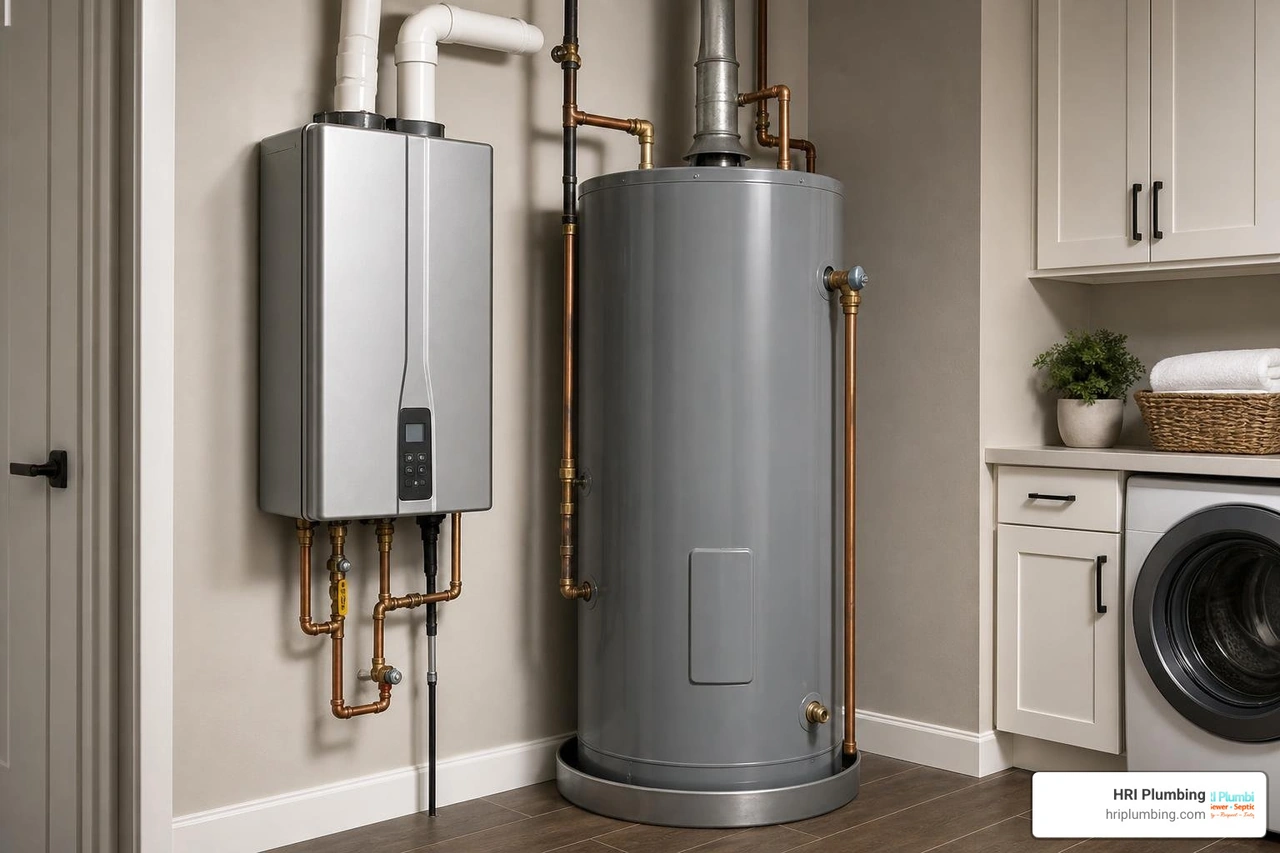


Choosing a Water Heater in Jacksonville, Springfield, or Rushville, IL: Should I Go Tankless or Keep a Tank?
Choosing between a tankless vs tank water heater for your home is one of the most important decisions you'll make as a homeowner — especially if your current unit is aging, leaking, or simply not keeping up with your family's hot water needs. Whether you're in Jacksonville, Springfield, or Rushville, IL, getting this choice right can mean the difference between years of reliable hot water and an avoidable headache down the road.
Here's a quick side-by-side to help you decide at a glance:
| Factor | Tank Water Heater | Tankless Water Heater |
|---|---|---|
| How it works | Stores and preheats 30-80 gallons | Heats water on demand as you use it |
| Hot water supply | Limited by tank size | Continuous (within flow rate limits) |
| Energy efficiency | Lower — loses heat when idle | Higher — no standby heat loss |
| Lifespan | 10-15 years | 20+ years |
| Space needed | Significant floor space | Wall-mounted, compact |
| Best for | Larger families with simultaneous demand | Smaller households or those prioritizing efficiency |
Both systems have real advantages. The right pick depends on your household size, how long you plan to stay in your home, and how you actually use hot water day to day. The sections below break each factor down so you can make a confident, informed choice.
Easy tankless vs tank water heater for your home glossary:
- how to choose the right water heater
- gas vs electric water heater which is better
- energy efficient water heater options explained
Comparing Tankless vs Tank Water Heater for Your Home: How They Work
At the most basic level, the debate of a tankless vs tank water heater for your home comes down to storage versus immediacy. While both systems are designed to deliver hot water to your taps, showers, and appliances, they use fundamentally different engineering methods to achieve that goal.
Understanding this technical difference is key to evaluating their overall energy consumption and how they will perform under daily pressure. For a deep dive into these fundamental differences, you can read our comprehensive Tankless vs Tank Water Heater Comparison.
How Storage Tanks Keep Water Hot in Jacksonville, IL
Traditional storage water heaters are the familiar, cylindrical fixtures that have anchored American basements and utility closets for decades. These systems work on a simple cycle of continuous storage and preheating.
Cold water enters the bottom of the steel tank through a dip tube. The water is heated either by a gas burner located underneath the tank or by electric elements suspended inside it. A thermostat monitors the internal temperature, cycling the heating elements on and off to maintain a constant temperature (usually between 120°F and 140°F) around the clock.
Because the tank must keep 30 to 80 gallons of water hot 24 hours a day, it experiences what we call "standby heat loss." Even when you are sleeping, at work, or away on vacation, your tank is using energy to prevent that stored water from cooling down. This continuous cycle explains Why Some People Still Buy Traditional Water Heaters for their familiar design and straightforward operation.
The On-Demand Technology of a Tankless vs Tank Water Heater for Your Home

In contrast, a tankless water heater completely eliminates the storage tank. Often referred to as "demand" or "instantaneous" water heaters, these compact devices only heat water when a hot water tap is turned on somewhere in your home.
When you open a faucet, cold water flows into the unit. A flow sensor detects this movement and immediately ignites a high-powered gas burner or activates heavy-duty electric heating elements. The water travels through a tightly coiled heat exchanger, absorbing heat rapidly before exiting the unit at your desired temperature.
To learn more about this technology, check out our Tankless Water Heaters Complete Guide. Because there is no storage tank, there is absolutely zero standby heat loss. However, this process relies on a delicate balance of flow rate (measured in gallons per minute) and temperature rise, meaning the unit must be precisely sized to handle your household's peak demand.
Key Performance and Efficiency Differences for Homeowners
As of June 2026, energy standards and residential building codes continue to push for higher-efficiency appliances. When comparing a tankless vs tank water heater for your home, efficiency and daily performance are often the biggest deciding factors.
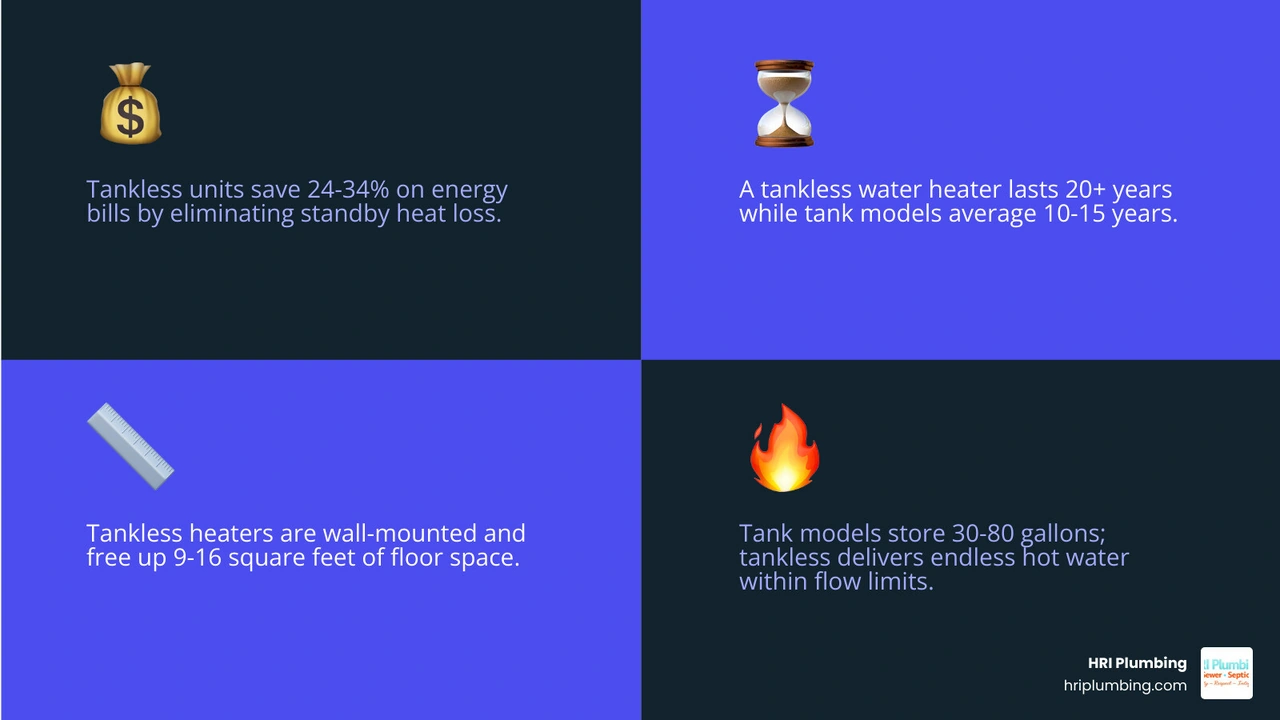
According to the U.S. Department of Energy, tankless water heaters can be 24% to 34% more energy efficient than conventional storage tanks for homes using 41 gallons or less of hot water daily. For homes using around 86 gallons per day, tankless units still provide an 8% to 14% efficiency boost. You can learn more in our article on tankless water heater efficiency over time and explore the Energy Saving Benefits Tankless Water Heaters.
Hot Water Availability and Flow Rates During Peak Usage
Tankless systems are efficient, but traditional tanks can have an advantage during heavy simultaneous use. A storage tank holds preheated water ready for multiple fixtures at once, such as a dishwasher, washing machine, and shower. The tradeoff is that once the tank runs out, you must wait for it to recover.
A tankless water heater provides continuous hot water, but only within its flow-rate limits. Most residential units deliver between 2 and 5 gallons per minute, with gas models generally outperforming electric ones. If demand exceeds capacity, you may notice reduced temperature or pressure. Some users may also experience a brief "cold water sandwich" when a faucet is turned off and quickly turned back on.
Lifespan and Maintenance Needs of a Tankless vs Tank Water Heater for Your Home
Traditional storage tanks typically last 10 to 15 years, while tankless water heaters often last 20 years or more. Because tankless systems use modular components, individual parts can often be replaced instead of replacing the whole unit. To monitor your system, read How Long Does a Water Heater Last, watch for the Signs Your Water Heater Is Going Out, and review the Signs That It's Time to Replace Your Water Heater.
Maintenance matters for both options. Tankless units need annual flushing and descaling, especially in hard-water areas, to protect the heat exchanger. Traditional tanks also benefit from annual flushing to remove sediment and protect the anode rod.
Space Savings and Sizing for Springfield and Rushville Homes
A standard 50-gallon tank takes up significant floor space in a basement, closet, or utility room. Tankless water heaters are compact, wall-mounted units that free up usable space. For more, see how Tankless Water Heaters Free Up Storage Space.
For local service options, explore Tankless Water Heater Springfield IL or Tankless Water Heater Rushville IL.
Making the Right Choice for Your Household's Daily Needs
Deciding on a tankless vs tank water heater for your home comes down to a few household factors:
- Household Size and Habits: Back-to-back showers often favor tankless systems, while heavy simultaneous demand may favor a large tank.
- Fuel Source: Gas tankless systems may require gas-line and venting upgrades. Electric tankless models may require electrical panel upgrades.
- Length of Homeownership: If you plan to stay 10 to 15 years or more, tankless efficiency and lifespan may be worthwhile. If you plan to move soon, a traditional tank may be more practical.
Before upgrading, review Switching from Tank to Tankless What to Know, the Water Heater Replacement Guide Jacksonville IL, or the Water Heater Replacement Guide Rushville IL.
At HRI Plumbing, our technicians provide honest guidance, maintenance plans, and 24/7 support to help your system run reliably.
If you are ready to upgrade, repair, or replace your home's water heating system, contact us today to schedule a consultation or explore our professional Water Heater Repair and Replacement Services.


