



The Threat of Prolonged Power Outages to Your Basement
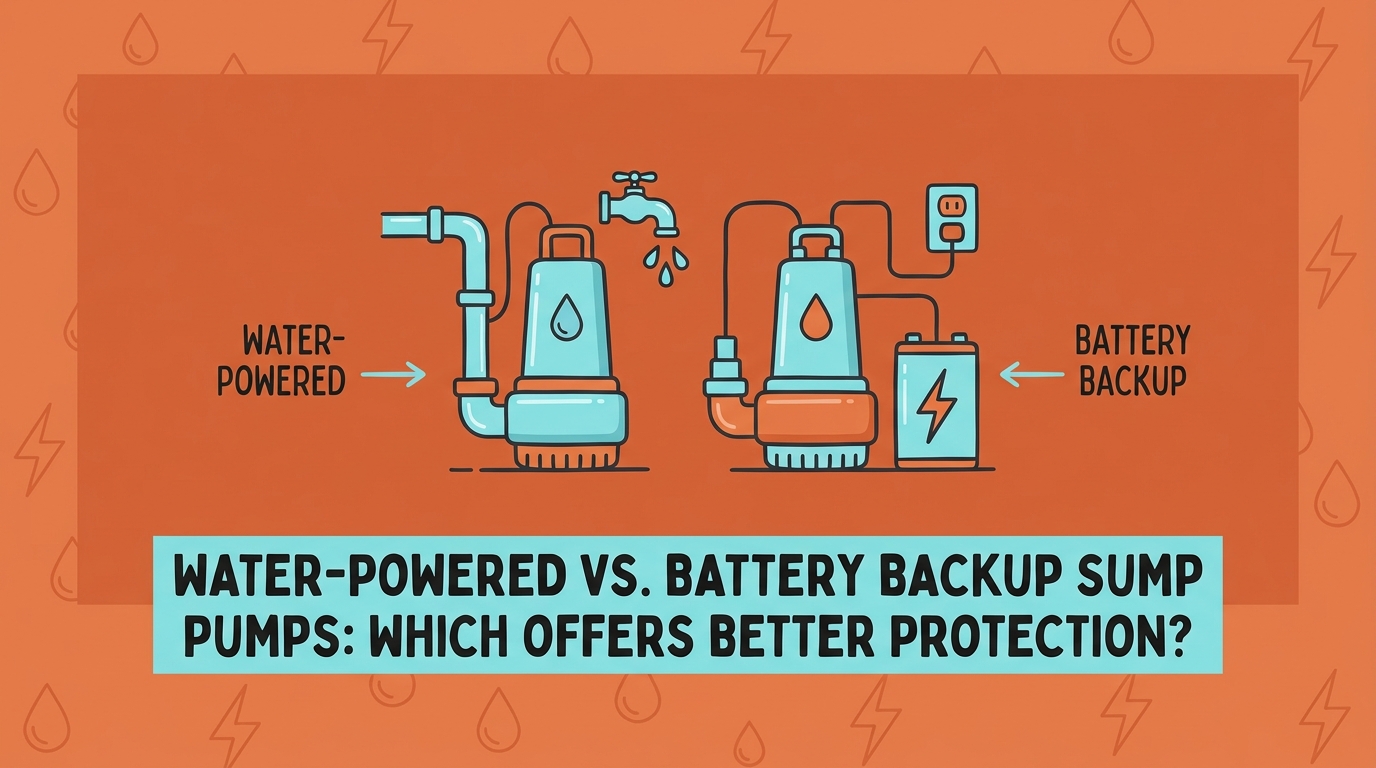
Your primary sump pump is completely useless the moment the electricity goes out, which is exactly why deciding between Water-Powered vs. Battery Backup Sump Pumps: Which Offers Better Protection? is one of the most critical choices a homeowner can make. The heaviest rains often arrive hand-in-hand with severe lightning and high winds, creating a perfect storm where your basement is taking on massive amounts of water just as the grid goes dark. At HRI Plumbing, we've seen perfectly dry basements turn into flooded disaster zones in a matter of hours simply because a reliable secondary system wasn't ready to take over instantly.
This vulnerability is especially pronounced during early fall storm prep. Early fall in the Midwest brings severe transitional weather systems capable of causing sudden, localized power outages alongside torrential rain. When evaluating your options, the core decision comes down to choosing between the endless, uninterrupted runtime provided by municipal water systems and the sheer, high-volume pumping power delivered by battery backups. The right choice is never a one-size-fits-all answer; it depends entirely on your home's specific plumbing infrastructure and drainage profile. For comprehensive guidance on protecting your home, exploring professional plumbing services and dedicated sump pump repair and replacement is the best first step.
How Water-Powered Sump Pumps Provide Infinite Runtime
The most significant advantage of a water-powered backup system is its ability to operate indefinitely without a single drop of electricity. While conventional backups are always racing against a draining battery clock, a water-powered pump leverages the existing pressure from your municipal water supply to remove floodwater. As long as the city water tower has pressure, your basement remains protected, whether the power is out for two hours or two weeks. In our years of serving Jacksonville IL area basements that experience prolonged grid failures but relatively moderate water intrusion, we have found that this technology offers unparalleled peace of mind.
Because these units do not rely on a motor, a circuit board, or a battery bank, there are very few moving parts to degrade over time. They sit silently in the sump pit, completely immune to the typical wear and tear that plagues electrical components in damp environments. When the primary pump fails or the power drops, the rising water simply lifts a float switch, opening a mechanical valve to begin the extraction process.
The Mechanics of Municipal Water Pressure Backup
Understanding how municipal water pressure can actually remove water from a pit requires a brief look at fluid dynamics. The system relies on a principle called the Venturi effect, which creates powerful suction without any motorized impellers.
1. The Float Switch Activation: As groundwater fills the sump pit during an outage, it lifts a dedicated float switch connected to the water-powered pump.
2. The Valve Opens: This switch mechanically opens a valve connected directly to your home's municipal fresh water line.
3. The Venturi Effect: Fresh water rushes through a narrow restriction inside the pump housing. As the water speeds up through this bottleneck, it creates a localized drop in pressure—a vacuum.
4. Suction and Expulsion: This vacuum sucks the standing floodwater out of the sump pit, mixing it with the fresh municipal water, and forces the combined volume up and out through the discharge pipe.
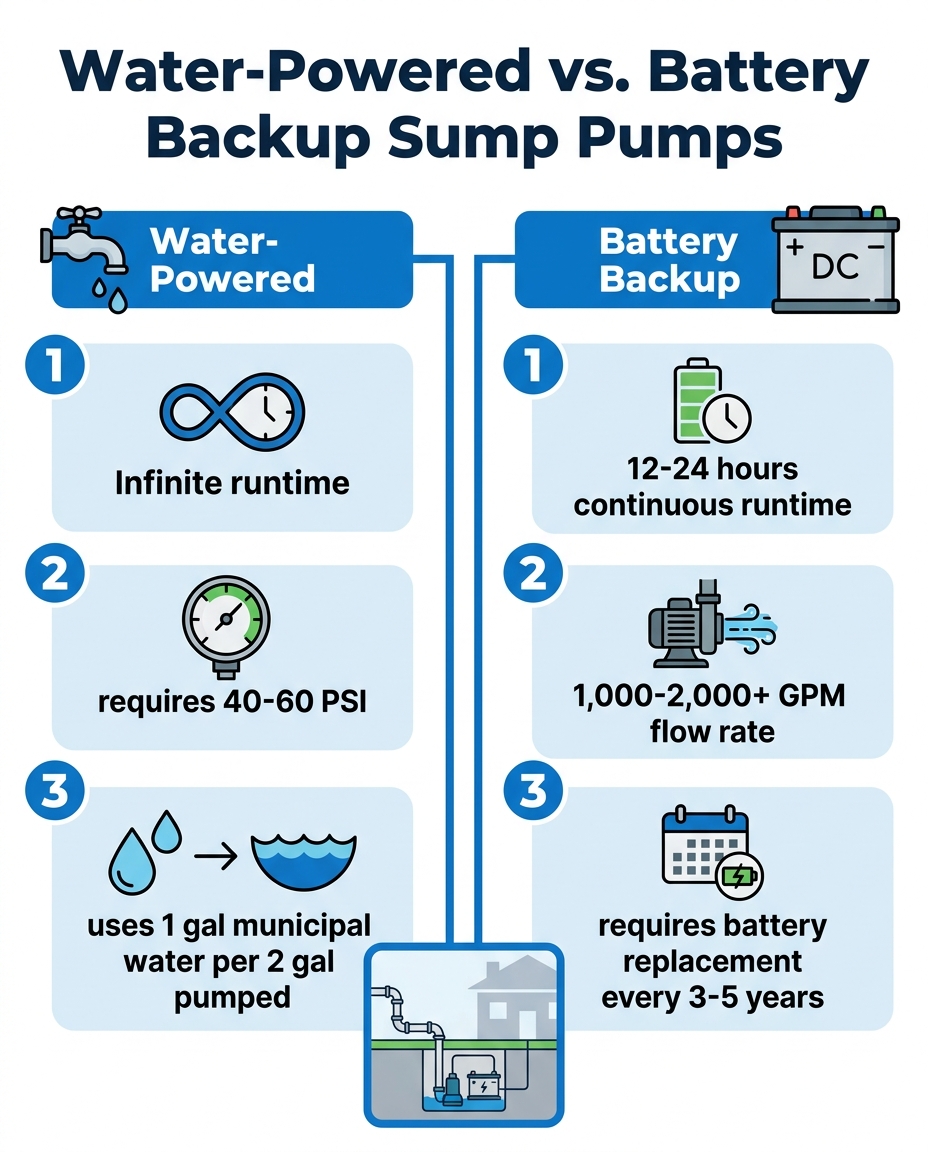
Generally, this process operates on a one-to-two ratio: it takes roughly one gallon of municipal drinking water to successfully remove two gallons of dirty sump water from your basement.
Weighing the Pros and Cons of Water-Powered Systems
While the promise of infinite runtime is highly appealing, water-powered systems are not universally compatible with every home. They require specific plumbing conditions to function correctly, and understanding these limitations is crucial before installation.
• Pro: Never runs out of power. During multi-day electrical outages caused by severe weather, this system will continue pumping as long as the municipal water supply remains pressurized.
• Pro: Very low maintenance. With no batteries to replace, no chargers to monitor, and no electrical motors to burn out, these pumps boast a remarkably long lifespan with minimal upkeep.
• Con: Requires high municipal water pressure. The Venturi effect demands a minimum municipal water pressure of 40 to 60 PSI to operate efficiently. If your neighborhood has low pressure, the pump will fail to create enough suction.
• Con: Lower clearing rate. The Gallons Per Minute (GPM) removal rate is noticeably lower compared to high-end battery systems, making them less ideal for homes that take on massive volumes of water very quickly.
• Con: Increases the municipal water bill. Because the system uses city water to operate, extended use during a multi-day outage will result in a significantly higher water bill for that billing cycle.
If you are unsure whether your home meets the strict pressure requirements for this technology, consulting with a qualified plumber in Jacksonville, IL is essential to avoid installing a system that cannot perform when needed.
How Battery Backup Sump Pumps Deliver High-Volume Clearing
For homes that experience rapid, heavy water intrusion, sheer pumping power is the ultimate priority. Our team frequently recommends battery backup sump pumps for these scenarios. They use a dedicated, heavy-duty battery to power a secondary electrical pump situated just above your primary unit. When the main power fails, the system automatically switches to battery power, driving a motorized impeller that can move massive amounts of water in a very short time.
Modern battery backups typically utilize marine-grade deep-cycle batteries or advanced AGM (Absorbent Glass Mat) batteries. These power cells are specifically designed to discharge energy steadily over a long period and then recharge completely once grid power is restored. A smart charging unit remains plugged into the wall, constantly monitoring the battery's health and keeping it topped off so it is always ready for the next severe weather event. Furthermore, many contemporary battery systems offer advanced telemetry, connecting to your home's Wi-Fi to send instant smartphone alerts if the power drops, the battery runs low, or the pump activates.
Handling Peak Demand During Downpours
The necessity for high flow rates becomes obvious during Midwest early fall downpours, which our crews frequently see dump inches of rain in a matter of hours across our service area. This sheer volume of water can easily overwhelm lower-capacity pumps.
During these intense weather events, the GPM (Gallons Per Minute) rating of your backup pump matters more than anything else. High-capacity battery backups are engineered to excel in these exact conditions, often clearing 1,000 to over 2,000 gallons per hour during peak demand. If your home has a large footprint, sits at the bottom of a slope, or is located in an area with a high water table, the rapid water intrusion requires a pump that can keep up with the aggressive flow rate. A battery system provides the brute force necessary to push that water up and out of the basement before it breaches the top of the pit.
Weighing the Pros and Cons of Battery Backup Systems
Battery backup systems are the most popular choice for homeowners due to their versatility and power, but they come with their own set of maintenance requirements and inherent limitations that must be managed.
• Pro: Extremely high flow rates. These systems are capable of handling severe flash flooding and rapid water intrusion that would easily overwhelm a water-powered alternative.
• Pro: Independent of municipal water. Because they do not rely on city water pressure, battery backups are fully viable for homes on private well systems.
• Con: Limited runtime. The system is entirely dependent on battery capacity. A standard setup typically provides 12 to 24 hours of continuous pumping, or several days if the pump only cycles intermittently. Once the battery dies, the basement is unprotected.
• Con: Battery degradation. Batteries do not last forever. Even with a high-quality smart charger, the cells degrade over time and generally require a full replacement every 3 to 5 years to ensure reliability.
• Con: Requires routine maintenance. Homeowners must periodically ensure the battery terminals are clean, check the fluid levels (if using a flooded lead-acid battery), and verify the unit is holding a charge. Neglecting this can lead to situations where you wonder why your sump pump won't trigger during a heavy rainstorm.
Head-to-Head Comparison: Flow Rate vs. Runtime
To make the best decision for your home, it helps to view the trade-offs side by side. The choice generally forces a compromise between how long the system can run and how fast it can move water.
• Maximum Runtime — Water-Powered Backup Pump: Infinite (as long as city water flows) — Battery Backup Sump Pump: Limited (12-24 hours continuous)
• Peak Clearing Volume — Water-Powered Backup Pump: Moderate GPM (slower extraction) — Battery Backup Sump Pump: High GPM (rapid extraction)
• Power Source — Water-Powered Backup Pump: Municipal Water Pressure (40-60 PSI) — Battery Backup Sump Pump: Deep-Cycle or AGM Battery
• Maintenance Needs — Water-Powered Backup Pump: Very Low (no batteries to replace) — Battery Backup Sump Pump: Moderate (battery swap every 3-5 years)
• Installation Requirements — Water-Powered Backup Pump: Strict plumbing codes & backflow prevention — Battery Backup Sump Pump: Dedicated electrical outlet & floor space
As the table illustrates, a water-powered system is the ultimate marathon runner. It will not break speed records, but it will keep working tirelessly through a week-long blackout. Conversely, the battery backup is a sprinter. It delivers massive power to handle a sudden, violent downpour, but it has a finite stamina limit. If your neighborhood is prone to quick, heavy storms that cause short-term power blips, the battery system is superior. If you live in an area where winter ice or early fall storm prep means preparing for the grid to be down for five days at a time, the water-powered system offers better long-term security—provided your home meets the pressure requirements.

Assessing Municipal Pressure and Drainage Needs for Your Home
Because the stakes are so high, a one-size-fits-all approach fails completely when it comes to sump pump backups. What keeps your neighbor's basement perfectly dry might leave yours under two inches of water. The decision must be based on hard data regarding your home's unique footprint, the local water table, and historical basement water intrusion rates.
When our HRI Plumbing technicians evaluate Jacksonville IL area basements, testing the municipal water pressure is the absolute most critical step before even considering a water-powered unit. It is not enough to simply turn on a faucet and guess. Professional plumbers use specialized gauges to test both the static pressure (the pressure when no water is running) and the dynamic pressure (the pressure when water is actively flowing). If the dynamic pressure drops below 40 PSI, a water-powered pump will fail to create the necessary Venturi suction, rendering it useless during a flood.
Why Professional Assessment Matters
Working with professional expertise ensures that your home is accurately assessed for both municipal water pressure capabilities and unique drainage volume needs. A licensed expert can recommend the most reliable system based on empirical data rather than guesswork.
Furthermore, local plumbing codes strictly regulate how water-powered systems are installed. Because these pumps connect your home's clean drinking water supply directly to a pit filled with dirty groundwater, there is a severe risk of cross-contamination. Proper backflow prevention devices, such as RPZ (Reduced Pressure Zone) valves or heavy-duty check valves, must be installed to ensure that dirty sump water can never be siphoned back into the city water lines. Navigating these codes, performing accurate pressure tests, and calculating your home's required GPM flow rate are complex tasks best handled by requesting emergency plumbing services or scheduling a comprehensive evaluation before the storm clouds gather.
Frequently Asked Questions
Which is better: a water-powered or battery backup sump pump?
Neither is universally better; the right choice depends entirely on your home's specific needs. A battery backup is better for handling massive volumes of water quickly and works on well systems, while a water-powered pump is better for prolonged, multi-day power outages where a battery would eventually die.
Do water-powered sump pumps work without electricity?
Yes, they operate completely without electrical power. They rely entirely on the physical pressure of your municipal water supply to create suction through a Venturi valve, making them immune to electrical grid failures.
How long does a battery backup sump pump last during a power outage?
A fully charged, high-quality battery backup will typically provide 12 to 24 hours of continuous, non-stop pumping. However, because sump pumps usually cycle on and off rather than running constantly, a good battery can often protect a basement for several days of intermittent use.
How much municipal water does a water-powered sump pump use?
These systems generally operate on a 1-to-2 ratio. This means it takes approximately one gallon of fresh municipal water to remove two gallons of dirty sump water from your pit, which will cause a noticeable increase in your water bill during prolonged use.
Can I install both a battery and water-powered backup sump pump?
Yes, establishing a triple-redundancy system is possible and provides the ultimate level of protection. In this setup, the primary electric pump handles daily duties, the high-volume battery backup engages during heavy downpours if power is lost, and the water-powered pump serves as a fail-safe of last resort if the battery eventually depletes.
Protecting Your Home Before the Next Outage
Choosing the right backup system requires a clear, objective comparison of your home's drainage needs and municipal water capabilities. Don't wait until the power drops and the rain is pouring to find out if your basement is secure. Reach out to our licensed professionals at HRI Plumbing to evaluate your sump pit, test your water pressure, and install the backup technology that will actually keep you dry.


