


Why Sewer Line Problems in Older Homes Are a Bigger Deal Than You Think
Sewer line problems in older homes are one of the most common — and most expensive — surprises a homeowner can face. If your home was built before 1970, the pipe buried beneath your yard has been quietly handling every shower, toilet flush, and load of laundry for over 50 years. And it may be running out of time.
Here is a quick look at the most common sewer line problems in older homes:
- Tree root intrusion - Roots seek moisture and crack their way into aging clay or cast iron pipes
- Pipe material failure - Clay, cast iron, and Orangeburg pipes all have limited lifespans and are now failing in homes across central Illinois
- Bellied or sagging lines - Soil settlement creates low spots where waste pools and blockages form
- Cracked or collapsed pipes - Age, ground movement, and freeze-thaw cycles cause structural failures
- Joint separation - Older pipes were laid in short sections; those joints weaken and pull apart over time
Most homeowners don't think about their sewer line until something goes wrong. But by then, you're dealing with sewage backups, foul odors, soggy patches in the yard, and repair bills that can spike fast. In Springfield, Jacksonville, and Rushville, IL — where many homes date back to the mid-1900s or earlier — these problems are not rare. They are expected.
This guide walks you through exactly what goes wrong, how to spot it early, and what your options are when it happens.
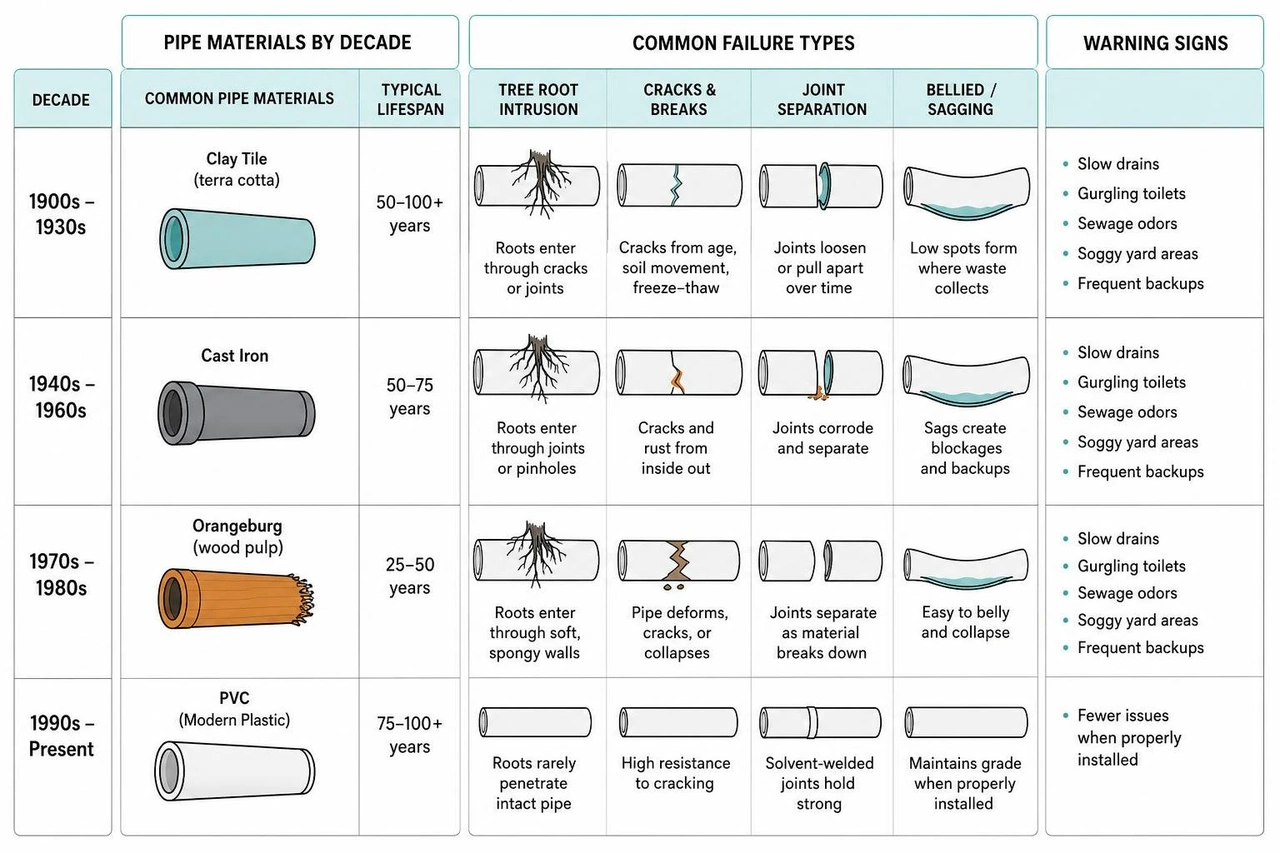
Basic sewer line problems in older homes glossary:
Common Sewer Line Problems in Older Homes

When we look at the plumbing infrastructure in older central Illinois neighborhoods, we see a pattern of progressive wear. Unlike the modern schedule 40 PVC pipes installed today, older sewer laterals were constructed using rigid, heavy materials that do not handle shifting earth well.
Ground movement is a major contributor to structural failures in buried lines. In our region, the soil expands and contracts significantly between wet and dry seasons. Compounding this issue are the annual freeze-thaw cycles. As the ground freezes in the winter and thaws in the spring, the surrounding soil puts immense pressure on older, brittle pipes. Over decades, this constant movement causes pipes to crack, joints to shear, and entire sections to collapse.
When structural damage occurs, it is rarely a simple clog that a standard drain snake can resolve. Understanding the difference between a minor blockage and a major structural failure is key to protecting your property. You can learn more about identifying these structural failures in our guide on 5 Common Sewer Line Problems in Taylorville, IL.
1. Tree Root Intrusion and Sewer Line Problems in Older Homes
Tree root intrusion is the single most frequent cause of sewer blockages in older residential areas. Mature trees are a beautiful feature of historic neighborhoods, but their underground root systems can extend two to three times the width of the tree's canopy.
Roots are naturally drawn to moisture, warmth, and nutrients—all of which are constantly radiating from your sewer lateral. Older pipe materials, especially vitrified clay and cast iron, were installed in short segments sealed with mortar or rubber gaskets. As these joints age and weaken, vapor escapes into the surrounding soil.
Nearby tree roots detect this moisture and grow toward it. They enter the pipe through hairline cracks or tiny gaps in the joints. Once inside, the roots feast on the nutrient-rich wastewater, expanding from hair-thin strands into massive, dense root balls.
These root masses act as a net, catching toilet paper, grease, and household debris. While mechanical root clearing (such as cabling or hydro jetting) can temporarily restore flow, the roots will inevitably grow back within 6 to 12 months because the physical entry point remains open.
2. Pipe Material Degradation: Clay, Cast Iron, and Orangeburg
To understand why sewer line problems in older homes are so common, we have to look at what lies beneath the ground. Before the adoption of modern plastics, municipalities and builders relied on materials that we now know have definitive expiration dates.
- Vitrified Clay: Extremely common in homes built from the early 1900s through the 1970s. While clay itself does not corrode, the material is highly brittle and prone to cracking under soil pressure. Additionally, the joints between the short clay segments easily separate over time, inviting root intrusion.
- Cast Iron: Widely used from the 1920s through the 1980s. Cast iron is incredibly strong, but it is highly susceptible to internal corrosion. Over decades, water and sewer gases cause rust and scale to build up inside the pipe, creating a rough surface that catches debris. Eventually, the bottom of the pipe corrodes completely, leading to leaks and structural collapse.
- Orangeburg: Made from layers of wood pulp bound with water-resistant coal tar pitch, this "bituminous fiber pipe" was used as a cheap alternative from the 1940s through the 1970s. Orangeburg is notorious for absorbing water, losing its structural integrity, flattening into an oval shape, and completely collapsing.
| Material | Typical Era of Use | Expected Lifespan | Primary Failure Modes |
|---|---|---|---|
| Vitrified Clay | 1900s – 1970s | 50 – 60 Years | Joint separation, root intrusion, brittle cracking |
| Cast Iron | 1920s – 1980s | 50 – 75 Years | Internal rust buildup (scaling), bottom channeling, corrosion |
| Orangeburg | 1940s – 1970s | 30 – 50 Years | Deforming (ovalizing), crushing, complete structural collapse |
3. Structural Shifts: Bellies, Sags, and Ground Movement
Over several decades, the soil surrounding a sewer lateral undergoes significant settling. When the earth beneath a pipe shifts or erodes, the pipe loses its support and sinks. This creates a "belly" or a sag in the line.
A properly functioning sewer line relies entirely on gravity to carry waste away from your home, requiring a consistent downward slope. When a belly forms, it creates a low spot where water and solid waste pool. Since gravity cannot push waste uphill out of the sag, heavy debris accumulates at the bottom of the dip. Over time, this buildup leads to chronic, recurring main line blockages.
In severe cases, the physical strain of a sagging pipe will pull joints apart, creating offsets where the edge of one pipe section sticks up higher than the next. This joint offset not only snags passing solids but also allows raw sewage to escape directly into the soil beneath your home, which can eventually lead to foundation settling and cracks.
Modern Solutions and Prevention for Illinois Homeowners
Fortunately, plumbing technology has advanced significantly. For homeowners in Springfield, Jacksonville, and Rushville, managing an older sewer system does not have to mean waiting for a catastrophic backup. Proactive maintenance, understanding your system's condition during real estate transactions, and choosing the right repair methods can save your yard and your budget.
If you suspect your system is struggling, securing professional Sewer Line Repair & Replacement is the most reliable way to restore long-term safety and code compliance to your home.
Recognizing the Warning Signs of Sewer Line Problems in Older Homes
You do not have to wait for sewage to back up into your basement drain to know there is a problem. Your home will usually give you several warning signs:
- Multiple Slow Drains: If only one sink is slow, it is a localized clog. If the kitchen sink, bathtub, and laundry line are all draining slowly at the same time, the main sewer lateral is restricted.
- Gurgling Toilets: If your toilet bubbles or gurgles when you run the bathroom sink or washing machine, air is trapped in the system due to a main line blockage.
- Sewer Gas Odors: A fully intact sewer system keeps gases contained. If you smell rotten eggs near your basement drains or in your yard, there is likely a crack or break in the line.
- Lush, Green Patches: Raw sewage acts as a highly effective fertilizer. If you notice a strip of grass in your yard that is significantly greener and grows faster than the rest of the lawn, your sewer line is leaking below.
- Soggy Spots or Sinkholes: Persistent wet spots in your yard during dry weather indicate that wastewater is pooling just beneath the surface.
To catch these warnings before they turn into emergencies, read our detailed article on how to Spot Early Signs of Sewer Line Issues.
Diagnostic Methods: Sewer Camera Inspections
In the past, identifying a sewer problem required digging up the yard. Today, we use advanced sewer scope cameras to look directly inside the pipe.
During a camera inspection, a technician feeds a high-resolution, waterproof camera on a flexible push-cable through your home's main cleanout or plumbing vent. As the camera travels through the lateral, it transmits real-time video to a monitor. This allows us to see the exact location and nature of any defects—whether it is root intrusion, a belly, corrosion, or a collapsed section of Orangeburg.
We highly recommend scheduling an inspection before finalizing any real estate transaction on an older home. Standard home inspectors do not evaluate underground sewer lines, meaning buyers can easily inherit failing systems without realizing it. For a complete breakdown of what to expect, check out our Sewer Camera Inspection Guide.
Trenchless Pipe Repair vs. Traditional Excavation

If your sewer line has suffered structural damage, you generally have two paths forward: traditional excavation or modern trenchless repair.
Traditional Excavation (Dig and Replace)
This method involves using heavy machinery to dig a trench along the entire path of your sewer lateral. While necessary for completely collapsed pipes or severe bellies that require slope correction, excavation is highly disruptive. It requires tearing up lawns, driveways, sidewalks, and landscaping, which adds significant restoration time and effort to the project.
Trenchless Pipe Repair
Trenchless technology allows us to rehabilitate or replace your underground pipes with minimal digging. The two most common methods are:
- Cured-in-Place Pipe (CIPP) Lining: A flexible, epoxy-saturated liner is inserted into the existing pipe through a single small access point. Once positioned, the liner is inflated and cured, creating a seamless, jointless "pipe within a pipe" that is highly resistant to tree roots and designed to last for over 50 years.
- Pipe Bursting: A pulling machine guides a heavy-duty bursting head through the old pipe, fracturing it outward while simultaneously pulling a brand-new, high-density polyethylene (HDPE) pipe into place behind it.
Trenchless repairs preserve your landscaping and hardscaping, often completing in just one to two days. If you are experiencing recurring backups, read our guide on how to handle these situations: My Sewer Line is Damaged: Find Companies That Do Sewer Line Replacement in Springfield, IL.
Protect Your Older Home's Plumbing Today
Living in a historic home comes with incredible character, but it also means taking responsibility for aging underground infrastructure. By staying observant of early warning signs, avoiding chemical drain cleaners that can corrode old pipes, and scheduling periodic camera inspections, you can prevent major property damage and address sewer issues on your own terms.
If you are experiencing slow drains, gurgling toilets, or suspect your pre-1970 sewer line is reaching the end of its life, we are here to help. HRI Plumbing provides honest, high-quality residential and commercial plumbing services across Springfield, Jacksonville, and Rushville, IL. Contact us today to schedule a sewer camera inspection and ensure your home's plumbing remains safe and reliable.


