



Why Did Your Rural Home Suddenly Lose Water?
Is your well pump actually broken, or did a small electrical relay just fail? Figuring out how to tell if your well pump pressure switch is failing is the first step to restoring your water supply safely. At HRI Plumbing, we frequently field calls from panicked Jacksonville homeowners who turn on the kitchen faucet expecting a steady stream, but instead, get a sputtering cough followed by complete silence. For homeowners relying on private wells, sudden water loss instantly triggers panic about massive repair bills and underground excavations.
Before you assume the worst about your pump motor, the culprit is often sitting right above ground. The pressure switch is a small, inexpensive mechanical relay that controls the entire system. When this component breaks down, you might hear rapid clicking noises or completely silent, dead contacts at the switch box. Diagnosing the issue using safe, sensory-based methods—looking and listening without touching bare wires—can save you time and stress. If you need professional help assessing the situation, reaching out for expert plumbing services ensures the problem is handled safely and correctly.
What Is a Well Pump Pressure Switch (And Why Do They Fail)?
The pressure switch acts as the brain of your rural water system. It continuously monitors the water pressure inside your holding tank. When you flush a toilet or run the washing machine, the pressure inside the tank drops. Once it hits a specific low point, the switch snaps closed, sending 240 volts of electricity to the well pump to refill the tank. When the tank reaches its maximum pressure, the switch snaps open, cutting the power.
While these switches are built to last for several years, they endure thousands of cycles and eventually wear out. In our years of servicing rural properties outside Jacksonville IL, our team has seen firsthand how environmental factors play a massive role in premature failure. Extreme temperature swings in Central Illinois cause condensation to form inside the small grey switch housing. Over time, this trapped moisture accelerates corrosion, causing the internal metal contacts to rust and burn out much faster than they would in a climate-controlled environment. If you are already troubleshooting rural well pump failures, checking this small grey box is always step one.
The Mechanics of the Relay System
Inside the plastic housing, the switch relies on a heavy-duty spring and a set of metal electrical contacts. Most residential well systems operate on one of two standard pressure settings:
• 30/50 PSI systems: The pump turns on when tank pressure drops to 30 PSI and turns off when it builds to 50 PSI.
• 40/60 PSI systems: The pump kicks on at 40 PSI and shuts off at 60 PSI, providing slightly stronger household water pressure.
When the system is working perfectly, you will only hear a single, solid "click" when the pump turns on, and another single "click" when it turns off.
Common Causes of Switch Burnout
Switches rarely fail without an underlying cause. The most common reasons for a dead switch include:
• Short-cycling: If your pressure tank loses its internal air charge (becomes "waterlogged"), the switch will rapidly bounce on and off.
• Electrical arcing: Every time the contacts open and close, a tiny electrical spark occurs. Over thousands of cycles, this arcing causes the metal contacts to become pitted and covered in black carbon buildup, which blocks the electrical current.
• Corrosion: Humidity and seasonal temperature changes rust the heavy springs, preventing them from moving freely.
Auditory Diagnostics: What to Listen For at the Switch Box
You do not need a toolbox to perform the most important diagnostic tests on your well system. Your ears are your best troubleshooting tools. To perform an auditory test, stand near the pressure tank and switch box (usually located in your basement, crawlspace, or utility room) while someone else turns on a bathtub faucet inside the house.
The Danger of Rapid Clicking (Short-Cycling)
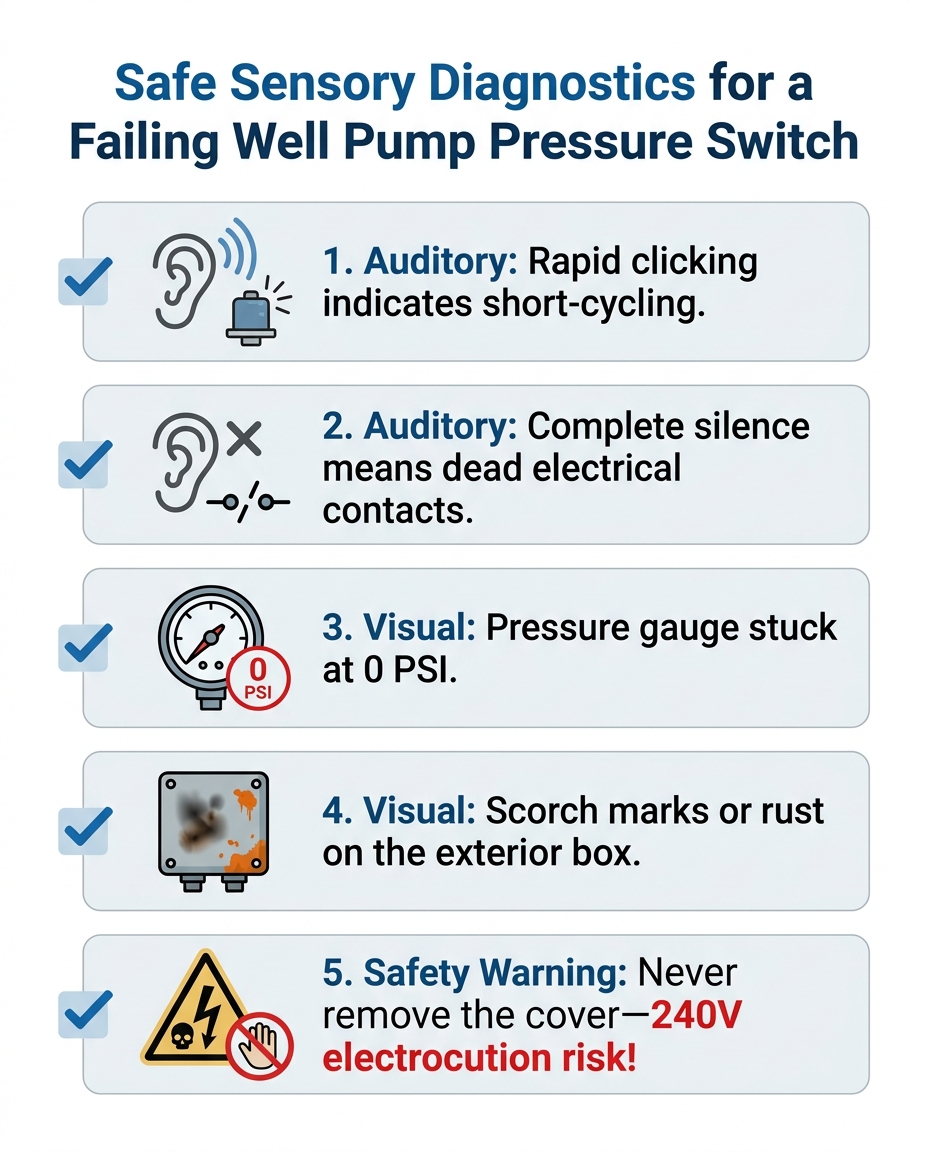
If you hear a fast, repetitive clicking sound—like a heavy-duty metronome—your system is short-cycling. This rapid clicking forces the pump motor to start and stop dozens of times per minute. Well pumps draw massive amounts of electricity upon startup, and they are designed to run for several minutes at a time to cool themselves down. Rapid clicking noises or completely silent, dead contacts at the switch box are clear warnings.
Short-cycling will literally melt the wiring inside your well pump motor if left unchecked. One local homeowner called our HRI Plumbing team this past spring after hearing strange noises from their utility room. What they thought was a minor plumbing problem turned out to be a severely short-cycling system that was destroying their pump motor. Our technician patiently explained the full extent of the issue and the necessary repairs, helping them understand that a failing switch was just a symptom of a much larger pressure tank failure. Catching this sound early saved their underground pump.
• Complete Silence: If the water is running inside the house (or the pressure is completely dead) and the switch box makes absolutely no sound, the electrical contacts are likely burnt out or covered in carbon. The switch is trying to close, but no electricity is passing through.
• A Low Humming Sound: If you hear a distinct electrical hum coming from the box but the pump never kicks on, power is reaching the switch, but the contacts are welded shut or failing to fully engage. Turn off the breaker immediately to prevent an electrical fire.
Visual Diagnostics: Safe Signs to Look For
Visual inspections can confirm what your ears are telling you, but safety is paramount. Our plumbers always advise homeowners that they can gather plenty of evidence without ever reaching for a screwdriver. Leave the grey plastic cover securely fastened to the switch box during this entire process.
Reading the Pressure Gauge
Most well systems feature a small, dial-style pressure gauge mounted on the plumbing pipe right next to the switch. This gauge is your window into the system's performance.
1. Check for a zero reading: If you have no water in the house and the gauge reads 0 PSI, tap the glass lightly. If the needle doesn't move, the switch has failed to trigger the pump.
2. Watch for a bouncing needle: If someone is running water and the needle is wildly swinging back and forth between 30 and 50 PSI in a matter of seconds, your system is short-cycling.
3. Inspect the exterior housing: Look closely at the grey plastic cover of the switch. Do you see scorch marks, melted plastic, or heavy rust bleeding out from the bottom? These are physical signs of internal electrical failure.
4. Look for insect infiltration: It sounds strange, but spiders, earwigs, and ants are naturally drawn to the electrical hum and warmth of a pressure switch. They frequently crawl inside, get crushed between the metal contacts, and block the electrical current. If you see heavy cobwebs or ant trails leading into the box, bugs may have killed your switch.
• Gauge stuck at 0 PSI — What It Likely Means: Contacts are dead or no power to system — Required Action: Check main breaker, call a professional
• Needle bouncing wildly — What It Likely Means: Waterlogged tank causing short-cycling — Required Action: Turn off breaker to save pump motor
• Scorch marks on plastic cover — What It Likely Means: Severe electrical arcing or short circuit — Required Action: Leave cover on, call for emergency service
• Ant trails leading into box — What It Likely Means: Insects blocking electrical contacts — Required Action: Professional cleaning or switch replacement

The Hidden Dangers of DIY Electrical Well Diagnostics
When a rural homeowner loses water, the temptation to jump onto YouTube and figure out a DIY fix is incredibly strong. You will find countless videos showing people removing the switch cover and testing the contacts with a multimeter. Our team strongly advises against attempting this.
Unlike standard household outlets that run on 120 volts, well pump pressure switches operate on 230 to 240 volts of raw electricity. Combining high voltage, damp basement environments, and untrained hands is a recipe for severe injury or fatal electrocution.
The metal contacts inside the switch are fully exposed once the cover is removed. A slight slip of a multimeter probe can cause a massive arc flash, blinding you and melting the tool in your hand. Furthermore, in our experience servicing rural properties outside Jacksonville IL, we often encounter older wiring or improvised grounding systems that make DIY testing dangerously unpredictable. If your sensory diagnostics point to a failed switch, leave the electrical testing to a licensed professional who handles residential plumbing and well pump electrical systems every day. Our experts have the insulated tools and training to test the voltage safely.
Why Early Fall is the Critical Window for Well Maintenance
Timing matters when it comes to well system maintenance. If you notice your pump taking longer to build pressure, or if you hear occasional rapid clicking, September is the time to act. As we transition into early fall, our team emphasizes that pre-freeze preparation is the most critical window for rural homeowners to ensure their water systems are reliable.
Ignoring minor symptoms now leads to major disasters in the winter. Once the ground freezes solid in Central Illinois, replacing well components becomes exponentially more difficult. If a failing switch finally burns out in December and damages the underground pump motor, digging through frozen soil requires heavy machinery and significantly more time.
We see this pattern at HRI Plumbing every year. Last winter, a customer called us with unspecified plumbing issues and zero water pressure during a freezing week. A technician arrived within an hour and helped resolve the customer's issues. The problem was resolved professionally, but emergency winter repairs are always more stressful for the homeowner than scheduled fall maintenance. Proactive check-ups in the fall prevent you from waking up on a holiday morning with a house full of guests and bone-dry faucets.
When to Call a Professional for Emergency Well Pump Service
Troubleshooting is about gathering information, not attempting dangerous repairs. You should stop your diagnostics and call a professional immediately if you hit any of these critical breaking points:
• Complete water loss: You have no water, the gauge reads zero, and the switch box is completely silent.
• Visible danger signs: You see sparks, smoke, or scorch marks on the grey plastic housing.
• Uncontrollable clicking: The switch is bouncing on and off every few seconds.
If your system is short-cycling uncontrollably, do not wait for the plumber to arrive before taking action. Go to your home's main electrical panel and turn off the dedicated breaker for the well pump. This single action can save your expensive pump motor from burning itself out while you wait for help.
During a professional diagnostic visit, a technician will safely test the incoming voltage, check the internal contacts for carbon buildup, and measure the air charge inside your pressure tank. Because HRI Plumbing specializes in rural Central Illinois plumbing systems, our team understands exactly how local weather and water conditions impact these relays. We provide prompt emergency response because we know that complete water loss isn't just an inconvenience—it brings your entire household to a standstill. Relying on experienced Jacksonville plumbers ensures your well system is restored to peak performance.
Restore Your Home's Water Supply Safely
A burnt-out pressure switch is one of the most common, highly solvable issues a rural homeowner will face. By relying on safe visual and auditory symptoms—like watching the pressure gauge and listening for rapid clicking—you can confidently identify the problem without ever touching a live wire.
Never risk your safety by attempting DIY electrical repairs on a 240-volt system. If your well pump is struggling, short-cycling, or completely dead, professional help is just a phone call away. Schedule a thorough system inspection or reach out for emergency plumbing services today to restore your water pressure safely and permanently.
Frequently Asked Questions
How do I know if my well pressure switch is bad?
The most common signs of a bad well pressure switch are complete water loss, a pressure gauge stuck at zero, or rapid clicking noises coming from the switch box. You may also notice your water pressure fluctuating wildly while taking a shower. If you hear a humming sound but the pump never turns on, the internal electrical contacts have likely failed.
Why is my well pump pressure switch rapidly clicking?
Rapid clicking, known as short-cycling, usually means your pressure tank has lost its internal air charge or the bladder has ruptured. Because the tank can no longer hold steady pressure, the switch is forced to turn the pump on and off continuously to keep water flowing. This is a severe issue that requires immediate attention to prevent the pump motor from burning out.
What causes a well pump switch to burn out?
Well pump switches burn out due to a combination of mechanical wear, electrical arcing, and environmental factors. Every time the switch activates, a tiny electrical spark occurs, which eventually pits the metal contacts and covers them in carbon. High humidity, temperature swings, and insect infestations inside the housing also accelerate corrosion and failure.
Can a bad pressure switch cause low water pressure?
Yes, a failing pressure switch can cause noticeably low water pressure throughout your home. If the heavy springs inside the switch become rusted or weak, they may fail to read the tank pressure accurately, causing the pump to turn on too late or shut off too early. This results in weak flow at your faucets and showerheads.
What happens when a well pump pressure switch goes bad?
When a pressure switch goes bad, it usually fails in one of two ways: it either gets stuck in the "open" position, resulting in a complete loss of water, or it gets stuck in the "closed" position, causing the pump to run non-stop. A pump that runs continuously will quickly overheat, potentially destroying the expensive underground motor.
Is it safe to test a well pump pressure switch myself?
No, it is highly dangerous for an untrained homeowner to test a well pump pressure switch using a multimeter. These switches operate on 230 to 240 volts of electricity, which carries a severe risk of fatal electrocution or arc flashes. You should only perform visual and auditory checks with the cover securely in place, and leave electrical testing to a licensed professional.


