



Is That Plunger Making Your Clogged Bathtub Worse?
If you are currently holding a plunger over a slow-draining tub, you need to know why plunging your clogged bathtub drain might actually damage your pipes before you push down again. It is incredibly frustrating when the water simply will not go down, especially during the hectic August back-to-school transition when morning routines demand a fully functional bathroom. You are standing there with a plunger, facing a critical decision point: do you push harder in hopes of forcing the blockage through, or do you stop to assess the risk to your plumbing infrastructure?
The short answer is yes, aggressive plunging can generate intense hydraulic pressure that may rupture weakened slip-joint connections in older homes. What feels like a simple DIY fix can instantly turn a localized clog into a severe structural problem. Before you reach for the plunger again, it is essential to understand the hidden forces at work beneath your bathtub and why knowing when to stop is the best way to protect your home. For a safer approach that protects your plumbing, relying on professional drain cleaning is always the smartest next step.
The Hidden Physics: What Happens When You Plunge a Bathtub?
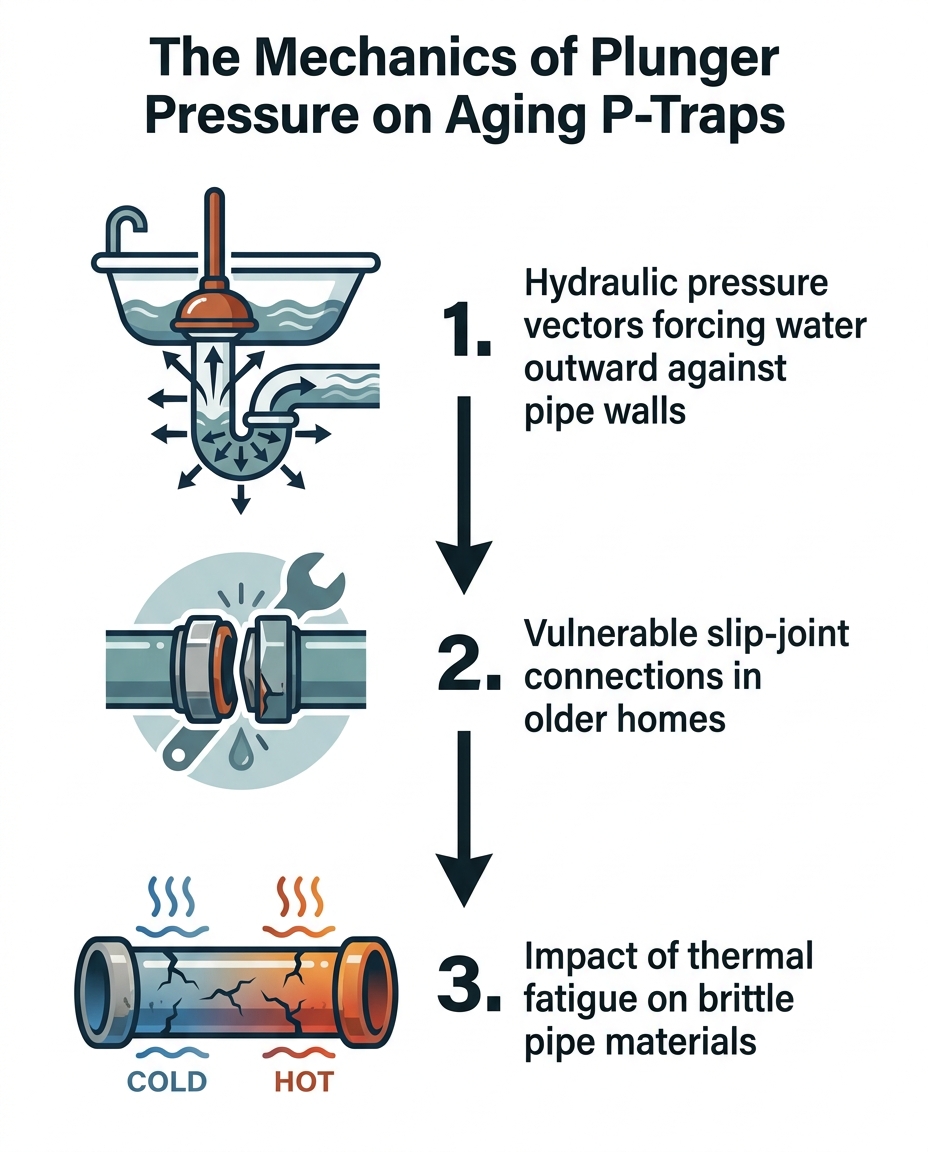
To understand why a plunger can be dangerous to your plumbing, you have to look at basic fluid dynamics. When you place a plunger over a drain and push down, you are not just pushing the clog itself. You are pressurizing the entire column of water trapped inside the pipe between the plunger cup and the blockage. Because water is incompressible, that physical force has to go somewhere. If the blockage is heavily calcified and refuses to move, that intense pressure pushes outward against the pipe walls and the joint connections.
Bathtub drain assemblies are structurally very different from toilets. While a plunger might work for minor toilet blockages where the trap is built directly into the thick porcelain fixture, bathtub drains rely on separate P-traps and slip-joint connections located beneath the floor. These components are designed to hold a small amount of standing water to block hazardous sewer gases from entering your home. They are absolutely not designed to withstand high-pressure spikes (PSI) generated by aggressive plunging. If you are dealing with a stubborn blockage, you likely need clogged drain repair in Jacksonville rather than blunt force.
When you force a plunger down repeatedly, that hydraulic pressure seeks the path of least resistance. Unfortunately, in older Jacksonville IL homes, the path of least resistance is rarely the stubborn clog. Instead, the pressure finds the weakest point in the plumbing assembly, which is almost always a degraded seal or an aging slip-joint beneath the tub.
How Hydraulic Pressure Affects Slip-Joint Traps
A slip-joint trap is the U-shaped section of piping situated directly beneath your bathtub drain. It connects the tub's tailpiece to the main drainage line using threaded slip-nuts and rubber or plastic compression washers. Under normal conditions, gravity gently pulls water through this trap.
When sudden pressure waves from a plunger impact this assembly, the force hits the threaded nuts and rubber washers like a hammer. The outward pressure stresses the threads and forces the compression washers to flex beyond their intended capacity. If the clog does not break free immediately, the pressure wave bounces back and forth within the pipe, violently rattling the slip-joint trap until the weakest component gives way.

Why Older Pipe Joints Are Highly Vulnerable to Pressure Blowouts
Plumbing infrastructure does not last forever. In older Jacksonville IL homes, the materials used to construct drain assemblies—whether brass, early generations of PVC, or galvanized steel—degrade over decades of daily use. The rubber gaskets and slip-nuts that hold these assemblies together are particularly vulnerable. Over time, constant exposure to water, soap, and air causes these rubber seals to dry out, lose their elasticity, and become highly brittle.
This natural degradation is severely accelerated by the local climate. Jacksonville's extreme temperature swings—from freezing, bitter winters to intensely humid, sweltering summers—cause the building materials and pipes within your home to constantly expand and contract. This continuous cycle of expansion and contraction leads to thermal fatigue. The structural integrity of the pipe threads weakens, and the brittle rubber gaskets warp out of shape.
A pipe joint that has been weakened by years of thermal stress and material degradation is a prime candidate for a blowout when subjected to sudden plunger pressure. The brittle rubber can no longer absorb the shock of the hydraulic wave. Instead of flexing, it snaps or dislodges entirely. What begins as a well-intentioned attempt to clear a slow drain instantly blows the trap apart, disconnecting the bathtub from the drainage system entirely.
The Late-Summer Clog Surge: Why Tubs Back Up Right Now
If your bathtub is suddenly struggling to drain, the timing is not a coincidence. The August back-to-school transition puts an enormous amount of sudden, heavy stress on household bathrooms. During the summer, schedules are relaxed, and bathroom usage is often staggered throughout the day. But when the school year begins, multiple family members suddenly need to shower within the same rigid, one-hour window every morning.
This increased daily shower volume leads to a rapid accumulation of debris in the tub trap. Hair, heavy soap scum, bath oils, and exfoliating products wash down the drain in quick succession. Because the pipes do not have time to fully dry out between uses, this mixture turns into a sticky, dense sludge that clings to the walls of the pipe. Over a matter of weeks, this organic blockage hardens and calcifies, forming a solid matrix that severely restricts water flow.
These hardened blockages are highly resistant to the blunt force of a plunger. A plunger is designed to move soft, loose obstructions. When a tub starts backing up consistently after every single shower, the blockage has likely calcified beyond what a rubber cup can safely move. Pushing harder will not dissolve the soap scum matrix; it will only redirect that destructive force into your aging pipe joints. Understanding why your bathtub drain keeps clogging after every shower is the first step in realizing that a plunger is no longer the right tool for the job.
The Warning Signs of an Under-Floor Leak Caused by Plunging
The most dangerous aspect of blowing out a slip-joint trap with a plunger is that the damage is rarely visible immediately. The plumbing assembly is hidden beneath the bathtub, either in a crawlspace, between floor joists, or buried in a concrete slab. When a slip-joint fails, the water from your tub no longer travels into the sewer line. Instead, it drains directly into the subfloor, insulation, or the ceiling of the room below.
One local customer called in this past spring regarding an urgent plumbing issue after a sudden backup. A technician arrived in less than 30 minutes and determined the issue in under five minutes: a trap beneath the floorboards had completely ruptured after aggressive plunging, causing water to pool silently beneath the house. Catching these issues early is critical to preventing massive structural damage.
If you have recently plunged a stubborn bathtub drain in an older home, you must be vigilant for the warning signs of a hidden under-floor leak. If you notice any of the following symptoms, stop using the tub immediately and shut off the water supply to the bathroom:
• Water stains on first-floor ceilings: Discoloration, bubbling paint, or damp drywall on the ceiling directly beneath the second-story bathroom.
• A sudden drop in water resistance: If you are plunging and the plunger suddenly pushes down very easily with no resistance—but the tub still isn't draining properly—you have likely blown the trap off the pipe.
• Damp, musty smells: A persistent odor of mildew or damp earth emanating from the bathroom floorboards, baseboards, or adjacent closets.
• Spongy flooring: Bathroom tiles that suddenly feel loose, or linoleum/wood flooring that feels soft or warped near the base of the tub.
• Unexplained pooling water: Puddles forming in the crawlspace or basement directly beneath the bathroom's footprint.
Slab leaks or under-house leaks caused by blown traps are severe structural emergencies. They require extensive professional remediation to fix the broken plumbing, dry out the subfloor, and prevent hazardous mold growth or wood rot. If you suspect your plunging efforts have compromised your pipes, reaching out for professional help for clearing clogged drains in Springfield and the surrounding areas is essential before the water damage spreads.
Infrastructure-Safe Solutions: Why Professional Clearing is Better
Protecting your home's aging infrastructure is just as important as clearing the immediate clog. The violent hydraulic pressure of plunging is simply too risky for brittle, temperature-stressed pipes. Professional drain clearing focuses on removing the blockage directly without stressing the pipe joints or the surrounding plumbing assembly.
At HRI Plumbing, our professional, infrastructure-safe drain clearing methods actively protect your home's aging pipes from unnecessary damage. Instead of using blunt pressure, we utilize precision tools designed to dismantle the clog from the inside out.
Professional cabling, commonly known as snaking, is a highly targeted method. A flexible metal cable with a specialized auger head is fed down the drain. The auger physically hooks into the matrix of hair and soap scum, breaking it apart and pulling it out of the pipe. Because the cable navigates through the water without pressurizing the water column, there is zero risk of blowing out a slip-joint trap.
For more severe, calcified blockages, hydro jetting offers a safe, highly controlled alternative. Hydro jetting uses specialized nozzles to spray water at a precise, regulated pressure backward against the pipe walls. This scours the interior of the pipe clean, removing years of sticky soap scum and restoring the drain to its original flow capacity without pushing outward against the vulnerable joint connections. Relying on safe hydro jetting services ensures that the clog is completely eradicated while keeping your older plumbing system perfectly intact.
• Aggressive Plunging — How It Works: Forces a high-pressure column of water against the clog and pipe walls. — Risk to Aging Pipes: High risk of blowing out slip-joints and causing under-floor leaks. — Effectiveness on Deep Clogs: Low. Usually bounces off hardened soap scum and hair matrices.
• Professional Cabling — How It Works: Uses a physical auger to hook, break apart, and extract the blockage. — Risk to Aging Pipes: Very low. Does not pressurize the water column or stress the joints. — Effectiveness on Deep Clogs: High. Excellent for pulling out dense hair and organic debris.
• Hydro Jetting — How It Works: Scours pipe interior with precise, controlled, reverse-angled water jets. — Risk to Aging Pipes: Low. Safely cleans the pipe walls without outward pressure spikes. — Effectiveness on Deep Clogs: Maximum. Removes calcified buildup and restores original pipe diameter.
Frequently Asked Questions About Bathtub Clogs and Pipe Damage
Can plunging a drain damage pipes?
Yes, plunging a drain can absolutely damage pipes, particularly in older homes with aging plumbing infrastructure. When you aggressively plunge a stubborn clog, you generate intense hydraulic pressure that pushes outward against the pipe walls. This sudden pressure spike can easily rupture weak slip-joint connections and brittle rubber gaskets beneath the tub, leading to severe under-floor water leaks.
Why does my tub keep getting clogged?
Your tub keeps getting clogged due to the rapid accumulation of hair, sticky soap scum, and bath products, which heavily increases during busy periods like the August back-to-school transition. As multiple family members take daily showers, the pipes do not have time to dry out, allowing this organic debris to bind together into a dense, hardened matrix. Over time, this matrix calcifies inside the P-trap, creating a stubborn blockage that restricts water flow after every shower.
What happens if you plunge a bathtub too hard?
If you plunge a bathtub too hard, the trapped water seeks the path of least resistance, which is usually the threaded slip-nuts holding the drain assembly together. The intense physical force can blow out the P-trap entirely, disconnecting the tub from the drainage line. When this happens, all the water draining from your bathtub will pour directly into your subfloor or the ceiling below, causing massive, hidden water damage.
Is it safe to plunge a bathtub?
Gentle plunging can be safe for very minor, surface-level clogs located right at the drain opening. However, aggressive plunging is highly dangerous for deep blockages, especially in older homes with temperature-stressed, brittle pipes. If a few gentle pushes with a plunger do not immediately clear the slow drain, it is no longer safe to continue, and you should switch to a professional cabling method.
Are liquid drain cleaners safer than plunging?
No, liquid drain cleaners are not safer than plunging and often present equal or greater risks to your plumbing. These store-bought chemicals rely on caustic, exothermic reactions that generate intense heat to melt clogs. This extreme heat can warp plastic pipes, degrade aging metal joints, and create highly hazardous, toxic conditions for any professional plumber who has to step in to fix the pipe later.
Stop Plunging and Protect Your Home's Plumbing Today
Knowing exactly when to put the plunger down is the absolute best way to prevent severe, hidden water damage in your home. A slow-draining bathtub is a highly solvable problem when it is handled with the right professional tools, but trying to force a clog through brittle, aging pipes will only turn a minor inconvenience into a major structural emergency. Do not risk blowing out your tub's trap. Schedule a professional inspection today to clear the blockage safely, restore your drainage, and protect your older home's valuable plumbing infrastructure.


