



The Sputtering Shower: Diagnosing Uneven Water Pressure
Your morning shower has gone from a relaxing, full-pressure cascade to a sputtering, uneven spray, making removing mineral buildup from showerheads caused by local hard water a top priority for your home. You turn the dial to maximum heat and flow, but instead of a steady stream, water shoots out in rogue directions, or worse, barely trickles from half the nozzles. This progressively weaker water pressure is a common frustration for homeowners, but it rarely points to a catastrophic failure in your pipes. Instead, you are likely dealing with the stubborn crust of calcium and magnesium clogging the tiny apertures of your fixture.
As you approach early fall indoor plumbing maintenance, our team at HRI Plumbing recommends addressing this scaling as a perfect weekend project before winter weather drives up your indoor hot water demand. The key is knowing how to safely descale the fixture without ruining its finish, and recognizing the critical decision point of when a simple cleaning is no longer enough and professional replacement is required.
If you are dealing with severe flow restrictions or suspect deeper issues, explore our residential plumbing services or reach out for professional shower installation and replacement.
Understanding the Severity of Local Hard Water Scaling
To effectively fix a clogged showerhead, you first need to understand the root cause of the blockage. Hard water is defined by its high concentration of dissolved minerals, primarily calcium and magnesium. While these minerals are completely safe for human consumption, they are notoriously aggressive on household plumbing. When hard water flows through your pipes, it leaves behind microscopic trace deposits. Over time, these deposits accumulate, forming a tough, chalky substance known as limescale.
Central Illinois groundwater and municipal water sources are naturally very hard, driving year-round scaling issues for local homeowners. In fact, Jacksonville IL residential water systems frequently exceed 120 to 180 milligrams per liter (mg/L) of calcium carbonate. At these concentrations, water is classified as "hard" to "very hard." In our years of hands-on experience at HRI Plumbing dealing with Jacksonville's specific municipal and well water profiles, our technicians have seen that local fixtures degrade much faster than the national average. You can learn more about how Jacksonville's water hardness impacts fixtures to see just how aggressive this mineral content can be.
The Science of Limescale Formation
Limescale does not form evenly across all plumbing fixtures. It aggressively targets areas where water is heated and where flow is restricted. Here is why your showerhead takes the brunt of the damage:
• Thermal precipitation: When calcium-rich water is heated by your water heater, the heat causes the dissolved calcium carbonate to precipitate, or drop out of suspension, much faster than it would in cold water.
• Aeration and evaporation: Showerheads introduce air into the water stream to improve pressure. When the water stops flowing, the remaining droplets at the nozzle faces evaporate rapidly, leaving pure mineral crust behind.
• Tiny apertures: Modern showerheads use very small rubber or plastic nozzles to restrict flow and save water. It only takes a tiny grain of calcification to completely block these micro-openings.
Because of this rapid scaling rate, we often remind our Jacksonville customers that they must perform fixture maintenance far more frequently than homeowners in regions with naturally soft water. In our experience, ignoring the buildup forces your plumbing system to work harder, pushing back-pressure into the pipes and valves.
The Hidden Dangers of Harsh Chemicals on Modern Finishes
The Problem: When faced with a severely clogged showerhead and dropping water pressure, the immediate temptation is to reach for the strongest chemical cleaner under the sink. Homeowners often grab industrial descalers, heavy bleach, or abrasive scrubbing pads in an attempt to blast the crust away quickly.
The Cause: The frustration of uneven water pressure drives a "more is better" approach to cleaning. Because limescale feels like a rock-hard substance, it seems logical that it requires a highly caustic chemical to dissolve it. However, modern bathroom fixtures are not made of solid, untreated brass or steel.
The Solution: You must avoid harsh chemicals entirely to protect your investment. Caustic cleaners will rapidly strip modern finishes. Matte black, brushed nickel, and oil-rubbed bronze are particularly vulnerable. These finishes are often applied using Physical Vapor Deposition (PVD) or specialized powder coatings. Heavy-duty chemical descalers contain acids that are too aggressive, leading to irreversible pitting, discoloration, and peeling of the finish.
Furthermore, caustic cleaners degrade the internal rubber gaskets, silicone nozzles, and plastic mixing components inside the showerhead. Bleach causes rubber to undergo embrittlement, meaning it dries out, cracks, and eventually fails, leading to leaks behind the shower wall. The safest approach for Jacksonville IL residential water systems—and the method our HRI Plumbing experts use and recommend—is using a mild acid, specifically the acetic acid found in standard distilled white vinegar. Vinegar gently dissolves the calcium carbonate bonds without reacting aggressively with the metal finishes or internal rubber seals.
A Plumber-Approved, Finish-Safe Descaling Method
Restoring your shower's water pressure does not require specialized tools or expensive chemical kits. In fact, the most effective method is one you can safely perform yourself during your early fall indoor plumbing maintenance routine. This process cleans the fixture in place, eliminating the risk of cross-threading the shower arm or damaging the in-wall mixing valve.
Materials you will need:
• Distilled white vinegar (5% acidity is perfect)
• A sturdy, leak-proof plastic bag (quart or gallon size, depending on the fixture)
• Thick rubber bands or heavy-duty zip ties
• A soft-bristled toothbrush
• A microfiber cloth
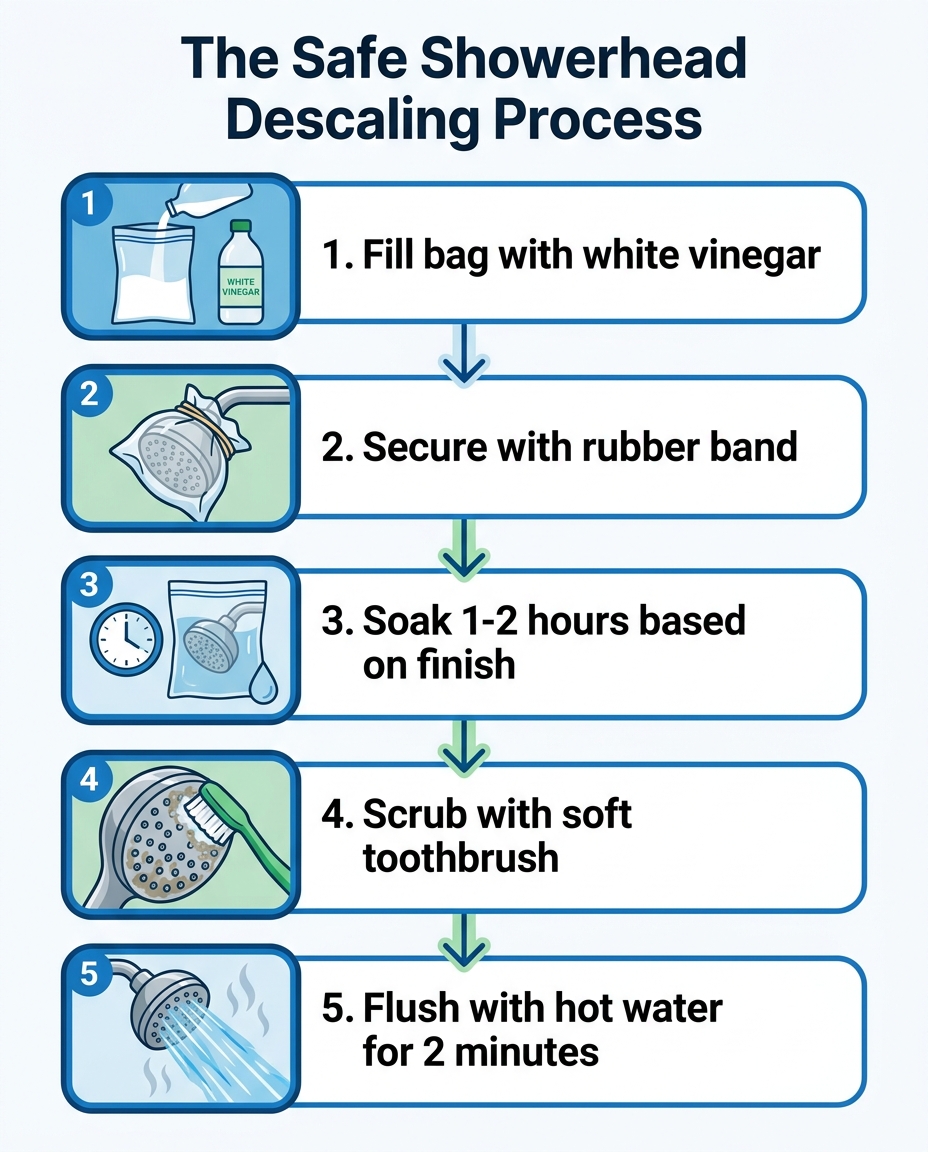
Step 1: Prepare the Vinegar Soak
Begin by inspecting the showerhead to ensure there are no existing cracks in the plastic housing. Take your sturdy plastic bag and fill it roughly halfway with the distilled white vinegar. You need enough liquid volume to completely submerge the entire face of the showerhead, including all the nozzles, without the bag overflowing when you lift it into place.
Step 2: Secure and Soak
Carefully lift the bag filled with vinegar up and over the showerhead. Ensure the mineral-crusted nozzles are fully submerged in the liquid. Gather the top of the bag tightly around the metal shower arm (the pipe protruding from the wall). Wrap a thick rubber band tightly around the gathered plastic to hold the bag securely in place.
Crucial Soaking Times:
• Standard Chrome: 2 to 3 hours.
• Brushed Nickel or Oil-Rubbed Bronze: 1 to 2 hours maximum.
• Matte Black: 30 to 45 minutes maximum (check frequently, as prolonged acid exposure can cloud matte finishes).
Step 3: Scrub and Flush
Once the soaking time is complete, carefully remove the rubber band and dump the vinegar down the drain. The heavy white crust should now look like a soft, gel-like paste. Take your soft-bristled toothbrush and gently scrub the face of the showerhead, paying special attention to the individual silicone nozzles. You can use your thumb to gently massage the rubber nozzles to break loose any internal grit.
Finally, step out of the shower enclosure and turn the hot water on full blast. Run the water for at least two solid minutes. This high-pressure flush forces all the softened calcium deposits out of the internal chambers and down the drain. Wipe the fixture dry with a microfiber cloth to prevent immediate water spotting.

Recognizing Hard Water Damage Across Other Plumbing Systems
While a sputtering showerhead is the most visible symptom of hard water, it is rarely an isolated issue. A heavily scaled showerhead is almost always an indicator of broader hard water issues silently impacting the rest of your home. The same calcium carbonate that clogs your shower nozzles is aggressively coating the inside of your water heater, your dishwasher, and your washing machine.
Because the aggressive local water profile means minerals precipitate out rapidly under heat, water heaters are particularly vulnerable. Inside a standard tank water heater, calcium settles to the bottom, forming a thick layer of rock-hard sediment. This sediment acts as an insulator between the heating element (or gas burner) and the water. As a result, the system has to run longer and burn more energy just to heat the water to your desired temperature, severely impacting its efficiency and lifespan.
Signs your water heater is suffering from scale:
• Popping or rumbling noises: This occurs when water gets trapped beneath the layer of sediment, boils, and bubbles up through the mineral crust.
• Dwindling hot water supply: Sediment physically takes up space inside the tank, reducing the overall volume of hot water available for your home.
• Fluctuating water temperatures: Scale buildup on the thermostat sensors can cause the unit to misread the internal temperature.
We recently had a Jacksonville homeowner reach out to HRI Plumbing during the summer when their water heater failed unexpectedly after years of ignored sediment buildup. Our technicians dispatched quickly, and we installed a new unit thoroughly and professionally. Addressing these broader issues before winter demands peak is critical. Regular flushing can extend the life of your unit, so it pays to stay on top of your water heater repair and maintenance to protect your home across all Jacksonville IL residential water systems.
Knowing When It's Time to Upgrade Your Shower Fixtures
Descaling is a highly effective maintenance routine, but it is not a permanent cure. There comes a point where DIY cleaning is no longer effective, and professional replacement becomes the necessary next step. Hard water can cause permanent structural damage to the fixture that vinegar simply cannot reverse.
As you conduct your early fall indoor plumbing maintenance, our plumbing pros recommend looking out for these signs that indicate it is time for an upgrade:
• Leaking from the main seam: If water is spraying out of the sides or the back casing of the showerhead rather than the nozzles, the internal pressure has likely blown the main O-ring or cracked the housing. This cannot be repaired.
• Cracked plastic nozzles: When silicone or plastic nozzles become brittle from age and hard water exposure, they tear. A torn nozzle will permanently alter the spray pattern.
• Persistent low pressure: If you have completed a thorough vinegar soak and flush, but the pressure remains terribly low, the internal flow restrictor or the mixing valve behind the wall may be permanently calcified.
• Corroded threading: If the connection point between the shower arm and the showerhead is green, rusty, or fused together with scale, attempting to force it off can snap the pipe inside the wall.
When severe internal calcification cannot be dissolved, upgrading to a modern, scale-resistant showerhead is the smartest move. Many newer models feature self-cleaning silicone nozzles that resist mineral adhesion. If you are considering a broader update, integrating new fixtures is a seamless part of professional bathroom remodeling services.
A critical safety warning: While cleaning a showerhead is a safe DIY task, dismantling in-wall pipes, replacing shower arms, or servicing the internal thermostatic mixing valve requires a licensed professional. Attempting to force calcified plumbing components can result in hidden wall leaks and catastrophic water damage.
Frequently Asked Questions About Hard Water and Fixture Maintenance
How do I clean my showerhead without removing it from the wall?
The safest way to clean a showerhead in place is by using the plastic bag method. Fill a sturdy plastic bag halfway with distilled white vinegar and lift it over the fixture until the nozzles are fully submerged. Secure the bag tightly to the shower arm pipe using a thick rubber band or zip tie. This allows the mild acid to dissolve the mineral buildup without requiring you to use wrenches or risk damaging the pipe threads.
How long should I soak my showerhead to remove hard water deposits?
Soaking times depend entirely on the finish of your specific fixture. Standard chrome fixtures can safely soak in white vinegar for 2 to 3 hours to dissolve heavy scale. However, delicate finishes like matte black, brushed nickel, or oil-rubbed bronze should only soak for 30 to 60 minutes. Prolonged exposure to even mild acids can cloud, pit, or strip these modern finishes.
Why is my shower water pressure suddenly uneven?
Uneven or sputtering water pressure is typically caused by calcium and magnesium deposits clogging the individual nozzles of the showerhead. As Jacksonville IL residential water systems push hard water through the fixture, the minerals precipitate out and form a hard crust when the water evaporates. When half of the tiny holes are blocked by limescale, the water is forced out of the remaining open nozzles at erratic angles, creating an uneven spray.
Does vinegar dissolve calcium buildup?
Yes, distilled white vinegar is highly effective at dissolving calcium carbonate, which is the primary component of limescale. Vinegar contains acetic acid, a mild acid that safely breaks the chemical bonds of the mineral deposits without the need for harsh scrubbing. It turns the rock-hard scale into a soft, gel-like paste that can be easily flushed away with hot water.
Can hard water permanently ruin a showerhead's internal mechanisms?
Yes, prolonged exposure to severe hard water can cause irreversible damage to the internal components of a showerhead. The calcium buildup can permanently fuse the flow restrictor, degrade the rubber O-rings, and cause the plastic housing to crack under the increased back-pressure. When the internal seals fail, the fixture will begin to leak from the seams, indicating that it must be replaced.
Are there whole-home solutions to prevent showerhead scaling in Central Illinois?
The most effective long-term solution to prevent scaling across all your fixtures is installing a whole-home water conditioning or softening system. These systems intercept the water as it enters your home, actively removing the calcium and magnesium ions before they ever reach your pipes, water heater, or showerheads. This preventative approach protects your entire plumbing infrastructure from the aggressive local water profile.
Restoring Your Home's Comfort and Water Flow
Restoring full, even water flow to your daily routine is entirely achievable with safe, routine maintenance. By understanding the impact of local hard water and using a finish-safe vinegar soak, you can effectively dissolve stubborn mineral buildup without risking damage to your valuable bathroom fixtures. Taking the time to perform this early fall indoor plumbing maintenance ensures your system runs smoothly heading into the colder months.
However, if the scaling is too severe, the fixture is leaking, or you are simply ready to upgrade your bathroom's comfort and aesthetic, do not hesitate to seek professional help. For expert guidance, reliable upgrades, and peace of mind, reach out to our team at HRI Plumbing to schedule your shower installation and replacement today.


