



The Eco-Friendly Marketing Myth vs. Long-Term Plumbing Reality
Upgrading to a modern, water-saving fixture is often sold as a flawless home improvement with zero downsides, but when you ask, "Do dual-flush toilets actually save enough water to justify the cost?" the answer requires looking past the eco-friendly marketing. The common myth is that high-efficiency fixtures operate exactly like traditional models, just with a smaller environmental footprint. In reality, achieving those impressive conservation numbers requires complex internal engineering that fundamentally changes how your bathroom fixture operates, ages, and eventually fails.
Balancing your household's desire for water conservation against the hidden maintenance realities of these modern systems is a concrete problem we see Jacksonville homeowners face every day. This is especially true during the early fall indoor home improvement season, a time when families are actively evaluating fixture upgrades before holiday hosting begins. You want a bathroom that looks great and operates efficiently, but as our HRI Plumbing technicians often remind customers, you also want a system that won't leave you stranded with a running tank on Thanksgiving morning.
Before you commit to a complex new fixture, it pays to understand the full scope of ownership. For those exploring comprehensive plumbing services, looking at the long-term mechanical reliability is just as important as the sticker on the box. Whether you are scheduling a routine inspection or planning a complete toilet repair and installation, weighing the actual water volume saved against the frequency of future part replacements ensures you make a choice you will be happy with years down the line.
Breaking Down the Volume: How Much Water is Actually Saved?
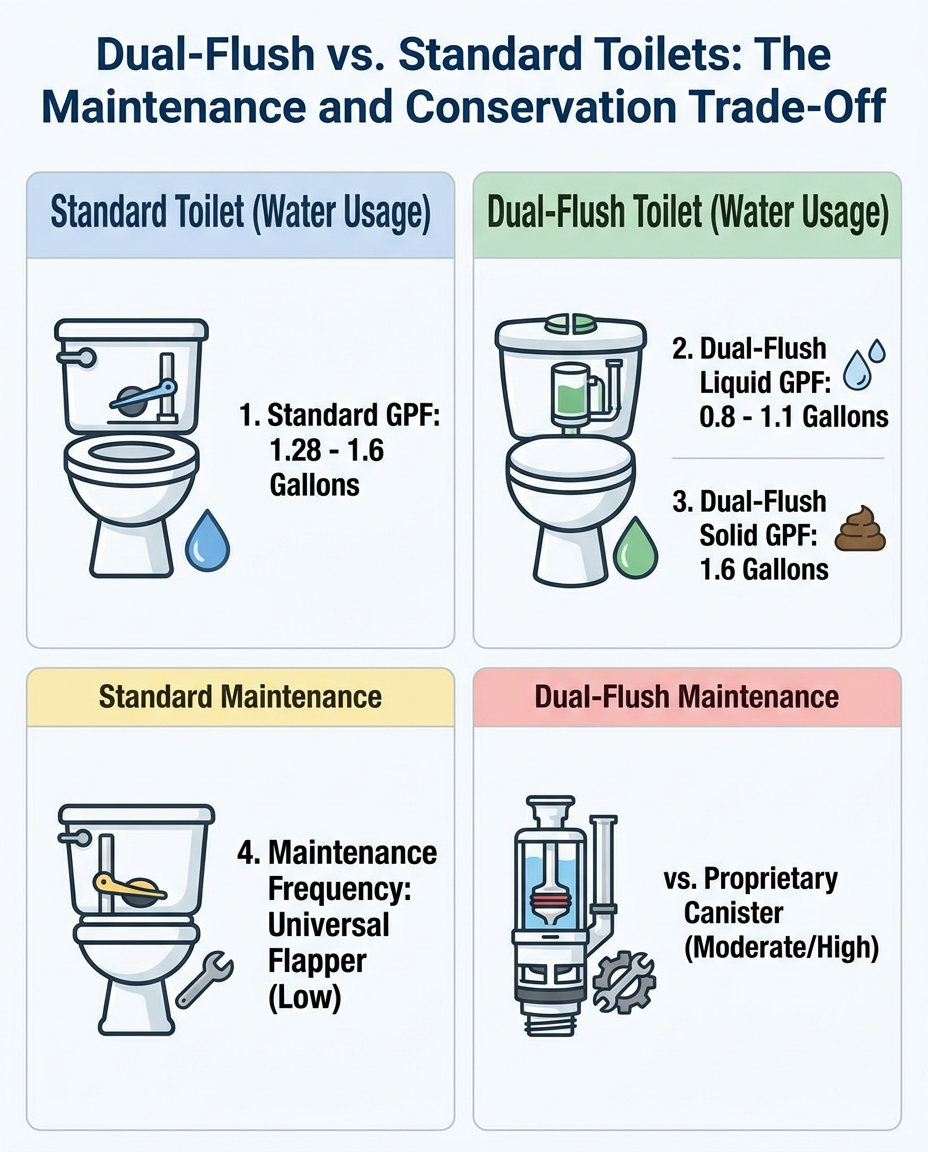
To understand the true value of a dual-flush system, you have to look at the raw numbers. Modern plumbing regulations have already drastically reduced household water consumption compared to the fixtures installed in the 1980s and 1990s. The current federal standard mandates that new residential toilets use no more than 1.6 gallons per flush (GPF). Many standard single-flush models today operate at an even more efficient 1.28 GPF to meet strict environmental guidelines.
Dual-flush models push this efficiency further by offering two distinct flush volumes. The liquid waste button typically releases between 0.8 and 1.1 gallons, while the solid waste button utilizes the full 1.6 gallons (or 1.28 gallons on ultra-high-efficiency models). To earn the Environmental Protection Agency's (EPA) WaterSense certification, a toilet must use at least 20 percent less water than the current federal standard while still maintaining strict performance benchmarks for waste removal.
Comparing Flush Volumes at a Glance:
• Legacy (Pre-1994) — Liquid Waste GPF: 3.5 - 5.0 Gallons — Solid Waste GPF: 3.5 - 5.0 Gallons — Average Daily Use (Per Person): ~17.5 - 25.0 Gallons
• Standard Modern (Federal Max) — Liquid Waste GPF: 1.6 Gallons — Solid Waste GPF: 1.6 Gallons — Average Daily Use (Per Person): ~8.0 Gallons
• High-Efficiency Single Flush — Liquid Waste GPF: 1.28 Gallons — Solid Waste GPF: 1.28 Gallons — Average Daily Use (Per Person): ~6.4 Gallons
• Standard Dual-Flush — Liquid Waste GPF: 0.8 - 1.1 Gallons — Solid Waste GPF: 1.6 Gallons — Average Daily Use (Per Person): ~4.5 - 5.5 Gallons
If you calculate the theoretical household water volume savings over a year, the numbers are notable. A family of four, each flushing five times a day, will use roughly 11,680 gallons annually with a standard 1.6 GPF toilet. That same family, utilizing the dual-flush system correctly (assuming a 4-to-1 ratio of liquid to solid flushes), might use around 7,500 gallons. That is a savings of over 4,000 gallons of water per year. However, as we will explore, that impressive conservation metric must be weighed against the mechanical complexity required to achieve it.

Under the Lid: Push-Button Dual-Flush Canister Valves vs. Traditional Flappers
To truly evaluate the long-term viability of these fixtures, you have to look inside the tank. The mechanical differences between push-button dual-flush canister valves vs. traditional flappers represent the technical core of this debate. A traditional toilet relies on brilliant, gravity-fed simplicity. When you press the handle, a lever lifts a chain, which pulls a thick rubber flapper up from the flush valve. Water rushes into the bowl, and as the tank empties, gravity pulls the flapper back down to seal the opening so the tank can refill. It is a system with very few moving parts, making it incredibly resilient.
Dual-flush systems, by contrast, utilize highly intricate mechanics. Instead of a simple rubber flap, they feature a central plastic tower known as a canister valve. Inside this tower are delicate push rods, springs, and a thin silicone seal at the very bottom. When you press the half-flush button, the mechanism lifts the canister just enough to release a metered amount of water before snapping shut. The full-flush button lifts the canister higher and holds it open longer.
Common Failure Points Compared:
• Traditional Flappers: The most common issues are a tangled lift chain or a rubber flapper that eventually warps after a decade of sitting in chlorinated water. Both are immediately visible and straightforward to diagnose.
• Canister Valves: The failure points are far more numerous. The internal springs can rust or lose tension, the push-buttons can stick in the downward position, and the thin silicone seals can degrade or stretch.
Because there are simply more moving parts in a canister valve, there is an inevitably higher probability of mechanical wear. A standard flapper might last seven to ten years without a second thought. A dual-flush canister seal often requires attention much sooner, especially when introduced to challenging municipal water conditions.
The Central Illinois Hard Water Factor
Mechanical complexity is only half the story; the environment in which those mechanics operate dictates their lifespan. Municipal water sources naturally contain dissolved minerals, primarily calcium and magnesium. When water has a high concentration of these minerals, it is classified as "hard water." This is a critical factor for homeowners to consider. In our years of servicing bathrooms across the region, the HRI Plumbing team has seen firsthand how Jacksonville IL's municipal water hardness accelerates scale buildup on the intricate internal mechanisms of dual-flush toilets, leading to premature leaks or sticking buttons.
Here is how the scaling process attacks your plumbing fixtures. As hard water sits in your toilet tank, the calcium and magnesium ions slowly precipitate out of the water, clinging to submerged surfaces. Over time, this forms a hard, chalky crust known as scale. On a traditional, thick rubber flapper, a minor amount of scale buildup rarely prevents the heavy rubber from forming a watertight seal over the flush valve. The sheer weight of the water above it forces the flapper into place.
Why Canisters Are Highly Vulnerable:
• Delicate Silicone Seals: The seal at the bottom of a dual-flush canister is often a very thin, flexible silicone ring. Even a microscopic layer of calcium scale can prevent this ring from seating perfectly flush against the valve opening.
• Ghost Flushing: When that seal fails to close completely, water silently trickles from the tank into the bowl. The fill valve then kicks on intermittently to replace the lost water—a phenomenon known as "ghost flushing."
• Sticking Mechanisms: Scale doesn't just attack the seal. It builds up inside the plastic guide tubes and on the push-rod springs. This causes the buttons on top of the tank to stick, forcing the toilet to run continuously until you manually jiggle the buttons free.
This accelerated wear drastically increases the frequency of required maintenance. The thousands of gallons of water you saved by using the half-flush feature can quickly be erased if your toilet silently leaks water down the drain for weeks because of a calcified canister seal.
Maintenance Hassles: Proprietary Parts vs. Universal Fixes
When evaluating the true "cost" of ownership for any household fixture, you must factor in the time, frustration, and parts availability required to keep it running. This is where the divide between traditional and modern high-efficiency toilets becomes starkest.
The Traditional Flapper Advantage:
• Universal Availability: If a standard flapper fails, you can walk into any local hardware store, home center, or even some grocery stores and find a universal replacement on the shelf.
• Standardized Sizing: Most traditional toilets use a standard 2-inch or 3-inch flush valve. You rarely need to know the specific make and model of your toilet to find a part that works perfectly.
• Simple Swaps: Replacing a flapper is a quick task that does not require dismantling the heavy porcelain tank.
The Dual-Flush Canister Reality:
• Proprietary Components: There is no such thing as a "universal" dual-flush canister. The mechanisms are highly proprietary, meaning a Kohler canister will not fit a Toto toilet, and often, parts are specific to individual models within the same brand.
• Sourcing Frustrations: Finding the exact replacement seal or canister tower usually involves searching for a faded serial number stamped inside the wet porcelain tank, cross-referencing it online, and waiting days for a specialized plumbing supply house to ship the part.
• Complex Replacements: While swapping a silicone seal is sometimes straightforward, replacing a completely failed canister valve assembly often requires unbolting the entire water tank from the bowl. This involves replacing the tank-to-bowl gasket and carefully re-torquing the bolts to avoid cracking the porcelain—a delicate process that almost always requires a professional touch.
For many homeowners, the realization that they cannot quickly resolve a running toilet on a Sunday afternoon is a frustrating surprise. Ultimately, the maintenance hassle and the need for professional intervention often offset the environmental utility savings that initially made the dual-flush model so appealing.
Factoring Toilet Upgrades into Your Broader Bathroom Remodel
Choosing the right toilet is rarely an isolated decision; it usually happens as part of a larger home improvement project. When you are planning bathroom remodeling in Jacksonville, every fixture choice impacts the overall reliability of the room. You have to weigh your personal environmental conservation goals against your household's tolerance for ongoing fixture maintenance.
We recently saw exactly how these interconnected plumbing decisions play out with a local homeowner. They originally called our HRI Plumbing team about a bad leak underneath their home on a slab. After our technicians arrived, walked through the available options, and fixed the major underlying plumbing problem, the customer decided to upgrade their entire setup. They ultimately opted for all new plumbing lines, a new exhaust fan, and completely new toilet fittings. In comprehensive overhauls like this, we always advise that selecting a toilet with a reliable, easy-to-maintain flush mechanism ensures that your beautiful new bathroom remains functional and stress-free.
Beyond the flush mechanism, there are other critical considerations for your upgrade. You need to evaluate the bowl shape (elongated vs. round) and decide between standard vs. comfort height toilets. Comfort height models, which sit a few inches taller than standard bowls, are increasingly popular for their accessibility, but they must be paired with a flush system that can adequately clear the bowl.
This is where our honest, local expertise at HRI Plumbing becomes invaluable for helping homeowners weigh actual utility savings against the realities of Central Illinois water conditions and maintenance. Our professional guidance ensures that you don't just buy a toilet that looks good on paper, but one that performs reliably in your specific home environment. The verdict we share with our customers? Dual-flush systems are excellent tools for water conservation, but they require a firm commitment to specialized, periodic maintenance to keep them operating efficiently.
Frequently Asked Questions About Dual-Flush Toilets
Are dual flush toilets worth the investment?
They offer excellent water conservation, but the total value depends on your willingness to perform specialized maintenance. If your primary goal is reducing your environmental footprint and lowering your monthly water volume usage, a dual-flush model delivers measurable results. However, if you prefer a "set it and forget it" fixture that requires minimal upkeep over a decade, the added mechanical complexity might negate the upfront appeal. You must weigh the utility savings against the likelihood of future professional service calls.
What are the primary disadvantages of a dual flush toilet?
The main drawbacks center around more complex internal parts, proprietary replacement components, and a higher susceptibility to hard water scaling. Because the internal canister valve relies on intricate springs, push-rods, and delicate silicone seals, there are simply more points of failure than a traditional gravity flapper. Additionally, when these parts do fail, you cannot easily find universal replacements at a local hardware store, often resulting in longer wait times for repairs.
Do dual flush toilets require more maintenance?
Yes, the intricate push-button mechanisms and delicate seals typically require more frequent professional attention than traditional flappers. A standard rubber flapper is robust and can withstand years of submersion before warping. In contrast, the thin seals on a dual-flush canister are highly sensitive to mineral buildup and chemical degradation. Keeping the dual-flush mechanism operating smoothly often requires periodic cleaning of the internal tower and more frequent seal replacements.
How do hard water deposits affect dual flush valves?
Minerals build up on the internal canister seals, preventing them from closing completely and causing the toilet to run continuously. Hard water contains high levels of calcium and magnesium, which precipitate out and form a chalky scale on submerged plumbing parts. When this scale forms on the delicate silicone ring at the base of a dual-flush canister, it breaks the watertight seal. This leads to silent "ghost flushing" that wastes significant amounts of water.
How much water does a dual flush actually save?
By using 0.8 to 1.1 gallons for liquid waste instead of 1.6 gallons, a household can save thousands of gallons of water annually. For a typical family of four, utilizing the half-flush option for liquid waste can reduce toilet water consumption by roughly 30 to 40 percent over the course of a year. While this is a substantial volume of water conserved, it is important to ensure the toilet is well-maintained so that silent tank leaks do not erase those conservation gains.
Make an Informed Decision for Your Home's Plumbing
Choosing the right fixtures for your bathroom is ultimately about balancing your desire for modern water conservation with the practical realities of home maintenance. Dual-flush toilets represent a fantastic leap forward in eco-friendly engineering, but they are not entirely maintenance-free. Understanding how local water conditions affect delicate internal valves ensures you aren't caught off guard by a running tank or a sticking push-button.
You don't have to navigate these technical plumbing decisions alone. When you consult with our team at HRI Plumbing, we help you evaluate your specific household needs, assess your home's water hardness, and select a fixture that provides both efficiency and long-term reliability. If you are planning a fall plumbing upgrade or need an expert assessment of your current fixtures, reach out to schedule a toilet repair and installation consultation today. Make a choice that delivers lasting performance for years to come.


