




The Myth of Massive Demolition in Historic Home Plumbing
If you are researching PEX vs. Copper Piping: What We Recommend for Retrofits in Older Homes, you might believe the pervasive myth that upgrading your plumbing requires destroying every original architectural detail. Many homeowners put off replacing failing pipes because they fear a contractor will need to tear down entire walls of original lath and plaster just to route new lines. The reality is that the material you choose dictates the intrusiveness of the project.
Balancing traditional building materials with modern plumbing alternatives is the key to a successful retrofit. For homes built pre-1950, you need a solution that protects the structural integrity of the house while ensuring reliable water flow. Making this decision during your early fall pre-winter prep is essential, as waiting until freezing temperatures arrive limits your options and increases the risk of a catastrophic burst.
To help you navigate this process, you can explore our repiping and remodeling services to see how we protect your property during major upgrades.
The Copper Standard: Proven Longevity and Tradition
For decades, rigid copper piping has been the gold standard in residential plumbing. It boasts a proven track record of 50 years or more under normal water conditions. Copper is naturally resistant to corrosion, prevents bacterial growth, and aligns perfectly with the historical accuracy of homes built pre-1950. However, when you are retrofitting an existing, fully finished older home, copper presents distinct physical limitations.
Because copper is entirely rigid, installing it inside enclosed wall cavities requires a specific, often invasive process. To understand why this traditional material impacts your home's structure so heavily, consider the steps required for a standard copper retrofit:
1. Extensive Wall Opening: Technicians must cut large, continuous channels into the plaster or drywall to accommodate straight, rigid lengths of pipe.
2. Navigating Settled Framing: Older homes feature framing that has settled and shifted over decades. Routing a completely straight pipe through misaligned studs often requires drilling larger holes or notching structural beams.
3. Fitting and Securing: Every change in direction requires a hard elbow joint to be physically attached to the straight sections.
4. Soldering the Joints: A technician must use an open flame torch to solder every single joint, requiring ample physical space to work safely inside the wall.
If you are currently replacing cast iron pipes in historic homes, you already know how labor-intensive patching historic wall materials can be. Copper demands a similar level of restoration work once the plumbing is complete.
Why Copper Requires More Wall Access
The mechanics of soldering joints in confined spaces dictate the amount of demolition required. A plumber cannot safely operate a blowtorch inside a three-inch wall cavity surrounded by dry, century-old timber without significant clearance. This fire risk means that even for a simple 90-degree turn, large sections of the wall must be removed to provide a safe working radius and proper ventilation. Furthermore, because copper cannot bend around obstacles like ductwork, electrical wiring, or original masonry, the installation path must be completely cleared, leading to more extensive disruption of your interior finishes.
The PEX Advantage: Flexibility and Preservation
Cross-linked polyethylene, commonly known as PEX tubing, has revolutionized the way we approach plumbing upgrades in historic properties. Unlike rigid metals, PEX is a highly durable, flexible plastic tubing that can bend and weave around existing obstacles inside your walls. This flexibility is the primary reason PEX minimizes demolition and preserves the architectural integrity of older properties during a complex retrofit.
The greatest advantage of PEX is the fishing technique. Because the tubing is supplied in long, continuous rolls, plumbers can feed it through small access holes cut strategically at the top and bottom of a wall cavity. Instead of trenching a massive channel through your original plaster, the flexible line is simply routed down through the existing framing, bypassing old wiring and structural quirks. This method preserves original interior finishes, drastically reducing the need for extensive drywall or plaster repair once the plumbing work is done.
As a team with deep local expertise in retrofitting historic Central Illinois homes, we prioritize maintaining your property's structural integrity without compromising modern plumbing reliability. We understand that in Jacksonville IL historic districts, maintaining original woodwork, moldings, and wall textures is a top priority. PEX allows us to upgrade your water delivery system quietly behind the scenes. The speed of installation also significantly reduces overall project disruption, meaning your home is back in working order days faster than a traditional rigid pipe installation.
Drafty Walls and Deep Freezes: A Midwest Climate Challenge
The Problem: The exterior walls of properties built decades ago rarely feature modern insulation. Original lath and plaster construction leaves large, empty voids between the exterior siding and your interior living space. During the harsh freezing winters of Central Illinois, these drafty, uninsulated cavities allow frigid air to circulate directly against any plumbing routed along the exterior framing.
The Cause: Shifting foundations in older homes create micro-cracks around windows, sills, and baseboards. These gaps turn plumbing cavities into high-risk freeze zones during cold snaps. The wind chill effect inside the wall can drop the ambient temperature around the pipes well below freezing, even if your thermostat is set to 70 degrees inside.
The Solution: Early fall pre-winter prep is the critical window for addressing vulnerable plumbing before deep freezes hit. Upgrading your pipes before November ensures your system can handle the temperature drop. For example, one homeowner reached out last fall with a major leak underneath their home on a slab foundation. The harsh weather had exploited a vulnerability, and the situation required replacing all the plumbing, the exhaust fan, and toilet fittings. We completed the job right on the discussed timeframe, protecting the home from further seasonal damage.
If you suspect your older home is at risk this winter, scheduling repiping services in Jacksonville before the first major frost is the safest way to prevent a catastrophic burst.
Freeze Resistance: How PEX and Copper Handle the Cold
When comparing PEX and copper, their physical reaction to freezing temperatures is one of the most critical factors for Midwest homeowners. Water expands by roughly 9% when it turns to ice. How your plumbing material handles that expansion determines whether you experience a minor inconvenience or a major flood.
Copper piping is highly susceptible to splitting under freezing conditions. Because the metal is entirely rigid, it has zero capacity to absorb the outward pressure of expanding ice. The pressure builds along the pipe until it finds the weakest point—usually a soldered joint or a seam—and splits the metal open. Once the ice thaws, water pours freely inside your walls.
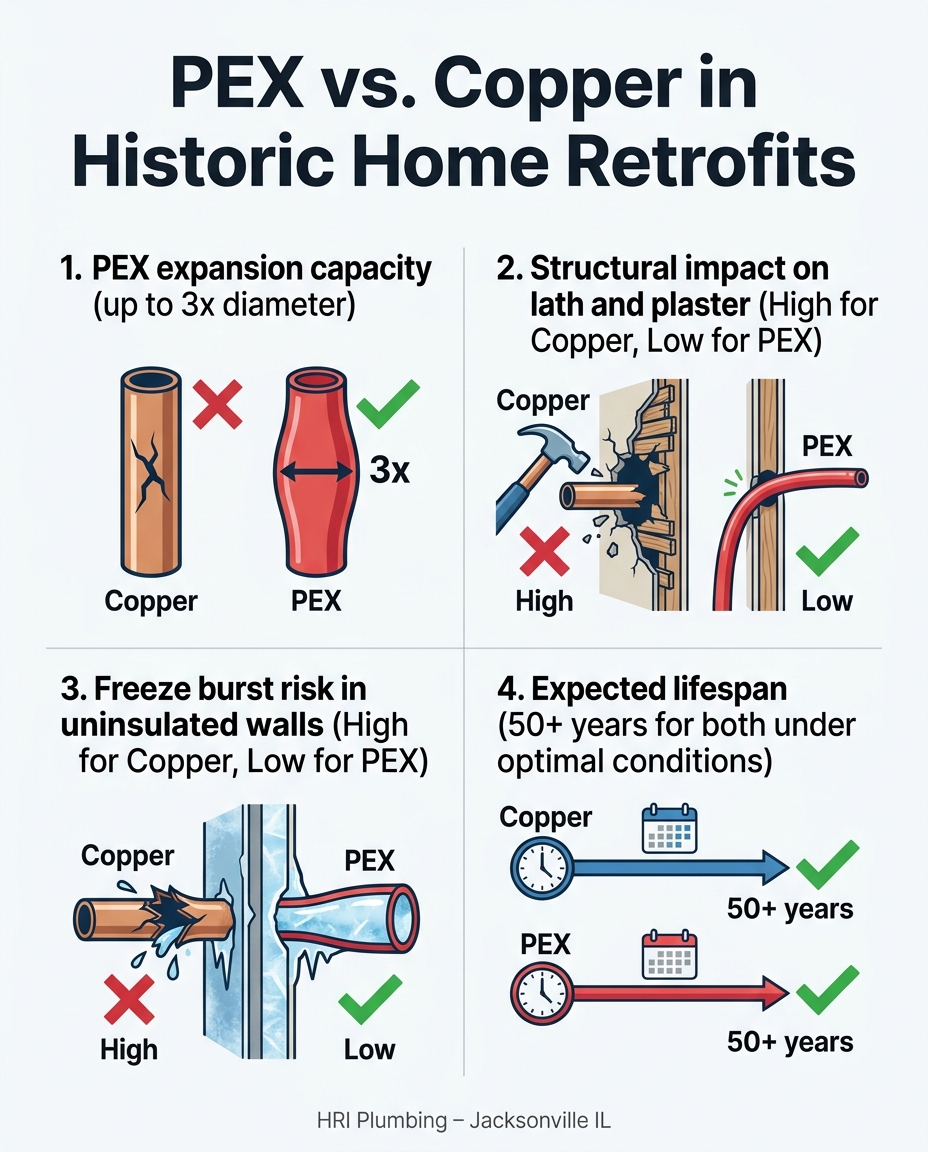
PEX tubing behaves entirely differently. Thanks to its chemical structure, PEX can expand up to three times its resting diameter to accommodate freezing water without bursting. While freezing is never ideal and will temporarily block water flow, PEX is designed to stretch under pressure. Once the ambient temperature rises and the ice thaws, the tubing naturally contracts and returns to its original shape without structural failure.
The Mechanics of Pipe Expansion
The secret to PEX's resilience lies in chemical cross-linking. This manufacturing process gives the plastic a "thermal memory" and extreme elasticity. It allows the material to withstand repeated freeze-thaw cycles over a decade without degrading the structural integrity of the line. Conversely, rigid metals suffer from metal fatigue. Even if a copper pipe survives one mild freeze without bursting, the stress weakens the joints, making a failure highly likely during the next cold snap. Regardless of the material you choose, best practices dictate that any pipe routed through vulnerable, uninsulated spaces during your early fall pre-winter prep must be wrapped in high-quality foam insulation to mitigate the cold.
Side-by-Side: Weighing the Retrofit Options
To help you synthesize this information and weigh your options for homes built pre-1950, we have broken down the core differences between the two materials. As residential plumbing experts, we evaluate these factors daily to ensure the right fit for every unique structural layout.
• Structural Impact — Copper Piping: High. Requires large wall openings for rigid installation and safe soldering. — PEX Tubing: Low. Can be fished through small access holes, preserving lath and plaster.
• Freeze Tolerance — Copper Piping: Low. Rigid metal splits easily when water expands into ice. — PEX Tubing: High. Expands up to 3x its diameter to accommodate ice, then returns to shape.
• Lifespan Expectancy — Copper Piping: 50+ years under optimal, non-corrosive water conditions. — PEX Tubing: 50+ years, highly resistant to scale buildup and acidic water.
• Water Quality Impact — Copper Piping: Excellent, naturally resists bacterial growth. — PEX Tubing: Excellent, immune to the corrosion that plagues older metal systems.
• Historic Preservation — Copper Piping: Historically accurate, but highly destructive to install in finished walls. — PEX Tubing: Modern material, but saves original architectural details from demolition.

Warning Signs Your Older Home Needs a Pipe Upgrade Now
If you live in one of the Jacksonville IL historic districts, your plumbing system may be operating on borrowed time. Aging galvanized lines are commonly found running alongside early copper installations, and both materials degrade over decades of constant use. Identifying the immediate red flags that indicate your current plumbing is failing can save you from a massive water damage event. Look for these symptoms:
• Discolored water: A rusty, brown, or yellow tint to your tap water usually indicates internal pipe corrosion, specifically from old galvanized steel lines breaking down from the inside out.
• Restricted water pressure: As scale and rust build up inside metal pipes, the interior diameter shrinks. If you notice a significant drop in pressure when running multiple fixtures, your pipes are likely choked with mineral deposits.
• Unexplained moisture: Frequent, small leaks, damp spots on your drywall, or a persistent musty smell in basements and crawlspaces point to failing joints or pinhole leaks in aging copper.
• A history of frozen pipes: If your pipes freeze every winter, the metal is suffering from repeated stress fatigue. A retrofit is necessary before the weakened seams finally give way.
Acting on these warning signs early is vital. Another local customer called us during the summer when a sewer backup issue led to a nicked water line during excavation. Because the city mandated a water line change, we ended up replacing a large portion of the sewer line and their aging galvanized water line on the same day. The job was completed in less than a day, resolving the backup and upgrading their vulnerable water supply in one swift motion. If you notice any of these symptoms, scheduling leak detection and repair immediately can help you map out a proactive replacement strategy.
Frequently Asked Questions About Historic Home Repiping
Is PEX or copper better for an old house?
PEX is generally better for retrofitting an old house because of its flexibility. The tubing can be routed behind existing lath and plaster walls without requiring massive demolition. While copper is historically accurate and incredibly durable, installing rigid pipes in a finished, pre-1950 home requires tearing open large sections of the wall and navigating settled framing. PEX preserves your architecture while delivering modern reliability.
Can you mix PEX and copper pipes in an older home?
Yes, you can successfully mix PEX and copper pipes within the same plumbing system. Specialized transition fittings allow plumbers to connect new PEX lines directly to existing copper mains that are still in good condition. This hybrid approach is very common in older homes, allowing you to upgrade vulnerable exterior wall plumbing to freeze-resistant PEX while leaving healthy interior copper lines intact.
Does PEX pipe freeze and burst in the winter?
PEX pipe can freeze if exposed to extreme cold, but it is highly resistant to bursting. The material is engineered to expand up to three times its normal diameter, absorbing the pressure of the ice. Once the temperature rises, the tubing thaws and shrinks back to its original size without splitting, making it vastly superior to rigid metals in uninsulated, drafty walls.
How long does PEX plumbing last compared to copper?
Both PEX and copper plumbing are rated to last 50 years or more under optimal conditions. Copper's lifespan can be shortened by highly acidic water or repeated freeze-thaw cycles that stress the joints. PEX is immune to acidic water corrosion and mineral scaling, meaning it often maintains its maximum water pressure and structural integrity longer in areas with challenging municipal water profiles.
Will retrofitting plumbing destroy my original lath and plaster walls?
Retrofitting does not have to destroy your original lath and plaster walls if you choose the right materials and methods. By utilizing flexible PEX tubing and the "fishing" technique, plumbers can run new lines through small, easily patched access holes. This method bypasses the need to cut long trenches through your historic plaster, preserving both the aesthetic and structural integrity of your home.
Secure Your Historic Home's Plumbing Before the Freeze
Upgrading your plumbing doesn't have to mean destroying your home's historic charm. As we have seen in our comparison of PEX vs. Copper Piping: What We Recommend for Retrofits in Older Homes, choosing a flexible, modern material allows you to protect your original architecture while gaining vastly superior freeze resistance.
The window for early fall pre-winter prep is closing. Acting before the deep winter freeze sets in ensures that your drafty exterior walls won't turn a minor cold snap into a major plumbing disaster. We encourage you to schedule a professional evaluation today to determine the best material for your specific structural layout. A clear, regionally-grounded inspection will provide the insights you need to make a confident decision and enjoy a safe, leak-free winter.


