




The 9% Expansion Rule: Why Outdoor Plumbing Faces Immediate Danger
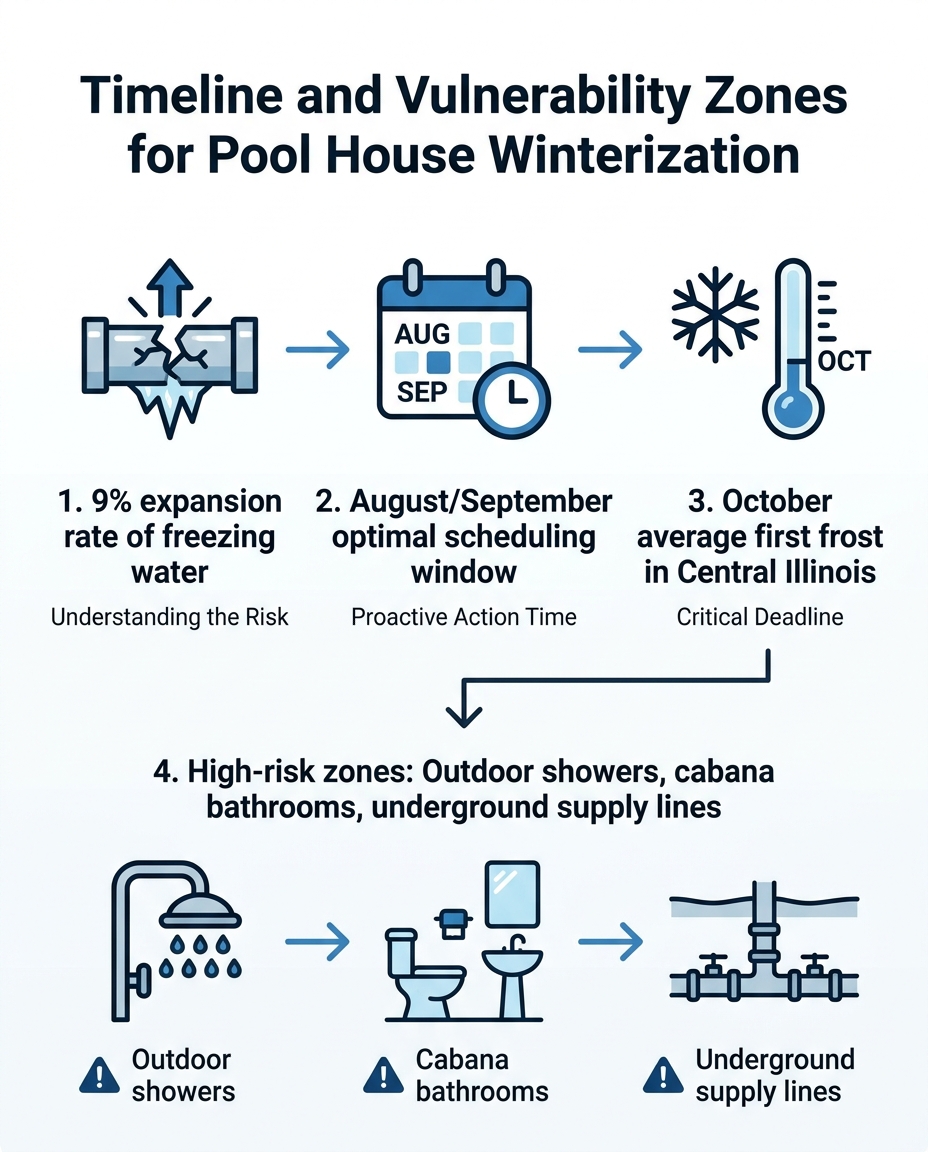
Water expands by approximately 9% when it freezes, generating thousands of pounds of pressure per square inch inside closed pipes—a scientific reality that makes winterizing your pool house plumbing before the first frost an absolute necessity. Unlike the primary residence, which benefits from constant ambient heating, insulated walls, and a deep foundation, unheated outdoor structures are completely exposed to the elements. When temperatures drop, the plumbing inside a cabana or pool house loses its ambient heat rapidly. This makes standalone outdoor structures the most highly exposed vulnerability on any property.
For homeowners looking to protect their investments, securing professional plumbing services from a licensed residential plumber in Jacksonville during the late summer ensures the property is protected before unpredictable temperature drops occur.
The Physics of Freezing Pipes
The bottleneck effect: When water turns to ice, the 9% expansion does not simply push outward against the pipe walls. It expands linearly along the pipe, pushing the remaining liquid water toward a closed valve or fixture. Because water is essentially incompressible, this trapped liquid acts like a hydraulic ram. The pressure spikes exponentially, often rupturing the pipe far away from the actual ice blockage.
Material vulnerability: Whether your pool house utilizes copper, PVC, PEX, or galvanized steel, no standard plumbing material is designed to withstand the immense hydraulic pressure of trapped, freezing water. Once the tensile strength of the pipe or fitting is exceeded, a catastrophic split or blowout is inevitable.
The Late-Summer Decision Point
Waiting for October frost warnings is a significant gamble. By the time meteorologists issue a freeze warning, our team at HRI Plumbing is often completely booked with emergency heating calls and last-minute winterization requests. The back-to-school transition in late summer serves as the ideal, stress-free cue to schedule preventative maintenance. Taking action in August or September guarantees that your outdoor amenities are safely decommissioned long before the first unexpected freeze threatens your property.
Understanding the Central Illinois Freeze Timeline for Cabanas
Central Illinois is notorious for its harsh, unpredictable autumn weather. Rapid freeze-thaw cycles mean that a sunny afternoon can quickly transition into a freezing night. Relying on a standard weather app to dictate when you close down the pool house is a risky strategy that frequently leads to burst pipes.
The Regional Vulnerability Window
Jacksonville IL properties with outdoor cabanas face a unique set of climatic challenges. Because these structures lack the thermal mass and ambient insulation of a primary residence, their internal temperatures mirror the outdoor air much more closely. A light overnight frost that barely touches the main house can easily freeze the exposed supply lines in a standalone cabana.
Understanding the exact timelines and structural vulnerabilities of local pool houses requires specialized local expertise. Based on our years of experience serving the Jacksonville community, a timeline of the typical regional transition highlights why early action is critical:
• Late Summer (August - Early Sept) — Temperature Trend: Warm days, cooling nights. Well above freezing. — Plumbing Risk Level: Zero to Low: The optimal window for scheduling preventative professional maintenance.
• Early Fall (Late Sept - Mid Oct) — Temperature Trend: Rapid temperature swings. Sudden overnight drops. — Plumbing Risk Level: High: Unpredictable cold snaps can freeze exposed outdoor shower lines overnight.
• Late Fall (Late Oct - Nov) — Temperature Trend: Consistent frost. Ground begins to freeze. — Plumbing Risk Level: Critical: Any remaining water in cabana traps or underground lines is virtually guaranteed to freeze and expand.
Scheduling maintenance during the late summer transition provides a comfortable, safe buffer against these sudden cold snaps. It eliminates the anxiety of watching the evening weather forecast and wondering if the outdoor bathroom will survive the night.

Identifying High-Risk Zones: Outdoor Showers and Bathrooms
Winterizing a standalone pool house involves much more than simply turning off a valve inside the main home. These structures contain specific, high-risk fixtures that require meticulous attention to ensure they survive the winter intact.
Critical Vulnerability Checklist
• Outdoor shower columns: Outdoor shower lines are completely exposed to the elements. Unlike pipes hidden behind drywall, these fixtures bear the full brunt of freezing wind and plummeting ambient temperatures, causing them to freeze significantly faster than interior lines.
• Mixing valves and cartridges: The delicate brass and plastic internal components of shower mixing valves are easily destroyed by expanding ice. Even a small amount of trapped moisture can crack a cartridge, rendering the shower useless in the spring.
• Cabana toilets and tanks: Porcelain is highly susceptible to cracking under pressure. Cabana bathroom toilets hold a significant amount of standing water in both the tank and the bowl. This water must be completely evacuated and properly treated to prevent the porcelain from shattering.
• Sink traps and floor drains: P-traps are designed to hold water to block sewer gases from entering the room. In an unheated cabana, this standing water is a major freezing hazard.
Furthermore, pre-existing plumbing issues can severely complicate the winterization process. Even small drips can accelerate ice blockage, making fixing a leaky outdoor faucet a necessary prerequisite to proper winterization. A pattern we see often is that a valve failing to close completely will allow a slow trickle of water to continuously enter the system, eventually forming a solid block of ice that destroys the fixture.
The Hidden Danger of Underground Pool House Supply Lines
One of the most misunderstood aspects of outdoor plumbing maintenance is the behavior of underground supply lines. Many homeowners assume that simply shutting off the main supply valve inside the warm house is enough to protect the cabana. This is a dangerous misconception that frequently leads to hidden, catastrophic damage.
The Problem: Dips, Valleys, and Trapped Water
Supply lines running from the main house to the pool house traverse long underground trenches. Over time, the earth settles, creating slight dips and valleys in the piping. When you shut off the main valve, gravity allows some water to drain out, but a significant volume of residual water remains pooled in these underground low spots.
The Cause: Frost Line Penetration
While pipes buried deeply enough are generally safe from standard winter weather, the reality of trenching means that some sections of the pipe—especially where it rises to meet the cabana foundation or the main house—sit well above the regional frost line. When the ground freezes solid, the frost penetrates the soil and reaches these shallow sections. If residual water is trapped in these areas, it freezes, expands, and fractures the pipe.
The Solution: Complete Line Evacuation
Simply opening the faucets in the cabana to let the water trickle out does not remove the water sitting below grade. The only way to ensure the underground supply lines are truly safe is through high-volume evacuation, pushing all residual moisture out of the dips and valleys before the ground freezes solid.
Why Proper Winterization Requires Professional Equipment
The internet is filled with DIY tutorials suggesting homeowners can winterize their own pool houses using a standard garage air compressor. For complex systems involving underground runs and multiple fixtures, this approach is not just ineffective—it is highly destructive.
The Limitations of DIY Compressors
Standard DIY air compressors are designed to inflate tires or run small pneumatic tools. They generate high pressure (PSI) but severely lack the sustained high volume of air—measured in cubic feet per minute (CFM)—required to push water completely through long underground runs. When a low-CFM compressor is used, the air simply bubbles over the top of the trapped water in the underground valleys, leaving the majority of the moisture behind to freeze.
The Danger of Improper Pressure
Conversely, trying to compensate for low volume by cranking up the pressure (PSI) on a standard compressor can permanently damage pipe fittings, blow out rubber seals, and destroy delicate fixture cartridges. Using improper pressure frequently leads to the need for advanced leak detection and repair in the spring, as the damaged seals remain hidden until the system is repressurized.
The Professional Standard
At HRI Plumbing, our licensed professionals use specialized, calibrated equipment designed specifically for plumbing evacuation. These high-CFM compressors deliver a massive volume of air at a strictly regulated, safe pressure. This ensures the system is entirely void of moisture without putting undue stress on the fittings. Professionals know exactly how to sequence the clearing of traps, valves, and long underground runs to guarantee the property is protected. Relying on DIY step-by-step methods frequently leaves residual water that leads to catastrophic bursts.
The Cost of Inaction: Catastrophic Bursts and Flooding
Failing to schedule preventative maintenance during the late summer / back-to-school transition carries severe consequences. When an outdoor shower line or cabana pipe bursts, the resulting damage extends far beyond a simple broken pipe.
Structural and Interior Damage
A ruptured supply line can unleash hundreds of gallons of water into an unheated structure in a matter of hours. This causes extensive flooding inside the cabana, leading to ruined drywall, warped flooring, and severe water damage to cabinetry and fixtures. Because pool houses are often unoccupied during the winter, a burst pipe may run for days before it is discovered, compounding the destruction.
Real-World Consequences
Water damage to foundations is particularly devastating. For example, our technicians recently responded to a local homeowner with a slab foundation who experienced a major leak underneath their home last fall after a severe weather event. Our team had to walk them through extensive repair options, ultimately installing all new plumbing and toilet fittings to resolve the massive underlying leak.
Addressing these complex structural issues after a freeze is significantly more stressful and disruptive than scheduling a brief preventative appointment. Dealing with emergency plumbing repair in the dead of winter often involves thawing frozen ground, tearing out damaged drywall, and replacing expensive fixtures—all of which can be avoided entirely with early intervention.
Protect Your Investment Before the Midwest Frost Arrives
Understanding why outdoor plumbing freezes faster is the critical first step in protecting your property. The 9% expansion of freezing water is a relentless force, and unheated structures like cabanas and outdoor showers are squarely in its path. Clearing these vulnerable lines, especially the hidden underground runs, requires professional equipment, precise timing, and a thorough understanding of the plumbing layout.
Act during the late-summer transition to ensure your cabana and outdoor shower are safely decommissioned for the winter. By scheduling your winterization services before the unpredictable autumn weather arrives, you secure the peace of mind that comes with knowing your property is protected, allowing you to seamlessly reopen your outdoor amenities when spring returns.
Frequently Asked Questions
Why do outdoor shower lines burst in winter?
Outdoor shower lines burst because they are completely exposed to freezing ambient temperatures without the benefit of household insulation. When the water trapped inside these lines freezes, it expands by about 9%, creating immense hydraulic pressure. This pressure easily exceeds the tensile strength of the pipes and delicate mixing valves, causing them to crack or rupture entirely.
When should I winterize my pool house in Illinois?
You should schedule your pool house winterization during the late summer or early fall, specifically around August or September. Waiting for October frost warnings is risky due to the unpredictable nature of Central Illinois weather. Taking action during the back-to-school transition ensures your pipes are cleared long before a sudden overnight freeze can cause damage.
At what temperature do pool house pipes freeze?
Pool house pipes can begin to freeze anytime the outdoor air temperature drops below 32 degrees Fahrenheit for a sustained period. Because standalone cabanas lack ambient heat and heavy insulation, their internal temperatures drop rapidly to match the outdoors. Even a light overnight frost can be enough to freeze exposed supply lines and outdoor shower columns.
Can I use a standard air compressor to blow out my cabana plumbing?
Using a standard DIY air compressor is highly discouraged for plumbing systems. Standard compressors lack the sustained high volume (CFM) necessary to push all the water out of long underground dips and valleys. Furthermore, using unregulated high pressure (PSI) can easily blow out rubber seals and destroy delicate fixture cartridges, leading to hidden leaks.
Is pouring RV antifreeze enough to protect an outdoor bathroom?
Pouring RV antifreeze into the sink and floor drains is necessary to protect the P-traps, but it is not enough to protect the entire bathroom. The pressurized supply lines, toilet tanks, and underground pipes must be completely evacuated of water using professional-grade equipment. Relying solely on antifreeze without clearing the supply lines will still result in catastrophic pipe bursts.


