



What Every Illinois Homeowner Should Know About How a Well Pump Works
How does a well pump work? Here's the short answer:
- Water source - Groundwater sits in underground layers of rock and soil called aquifers.
- The pump - An electric pump (usually submersible) moves water up from the well to your home.
- Check valve - A one-way valve stops water from flowing back down into the well.
- Pressure tank - Water is stored under compressed air pressure, so you get instant flow when you turn on a faucet.
- Pressure switch - This monitors tank pressure and signals the pump to turn on and off automatically.
- Your faucet - Water travels from the pressure tank through your home's pipes to where you need it.
If you rely on a private well, this system works quietly in the background every day. Most people do not think about it until something goes wrong.
About 45 million Americans get their water from a private well rather than a municipal system. That means the pump, pressure tank, and related controls are largely your responsibility.
For homeowners in central Illinois, understanding the basics can help prevent unexpected loss of water, emergency repairs, and hidden system damage.
This guide explains how well pumps work, what type you likely have, and what warning signs to watch for.
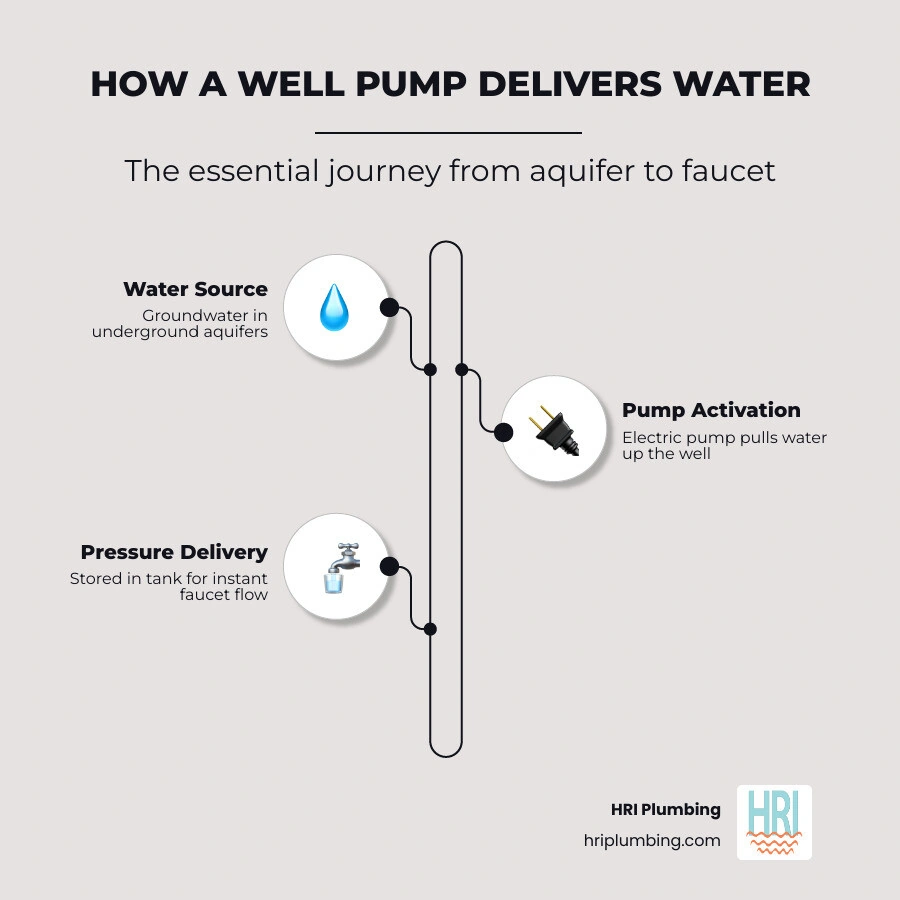
How Does a Well Pump Work to Deliver Water?
At the most basic level, a well system moves water from underground to your house and keeps that water at usable pressure.
Here is the full trip:
- Water enters the well from the surrounding aquifer.
- The pump moves that water up through a drop pipe or suction line.
- A check valve prevents the water from draining backward into the well.
- Water enters the pressure tank, where compressed air helps maintain pressure.
- The pressure switch monitors the system and starts or stops the pump automatically.
- Water then flows through your home's plumbing when you open a fixture.
In most Illinois homes with drilled wells, the pump is a submersible model installed deep in the casing. It is commonly suspended in the well and connected through a pitless adapter, which lets the water line exit below the frost line to help prevent freezing.
If you want more detail on installation basics, our well pump installation guide for Jacksonville, IL is a helpful next read.
The Mechanics of How a Submersible Well Pump Works
Submersible pumps serve the majority of drilled private wells in the U.S. because they work especially well in deeper wells.
A submersible pump sits underwater inside the well and pushes water upward rather than trying to pull it from the surface.
Key parts of a submersible pump include:
- A sealed electric motor
- Multiple impellers
- Diffusers that convert water velocity into pressure
- A pump housing
- A drop pipe carrying water to the home
- Electrical cable running to the motor
- One or more check valves
Here is how it works:
- The pressure switch senses that tank pressure has dropped to the cut-in setting.
- Power goes to the motor.
- The motor spins the impeller stack.
- Each impeller adds velocity to the water.
- Diffusers convert that velocity into pressure.
- The pump pushes water up the pipe and toward the pressure tank.
Many deep-well submersible pumps use several stages of impellers and diffusers stacked together to generate enough pressure for household use.
For homeowners in Rushville considering a new system, our well pump installation services in Rushville, IL page covers when professional installation makes sense.
How a Jet Well Pump Works Using Suction
Jet pumps are surface-mounted pumps, usually located in a basement, utility room, or pump house. Instead of pushing from inside the well, they use suction and pressure differences to draw water up.
They are most common for shallow wells. The practical suction lift limit is about 25 feet at sea level, so shallow-well jet pumps are used only when the water level is relatively close to the surface.
A jet pump works by:
- Using an electric motor to spin an impeller
- Sending water through a narrow jet or nozzle
- Creating a pressure drop through a Venturi effect
- Pulling more water from the well toward the pump
Important things to know about jet pumps:
- They often need to be primed with water before they can work properly
- They are usually noisier than submersible pumps
- They are better suited to shallow applications
- Deep-well jet versions exist, but they are generally less efficient than submersible systems in deeper wells
If your above-ground pump loses prime, struggles to maintain pressure, or runs erratically, those may be signs of a larger issue. We cover several of those warning signs in common problems with well pumps that require repairs.
Pressure Tanks and the Operation Cycle
The pressure tank keeps your pump from turning on every time you briefly use water. It stores water under pressure and provides drawdown, which is the usable water delivered before the pump has to restart.
Most modern systems use a bladder or diaphragm pressure tank. Inside the tank, water and compressed air are separated. As the pump fills the tank, it compresses the air. When you open a faucet, that compressed air pushes water into the plumbing system.
A common residential pressure setting is 40/60 PSI:
- At 60 PSI, the pump shuts off
- As you use water, pressure drops
- At 40 PSI, the pressure switch turns the pump back on
If the pressure switch clicks rapidly on and off, that is a major red flag. One common cause is a waterlogged pressure tank, which can make the pump short-cycle and put extra stress on the motor.
Our well pump repair in Rushville, IL team can help diagnose whether the issue is the pump, tank, switch, or another system component.
Maintaining Your System and Identifying Common Issues
Routine maintenance matters because the average well pump lifespan is often around 8 to 15 years, though some systems last longer with proper care and favorable water conditions.
A good maintenance plan includes:
- Annual well and pump inspection
- Regular water quality testing, including bacteria checks
- Monitoring the pressure gauge for normal cycling
- Inspecting the well cap to make sure it is sealed properly
- Keeping the area around the well clean and protected
- Checking for changes in pressure, noise, or water quality
- Protecting indoor tanks and piping from freezing
Below is a quick comparison of common pump types:
| Pump type | Best use | Typical depth range | Main advantage | Main limitation |
|---|---|---|---|---|
| Submersible | Most drilled residential wells | Deep wells | Efficient, quiet, strong pressure | Repairs require pulling pump from well |
| Jet | Shallow or some moderate-depth wells | Shallow wells, with suction limits around 25 feet for shallow models | Above-ground access | Less efficient, may require priming |
| Centrifugal | Very shallow applications | Usually under 25 feet | Simple design | Limited depth capability |
For more on system planning and upkeep, see our Rushville well pump installation guide.
Sizing matters too. A pump should be selected based on:
- Well depth
- Static water level
- Total dynamic head
- Well yield
- Household demand in gallons per minute
- Number of bathrooms and fixtures
A typical family home may need roughly 5 to 12 GPM depending on fixture count and simultaneous use. Oversizing can waste energy and stress the system, while undersizing can leave you with weak pressure during peak demand.
Signs You Need Well Pump Repair in Springfield or Jacksonville
Many well system problems give warning signs before total failure.
Common signs include:
- Low water pressure
- Water sputtering or spitting air at faucets
- Pump running constantly
- Rapid clicking from the pressure switch
- Short-cycling
- No water at all
- Sediment or discolored water
- Sudden changes in taste or odor
- Unusually high electric bills
If you hear frequent clicking near the pressure tank, the pressure tank may be waterlogged or the switch may be failing. If faucets spit air, you may have a leak in the line, low water level, or a pump issue. If the pump runs nonstop, that can point to a leak, bad check valve, failing pump, or pressure switch trouble.
Homeowners in central Illinois can learn more about local repair help here:
Constant Pressure Systems vs. Traditional Setups
Traditional well systems cycle between two pressure points, such as 40 and 60 PSI.
Constant pressure systems use electronic controls, often with a variable frequency drive, to adjust pump speed in real time.
Benefits can include:
- More even shower pressure
- Better performance when multiple fixtures run at once
- Fewer hard starts
- Potentially less wear on some components
- Smaller tank requirements in some setups
If you are exploring an upgrade, our article on well pump installation services explains when replacement or modernization may be worth considering.
Expert Well Pump Solutions for Illinois Homeowners
If you are in Jacksonville, Springfield, or Rushville and your well system is acting up, we are here to help. At HRI Plumbing, we provide reliable well pump support backed by honest service, flexible options, and 24/7 emergency availability when water problems cannot wait.
Whether you need diagnosis, replacement, or a full new setup, our team can help with:
- Well pump repair
- Well pump installation
- Pressure tank issues
- Pressure switch troubleshooting
- Low-pressure problems
- Emergency plumbing support
If you are planning a replacement or new installation, visit our well pump installation in Springfield, IL page to get started.
A final safety note: well systems involve electricity, pressurized water, and contamination risks. Installation and major repairs should be handled correctly, with proper sanitary sealing, freeze protection, and code-compliant electrical work.
So, how does a well pump work? It is a coordinated system of pump, check valve, pressure tank, and controls that moves groundwater from the aquifer to your faucet safely and reliably.


