

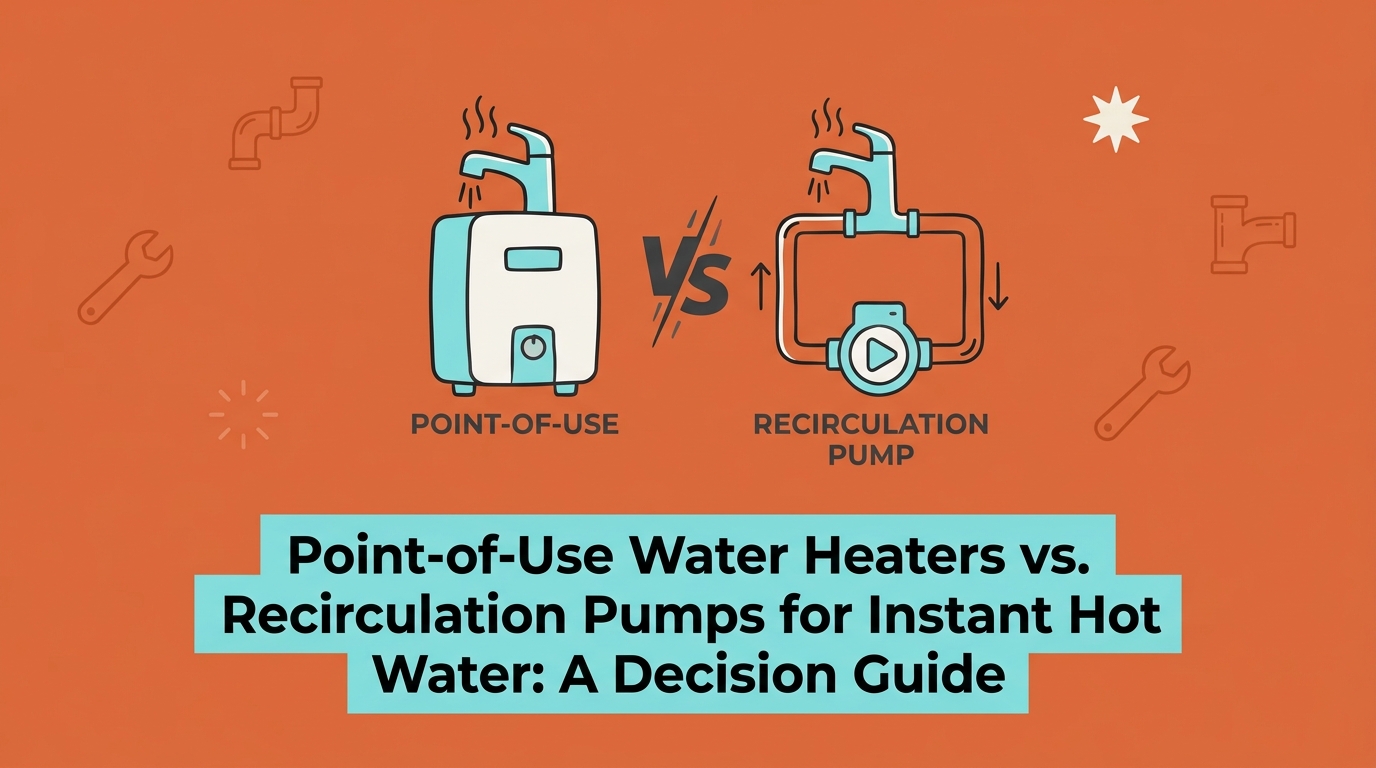


Tired of Running the Tap? The Battle for Instant Hot Water
Are you constantly trying to decide between point-of-use water heaters vs. recirculation pumps for instant hot water because you are tired of waiting minutes for a distant bathroom sink to finally warm up? You turn on the faucet, place your hand under the stream, and wait. And wait. Meanwhile, perfectly good, clean water pours straight down the drain. This daily frustration is more than just a minor inconvenience; it is a significant waste of resources and a jarring way to start your morning.
Ready to fix your home's plumbing layout? Learn more about our comprehensive plumbing services to find the right permanent solution for your household.
The delay you experience happens because the water sitting in the pipes between your main water heater and that distant fixture cools down completely overnight. As early fall morning temperature drops begin to chill the house, that initial blast of cold water feels even more punishing. You know you need a permanent fix before winter arrives, but choosing the right path forward requires understanding your options. The decision ultimately comes down to two primary solutions: installing a localized point-of-use unit directly at the problem sink, or retrofitting your home with a whole-house recirculation pump. Both approaches solve the fundamental problem of cold water delays, but they do so in completely different ways.
The True Cost of Waiting
Most homeowners severely underestimate how much water they lose while waiting for the temperature to rise. A fixture located on the opposite side of the house from the main utility room might hold dozens of feet of water in its supply line. Every time you want to wash your hands, shave, or take a shower, you are forced to push all that dormant, chilled water out of the way before the fresh hot water can reach you. Over the course of a year, this daily ritual adds up to thousands of gallons of wasted water per household.
Beyond the environmental impact, there is the simple matter of comfort. Shivering in a chilly bathroom while waiting for the tap to heat up is a terrible way to begin your day. By addressing this issue now, you can upgrade your daily routine and eliminate the unnecessary waste.
Why the Wait for Hot Water Gets Worse in the Fall
The frustrating delay at your distant sink is not a static problem. Many homeowners notice that the wait time fluctuates depending on the season, becoming noticeably longer as the year progresses. To understand why this happens, you have to look at the basic mechanics of heat loss within your home's plumbing architecture.
The Physics of Heat Loss in Plumbing
When your main water heater finishes a heating cycle, it sends hot water through the supply lines to whatever fixture is calling for it. Once you turn off the tap, the remaining hot water stops moving. It sits idle in the pipes. Because heat naturally moves toward colder environments, this stationary water rapidly loses its thermal energy to the surrounding air and building materials. Within a matter of hours, the water in the pipe is just as cold as the space around it.
If you are considering a major system overhaul, it might be time to look into a complete water heater replacement to ensure your primary unit is operating at peak efficiency before adding secondary systems.
The Impact of Midwestern Weather
The surrounding environment plays a massive role in how quickly your pipes lose heat. In many homes, plumbing lines run through unconditioned spaces like crawlspaces, exterior walls, or unfinished basements. During the summer, these spaces stay relatively warm, meaning the heat loss is slower and the incoming ground water is tepid. However, early fall morning temperature drops drastically change the equation.
Cold Midwestern weather rapidly chills uninsulated pipes in the home's crawlspaces or walls, amplifying the rate of heat loss. Furthermore, the incoming ground water supply drops significantly in temperature during the fall and winter months. Your main water heater has to work harder to raise this freezing ground water to your desired temperature, and that water then travels through freezing pipes to reach you. The delta between the incoming cold water and the desired hot water expands, making the wait time feel agonizingly long. Solving this issue before winter hits is critical pre-season preparation to avoid peak seasonal discomfort.
Understanding Point-of-Use Water Heaters
If your primary frustration is isolated to a single location—like an en suite bathroom added onto the far side of the house—a point-of-use (POU) water heater offers a highly targeted solution. These compact, localized units are installed directly at the fixture, bypassing the long journey from the main utility room entirely.
How These Compact Units Operate
A point-of-use water heater intercepts the cold water supply line right before it reaches your faucet. When you turn on the hot water handle, the POU unit immediately heats the water right there under the counter. Because the distance between the heater and the faucet is just a few inches of pipe, the hot water delivery is virtually instantaneous.
These systems generally come in two styles: electric tankless models that heat water on demand, and mini-tank models that store a small reservoir (usually 2.5 to 7 gallons) of pre-heated water. If you are planning a larger renovation, integrating one of these units is a smart addition to any bathroom remodeling project.
Installation and Space Requirements
Because they operate independently of your main system, POU heaters require dedicated infrastructure. They must be mounted inside the cabinet under the sink or in an adjacent closet. More importantly, they require adequate electrical support. Most tankless point-of-use units require a dedicated high-voltage circuit to draw the massive amount of power needed for instant heating, while mini-tanks might run on a standard 120V outlet but still require a dedicated breaker to prevent tripping.
Pros and Cons of Point-of-Use Systems:
• Zero wait time: Water is heated exactly where you need it, eliminating the long purge of cold water.
• Highly targeted: Perfect for Jacksonville IL older residential homes where a single distant addition suffers from poor hot water delivery.
• Reduced strain: Takes the workload off your primary water heater for that specific fixture.
• Limited scope (Con): Only solves the problem for the specific sink or shower it is attached to.
• Space consumption (Con): Sacrifices valuable under-sink storage space to house the unit and its plumbing connections.
Understanding Recirculation Pumps
While a point-of-use heater provides a localized fix, a recirculation pump is designed to solve the delay problem for the entire house. Instead of heating the water at the fixture, a recirculation system ensures that hot water from your main tank is constantly staged and ready in the pipes right behind every faucet.
Dedicated Return Lines vs. Thermal Bypass Valves
Recirculation pumps work by creating a continuous loop of moving water. The pump pushes hot water out of the water heater, circulates it through the main supply lines, and sends the unused water back to the heater to be warmed up again. This means hot water is always circulating past your bathrooms and kitchen, ready to flow the moment you open a tap.
There are two primary ways these systems are configured. In new construction, builders often install a dedicated return line—a separate pipe whose only job is to carry unused hot water back to the tank. However, retrofitting a return line into an existing home requires tearing open walls and ceilings. To avoid this, plumbers often install a thermal bypass valve at the fixture furthest from the water heater. This valve uses the existing cold water line as a temporary return path, pushing the cooling hot water into the cold line so it can travel back to the water heater. If you are unsure which setup your home can support, consulting a professional residential plumber is the safest first step.
Managing System Efficiency
Because moving water constantly requires electricity and forces the main water heater to run more frequently, modern recirculation pumps are rarely left on 24/7. Instead, they are equipped with programmable timers, aquastats (temperature sensors), or smart-home motion detectors. The pump only activates during your typical high-usage hours—like early mornings and evenings—ensuring you get instant hot water when you need it without wasting energy while you are at work or asleep.
Pros and Cons of Recirculation Pumps:
• Whole-house solution: Provides near-instant hot water to every fixture connected to the main plumbing trunk.
• Massive water savings: Eliminates the need to run the tap to purge cold water, conserving thousands of gallons annually.
• No cabinet space lost: The pump is installed at the main water heater, leaving your under-sink storage completely free.
• Energy consumption (Con): Can increase your gas or electric bill slightly, as the main unit must reheat the circulating water.
• Complex retrofits (Con): Installing bypass valves or return lines requires modifying the existing plumbing architecture.
Side-by-Side Comparison: Point-of-Use vs. Recirculation
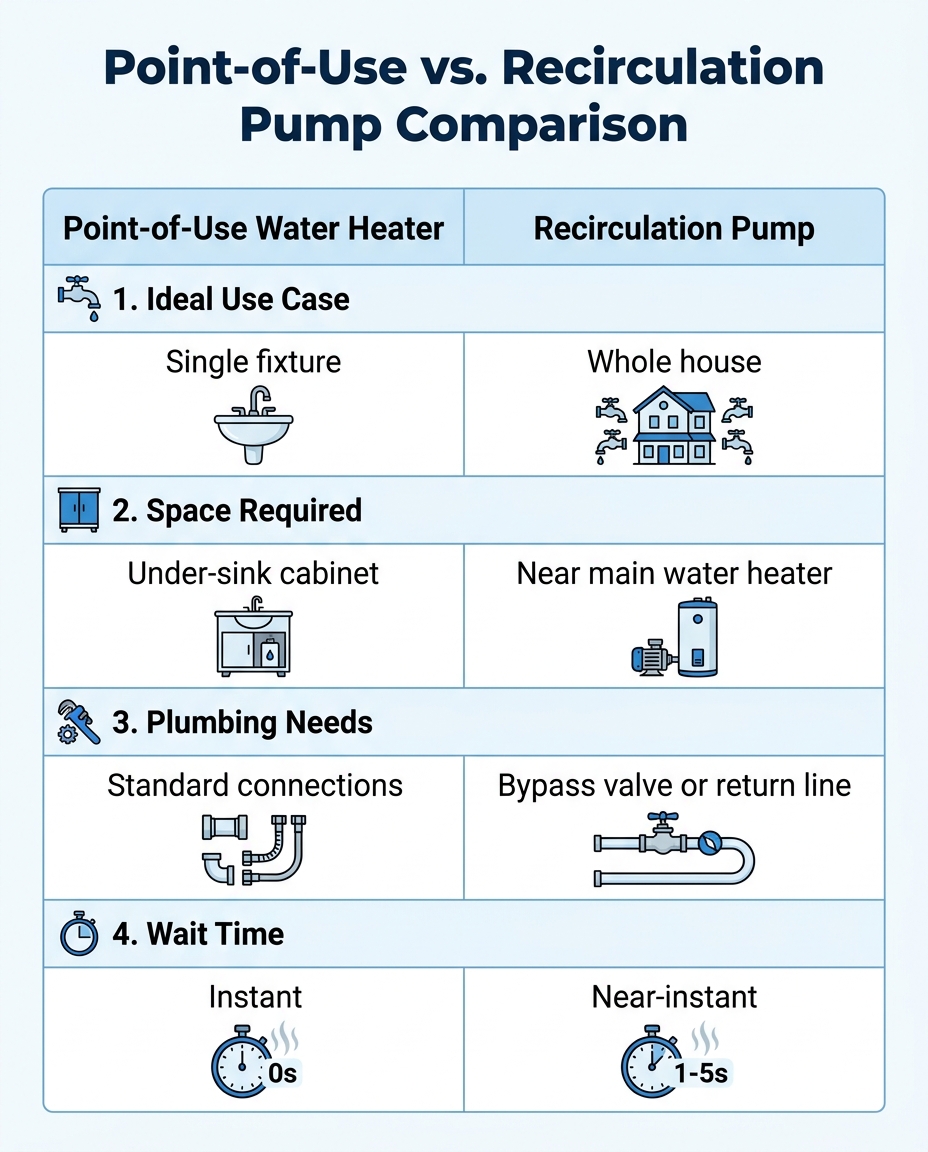
Choosing between these two systems requires weighing the scope of your problem against the physical realities of your home. To help you evaluate which path makes the most sense for your household, here is a direct comparison of the key decision factors.
• Ideal Use Case — Point-of-Use Water Heater: A single, isolated fixture (like a distant guest bathroom or an in-law suite addition). — Recirculation Pump: Whole-house delays where multiple bathrooms and the kitchen all suffer from long wait times.
• Installation Requirements — Point-of-Use Water Heater: Dedicated under-sink space and robust electrical access (often requiring a new dedicated circuit). — Recirculation Pump: Pump installation at the main water heater, plus thermal bypass valves installed at the furthest fixtures.
• Wait Time — Point-of-Use Water Heater: Truly instantaneous. The water is heated inches from the spout. — Recirculation Pump: Near-instantaneous. You may wait 1-3 seconds to clear the short pipe from the wall to the faucet.
• Maintenance Needs — Point-of-Use Water Heater: Requires occasional flushing to remove scale buildup, similar to a standard tankless unit. — Recirculation Pump: Very low maintenance. The pump itself is durable, though bypass valves may need eventual replacement.
• Expected Lifespan — Point-of-Use Water Heater: Typically 10 to 15 years depending on local water hardness and maintenance frequency. — Recirculation Pump: Pump motors generally last 10 to 15 years before requiring a swap.
Ultimately, a point-of-use heater is generally more cost-effective if you only have one problematic sink. However, if you find yourself shivering and waiting for hot water in the master bath, the kitchen, and the laundry room, a recirculation pump provides a much better return on investment by solving the issue globally.

How Your Home's Layout Dictates the Best Solution
It is easy to look at a comparison chart and pick the option that sounds best on paper. However, the reality of plumbing is that your home's existing architecture has the final say. The right choice depends heavily on how your pipes were originally routed, the accessibility of your plumbing lines, and the electrical capacity of your breaker panel.
The Challenge of Retrofitting Older Layouts
A typical pattern we see often in Jacksonville IL older residential homes is a sprawling layout that was added onto over decades. These older homes almost never have dedicated hot water return lines built into the walls. When a new master suite was added to the back of the house in the 1990s, the builders simply extended the existing supply lines. This immense distance from the basement utility room creates massive delays.
Retrofitting a true whole-house loop with a dedicated return line into these older properties might require invasive work—cutting into drywall, navigating tight crawlspaces, and disrupting the living space. While a thermal bypass valve system circumvents some of this demolition, it still requires the cold water line to be in good condition to handle the temporary warm water return.
Why Professional Assessment Matters
Because every home is unique, assessing the layout is a crucial first step. Working with a local team means you benefit from our deep expertise in assessing Central Illinois home layouts to recommend the most efficient instant hot water solution without unnecessary invasive work. A professional can evaluate the distance from your main water heater, check the condition of your existing pipes, and inspect your electrical panel to determine if a point-of-use heater's voltage requirements can be safely met.
We strongly advise against attempting to install either of these systems yourself. Because these installations involve tapping into pressurized domestic water lines, managing electrical loads near water sources, and altering the flow dynamics of your home, they require strict adherence to local plumbing and electrical codes. A licensed professional ensures the system operates safely, efficiently, and legally.
Energy Efficiency and Water Conservation
When upgrading your plumbing for comfort, it is equally important to address the environmental and utility impact of both systems. Both point-of-use heaters and recirculation pumps offer distinct efficiency benefits, helping you understand their long-term value beyond just ending the morning shivers.
The Hidden Cost of Wasted Water
According to EPA WaterSense data, the average household wastes thousands of gallons of water annually just waiting for it to get hot. This is clean, treated, municipal water that goes straight into the sewer system without ever being used. By installing either a localized heater or a recirculation pump, you immediately eliminate this waste. Over the lifespan of the equipment, the reduction in your water bill helps offset the initial installation costs.
Electricity Usage Comparisons
While you save water, you must also account for energy usage. Point-of-use heaters are highly efficient in their energy application; they only draw electricity when you actively turn on the tap, and they only heat the exact amount of water you use. There is no standby heat loss because the water does not travel through long pipe runs.
Recirculation pumps, conversely, use energy to physically move the water, and they force your main water heater to fire more frequently to offset the heat lost as the water travels through the loop. To mitigate this, modern pumps rely heavily on smart timers and aquastats so they only run during peak demand hours. If you are highly focused on energy efficiency, you might also consider whether upgrading your primary unit to a tankless water heater makes sense for your family's overall consumption patterns.
Additionally, generic energy rebates or utility incentive programs may apply to high-efficiency water heating upgrades. Always check with your local utility provider or a tax professional to see if you qualify for current efficiency programs, as these can further improve the return on your investment.
Choosing the Right Instant Hot Water Solution for Your Home
The frustration of waiting for hot water is a solvable problem. The choice between point-of-use heaters and recirculation pumps ultimately comes down to whether you need a highly localized fix for a single distant sink, or a comprehensive whole-house upgrade to improve delivery to every bathroom.
With early fall weather already cooling down the ground and your uninsulated pipes, now is the time to make this upgrade before winter freezing exacerbates the wait times. You do not have to spend another season shivering in the bathroom while perfectly good water washes down the drain.
You do not have to guess which system is right for your architecture. A professional assessment can easily identify the best path forward based on your home's specific layout, electrical capacity, and plumbing condition. Schedule an inspection today to weigh your options, and let us help you choose the right permanent solution for your home.
Frequently Asked Questions
Which is better for a single distant bathroom: point-of-use or recirculation pump?
For a single distant bathroom, a point-of-use water heater is usually the better choice. It provides a targeted, highly efficient fix without altering the plumbing dynamics of the rest of the house. You avoid the complexity of a whole-house retrofit while guaranteeing instant hot water exactly where you need it most.
Do recirculation pumps work without a dedicated return line?
Yes, they can work effectively without a dedicated return line by utilizing a thermal bypass valve. This valve is installed at the plumbing fixture furthest from the water heater and uses the existing cold water line to send cooling hot water back to the tank. It is a highly popular retrofit solution for older homes where tearing open walls is not feasible.
How do cold winter temperatures affect hot water delivery times?
Cold winter temperatures drastically chill uninsulated pipes located in crawlspaces and exterior walls, accelerating the heat loss of stationary water. Additionally, the incoming municipal ground water is much colder in the winter, meaning your water heater has to work harder to raise the temperature. Together, these factors significantly increase the time it takes for hot water to reach your faucet.
Do recirculation pumps waste electricity by running constantly?
Older, continuously running pumps did waste electricity, but modern systems are much smarter. Today's recirculation pumps are equipped with programmable timers, temperature sensors (aquastats), or motion detectors. They only circulate water during your usual high-demand hours, keeping energy consumption well managed.
How much under-sink space does a point-of-use water heater require?
Space requirements vary by model, but electric tankless units are generally the size of a large textbook and mount flat against the back or side wall of the cabinet. Mini-tank models are bulkier, often requiring an area roughly 12 to 15 inches square. You will need to sacrifice a portion of your under-sink storage to accommodate the unit and its plumbing connections safely.
Can a point-of-use water heater supply an entire bathroom?
It depends on the size and electrical capacity of the unit. Small 120V units are typically only powerful enough to supply a single handwashing sink. If you want a point-of-use heater to supply a shower and a sink simultaneously, you will need a larger, high-voltage (240V) tankless unit that requires robust electrical upgrades.


