



Why Knowing How to Choose the Right Water Treatment System Could Be the Most Important Home Decision You Make
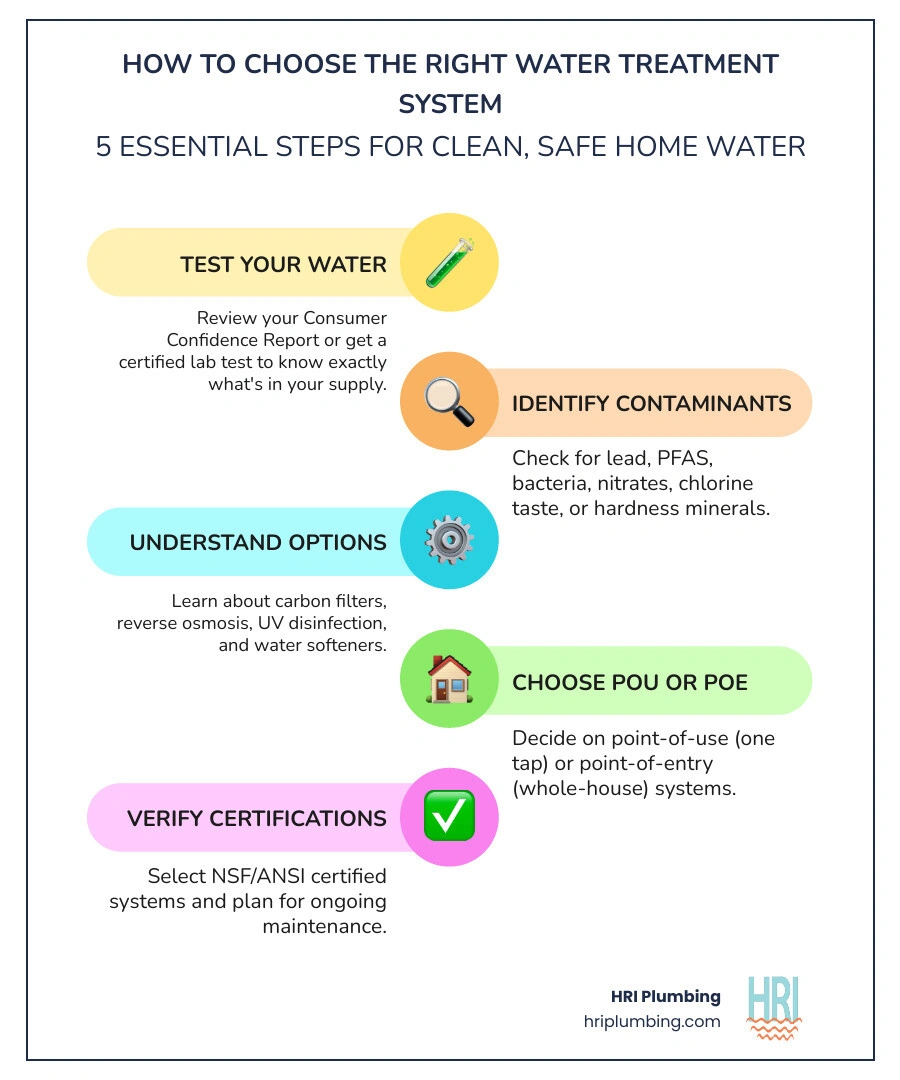
Knowing how to choose the right water treatment system starts with testing your water, identifying your specific contaminants, and matching the right technology to those results. Here's a quick overview:
- Test your water - Get a certified lab test or review your municipality's Consumer Confidence Report.
- Identify your contaminants - Look for lead, PFAS, hardness, bacteria, nitrates, or chlorine.
- Understand your options - Carbon filters, reverse osmosis, UV disinfection, and water softeners each target different problems.
- Choose point-of-use or whole-house - Decide whether you need filtered water at one tap or throughout your entire home.
- Check certifications - Look for NSF/ANSI certified systems that verify real contaminant reduction.
- Plan for maintenance - Factor in filter replacement, water waste, and energy use over time.
Most people assume their tap water is safe simply because it meets legal standards. But meeting minimum requirements and having truly clean water aren't always the same thing. A 2023 U.S. Geological Survey study found that at least 45 percent of the nation's tap water contains PFAS — a group of chemicals linked to serious health concerns. And while the EPA sets legal limits on more than 90 contaminants under the Safe Drinking Water Act, testing across the U.S. has found detectable amounts of lead, arsenic, or PFAS above recommended maximum levels in the vast majority of locations sampled.
For homeowners in Jacksonville, Springfield, and Rushville, IL, this isn't just a local reality. Whether you're on city water or a private well, what comes out of your tap matters for your family's health, your plumbing, and your appliances.
This guide walks you through every step of finding the right solution for your home.
How to Choose the Right Water Treatment System for Your Home
The journey to better water begins with one critical step: knowing exactly what is in your water. You wouldn't take medicine without a diagnosis, and you shouldn't install a filtration system without a water profile. As we move through May 2026, the technology available to homeowners has never been better, but the variety of options can be overwhelming.
The first step is always an assessment. If you are on a municipal supply, you can start by reading your annual Consumer Confidence Report (CCR). However, keep in mind that these reports reflect the water as it leaves the treatment plant, not necessarily as it comes out of your kitchen faucet. For those using private wells, the responsibility falls entirely on you to test for safety. Understanding the Municipal vs Well Water Quality in Central Illinois is vital because the contaminants found in a deep well in Rushville can be drastically different from those in the Springfield city supply.
Beyond health, the chemistry of your water impacts your home’s infrastructure. Learning about Central Illinois Water Quality and What It Means for Your Plumbing can help you avoid costly pipe repairs down the road.

Assessing Local Water Quality in Springfield and Jacksonville
In Springfield and Jacksonville, our municipal water systems work hard to meet EPA standards. However, "legal" doesn't always mean "perfect." Many residents find that while their water is safe, it may still contain disinfection byproducts or a strong chlorine taste.
For our neighbors in more rural areas or those in Rushville using private wells, the risks shift. Wells are susceptible to bacteria, nitrates from agricultural runoff, and naturally occurring arsenic. Unlike city water, well water isn't monitored by a central agency. Regular testing is the only way to ensure your family isn't being exposed to invisible threats. By improving water quality through filtration, you can address these specific local concerns effectively.
Identifying Contaminants to Choose the Right Water Treatment System
Once you have your test results, it’s time to play detective. Are you dealing with aesthetic issues or health risks?
- Chlorine and Chloramines: These are added by cities to kill bacteria but can leave a chemical "pool" smell and taste.
- PFAS and Heavy Metals: These "forever chemicals" and metals like lead or arsenic require high-level filtration.
- Hardness: This is perhaps the most common issue in Central Illinois. Hard water is caused by high levels of calcium and magnesium.
You can often see the evidence of hard water yourself. If you notice white, crusty buildup on your showerheads or spots on your "clean" dishes, you have a mineral problem. Understanding hard water in Central Illinois and what it means is the first step toward protecting your water heater and dishwasher. If you’re unsure, look for the signs you have hard water in your home, such as dry skin or dull laundry.
Comparing Point-of-Use vs. Point-of-Entry Solutions
When deciding how to choose the right water treatment system, you must choose between filtering water at a single spot or for the whole house.
- Point-of-Use (POU): These systems, like under-sink Reverse Osmosis units or pitcher filters, treat water at a specific tap. They are excellent for drinking and cooking water.
- Point-of-Entry (POE): Also known as whole-house systems, these are installed where the main water line enters your home. This ensures that every drop—from the shower to the washing machine—is treated.
If you are primarily concerned about the taste of your coffee, a POU system might suffice. However, if you want to protect your plumbing and have softer skin after every shower, a POE system is the way to go. Exploring must-have water filtration features can help you decide which scale fits your lifestyle. Many homeowners find that the benefits of a new water purification system far outweigh the initial setup effort.
Selecting the Best Technology for Your Household Needs
No single filter removes everything. Matching the technology to your specific water "fingerprint" is the key to success.
| System Type | Best For Removing | Maintenance Level |
|---|---|---|
| Carbon Filtration | Chlorine, odors, some VOCs | Low (Filter change every 6 months) |
| Reverse Osmosis | Lead, PFAS, Arsenic, Fluoride | Moderate (Filter & membrane changes) |
| UV Disinfection | Bacteria, Viruses, Cysts | Low (Annual bulb replacement) |
| Water Softener | Hardness (Calcium/Magnesium) | Moderate (Adding salt regularly) |
For families in Springfield, understanding reverse osmosis water treatment is often the best path for those wanting the highest purity levels for drinking.
Matching Systems to Your Needs: How to Choose the Right Water Treatment System
If your test shows heavy metals or PFAS, a Reverse Osmosis (RO) system is the gold standard. While older RO systems were known for wasting water, modern models are much more efficient. By understanding reverse osmosis systems, you'll see they use a semi-permeable membrane to strip away almost all dissolved solids.
The key benefits of reverse osmosis include crystal-clear ice cubes and better-tasting food. There are also many unexpected benefits of reverse osmosis systems, such as saving money on bottled water and reducing plastic waste. If your water has a bacterial concern—common in shallow wells—adding UV disinfection provides a chemical-free way to ensure your water is microbiologically safe.
Solving Hard Water Issues in Central Illinois
In Jacksonville and Rushville, the "rocky" water can wreak havoc on your home. This is where water softeners come in. Unlike filters that remove chemicals, softeners use ion exchange to swap hardness minerals for sodium or potassium ions.
The water softener benefits for homeowners are extensive, including longer-lasting appliances and reduced soap usage. If you are asking, "Do I need a water softener in Central Illinois?", the answer is almost always "yes" due to our regional geology.
Many people get confused between filters and softeners. To clear this up, check out our guide on water softener vs. water filter: which do I need?. You can also learn how a water softener works to see why it’s so effective. The benefits of using a water softener on your home include saving your pipes from the "clogging" effects of scale.
Ensuring Efficiency and Professional Maintenance
When shopping for a system, look for the NSF/ANSI seal. For example, NSF/ANSI 58 is the standard for RO systems, while NSF/ANSI 44 applies to water softeners. Efficiency is also key; WaterSense labeled RO systems are designed to waste significantly less water than standard models.
Even the best system will fail without proper care. Common mistakes include:
- Forgetting to change carbon pre-filters (which can lead to membrane damage).
- Letting the brine tank run out of salt.
- Ignoring a "salty" taste or a drop in water pressure.
If you run into trouble, troubleshooting water softener problems early can save you from a full system breakdown. Sometimes, your water softener needs professional repair to recalibrate the regeneration cycle for maximum efficiency.
At HRI Plumbing, we believe in honesty and integrity. We serve Jacksonville, Springfield, and Rushville with reliable, high-quality plumbing solutions. Whether you need a simple under-sink filter or a comprehensive whole-home treatment plan, our team is here to help you navigate the options. We offer 24/7 support and flexible maintenance plans to ensure your water stays pure year-round.
Ready to transform your home's water? Contact us today at https://www.hriplumbing.com/water to schedule a consultation and find your perfect water solution.


