


What to Consider Before Replacing Your Water Heater (And Why It Matters)
Knowing what to consider before replacing your water heater can save you from a stressful, costly emergency — and that's especially true for homeowners in Jacksonville, Springfield, and Rushville, IL, where a failed unit in the middle of winter is no small inconvenience. Water heating accounts for roughly 18% of a household's energy use, and with about 8 million water heaters replaced across the U.S. every year, this is one of the most common — and most important — home decisions you'll make. The average unit lasts around 10 years, which means if yours is getting up there in age, now is the time to plan ahead rather than react in a panic.
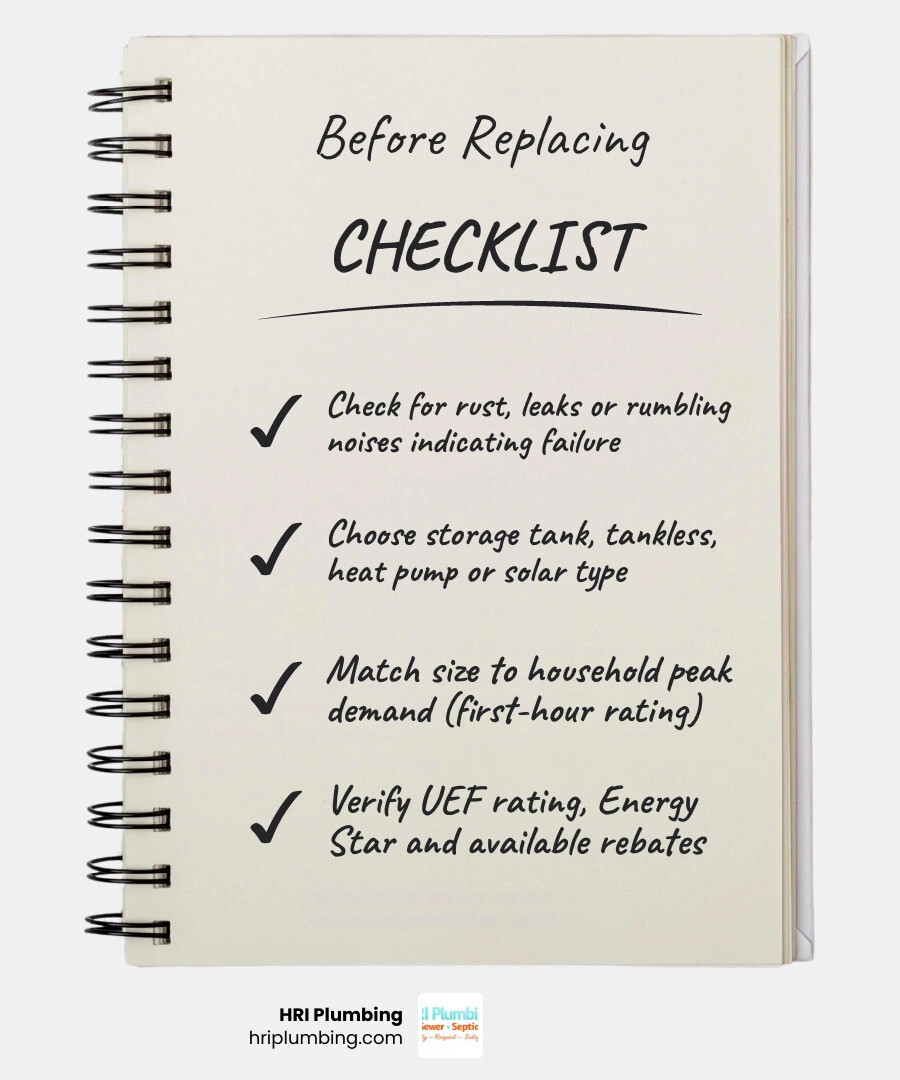
Here's a quick overview of the key things to consider before replacing your water heater:
- Signs of failure - Look for rust, leaks, rumbling noises, or inconsistent hot water
- Type of water heater - Storage tank, tankless, heat pump, or solar
- Fuel source - Natural gas, electricity, propane, or solar
- Size and capacity - Match the unit to your household's peak hot water demand
- Energy efficiency - Check the Uniform Energy Factor (UEF) and look for Energy Star certification
- Installation requirements - Space, venting, gas lines, electrical upgrades, and permits
- Long-term maintenance - Anode rod replacement, annual flushing, and descaling
- Total cost and incentives - Factor in purchase, installation, operating costs, rebates, and tax credits
- Installer qualifications - Verify licensing, insurance, warranty coverage, and permit handling
The sections below walk through each of these in detail so you can make a confident, well-informed decision — whether you're replacing a failing unit or planning ahead.
Common what to consider before replacing your water heater vocab:
- how to choose the right water heater
- what size water heater do i need
- tankless vs tank water heater for your home
Key Factors on What to Consider Before Replacing Your Water Heater
Opting for a proactive water heater replacement rather than waiting for an emergency failure gives you the upper hand. You can research options, compare energy-efficient models, and schedule installation at your convenience, ensuring the best long-term value for your family's hot water needs.
Signs Your Current System is Failing and When to Replace
If your water heater is approaching its tenth birthday, pay close attention to its performance. Knowing how to know when to replace your water heater can save your home from unexpected water damage.
Keep an eye out for these common warning signs:
- Visible Corrosion and Rust: Look closely at the tank seams and the water connections. If you spot rust or green corrosion, the metal is weakening.
- Active Water Leaks: Any moisture or pooling water around the base of the tank is an immediate red flag. A leaking tank cannot be repaired and requires prompt replacement.
- Rusty or Discolored Water: If your hot water looks rusty but your cold water runs clear, the interior lining of your tank is likely deteriorating.
- Unusual Rumbling or Popping Sounds: As sediment builds up, it hardens and traps water, creating loud popping noises. If you hear this, read our guide on a water heater making popping or rumbling noises to understand what is happening.
Recognizing these signs your water heater is going out allows for an orderly transition. If you are debating a quick fix, check out how to decide between water heater repair and replacement or read about signs that it's time to replace your water heater.
Choosing the Right Type: Tankless vs. Traditional Storage
One of the biggest choices you will make is deciding on the technology that heats your water. The market has evolved significantly, offering several distinct options.
- Traditional Storage Tank Water Heaters: These keep a steady reservoir of hot water (30 to 80 gallons) ready. They have a lower upfront cost but consume energy continuously to maintain temperature.
- Tankless (On-Demand) Water Heaters: These heat water instantly as it flows, offering an endless supply while saving space and reducing energy use by 10% to 35%. Explore our tankless vs tank water heater guide 2026 to see if this fits your home.
- Heat Pump (Hybrid) Water Heaters: These pull heat from the surrounding air to heat water. An Energy Star certified model can save a household of four hundreds of dollars annually compared to standard electric models.
- Solar Water Heaters and Condensing Models: Solar heaters utilize solar energy, while condensing models capture hot exhaust gases that would otherwise go to waste, making them ideal for high-demand homes.
To dive deeper into how these technologies compare, take a look at our breakdown of energy efficient water heater options explained and learn about the various options for replacing an aging or obsolete water heater.
Fuel Sources and Energy Efficiency: What to Consider Before Replacing Your Water Heater
Your fuel source—electricity, natural gas, or propane—impacts operating costs. Natural gas is highly cost-effective, but converting fuel sources requires careful planning. We break down these differences in gas vs electric water heater which is better.
When comparing models, always look at the Uniform Energy Factor (UEF), which is the Department of Energy’s standard for measuring water heater efficiency. The higher the UEF, the more efficiently the unit converts energy into hot water.
An Energy Star certified model slashes utility bills and qualifies you for financial incentives. Federal tax credits and local utility rebates can significantly offset initial installation costs.
Sizing and Capacity Requirements for Your Household
If you have ever had your hot water run out mid-shower, you know the frustration of an undersized water heater. On the flip side, an oversized system wastes energy heating water you never use.
To determine the right size, we look at different metrics depending on the system type:
- For Tank Water Heaters: We evaluate the First-Hour Rating (FHR). This measures how many gallons of hot water the unit can deliver in its first fully heated hour of operation.
- For Tankless Water Heaters: We calculate the Gallons-Per-Minute (GPM) flow rate and the required temperature rise (how much the system needs to heat the incoming cold groundwater to reach your desired output temperature).
| Household Size | Recommended Tank Capacity | Recommended Tankless GPM | Typical Household Applications |
|---|---|---|---|
| 1 - 2 People | 30 - 40 Gallons | 2.0 - 3.5 GPM | 1 shower at a time, light appliance use |
| 3 - 4 People | 40 - 50 Gallons | 4.0 - 5.0 GPM | 2 showers at a time, dishwasher running |
| 5+ People | 50 - 80 Gallons | 6.0+ GPM | Multiple showers, laundry, and appliances simultaneously |
If your family has grown or you have added a new bathroom, you might find yourself asking, has your water heater been struggling to meet your needs? Sizing the system correctly ensures you never have to coordinate shower schedules again.
Installation Considerations and Long-Term Maintenance
Replacing a water heater isn't always a simple "plug-and-play" swap. Newer high-efficiency systems often have different physical dimensions, ventilation requirements, or electrical needs.
Before making a purchase, plan for these key installation factors:
- Space and Venting: Heat pump water heaters require a certain cubic footage of air space to operate efficiently, while high-efficiency gas models may require new PVC venting routed through an exterior wall.
- Utility Upgrades: Upgrading to a tankless electric unit may require an upgrade to your home's electrical panel. Switching to a larger gas unit might require upgrading the size of your gas line.
- Permits: Local plumbing codes in Jacksonville, Springfield, and Rushville require proper permits and inspections to ensure safety and code compliance.
Once your new system is in place, simple maintenance can protect your investment and maximize its lifespan. For traditional tanks, checking the anode rod (which attracts corrosive elements to protect the steel tank) every few years and scheduling an annual tank flushing to clear out sediment are vital steps. For tankless systems, periodic descaling prevents mineral buildup from clogging the heat exchanger.
To see how local factors impact your installation, check out our localized guides: the water heater replacement guide Jacksonville IL and the water heater replacement guide Rushville IL.
Finding Professional Help for Your Water Heater Replacement
While a DIY approach might seem tempting, water heaters involve high-voltage electricity, natural gas lines, carbon monoxide venting, and pressurized water systems. Improper installation can lead to code violations, voided manufacturer warranties, or serious safety hazards. Hiring a licensed, professional plumber ensures the job is done safely, legally, and to the highest standards.
What to Ask Your Installer and What to Consider Before Replacing Your Water Heater
Before you hire a team for your replacement, it is important to ask the right questions to make sure everyone is on the same page. At HRI Plumbing, we believe in complete honesty and integrity, which is why we encourage homeowners to ask these essential questions:
- Are you fully licensed, bonded, and insured to work in my specific Illinois municipality?
- Will you handle the local building permits and plumbing inspections?
- Is the removal and eco-friendly disposal of my old water heater included in the service?
- What manufacturer warranties apply to this unit, and do you offer a labor warranty on your installation work?
- Will my home require any electrical, gas line, or venting modifications to meet current safety codes?
For a deeper dive into choosing the right plumbing partner, read through our best Springfield water heater repair guide and learn more about navigating the decision to fix or upgrade in our guide, should i repair or replace my water heater.
When you are ready to take the next step toward reliable, worry-free hot water, we are here to help. You can learn more about our professional installation options by visiting our dedicated HRI Plumbing Water Heater Services page. Our friendly, expert technicians serve Jacksonville, Springfield, and Rushville, IL, providing 24/7 support and honest, high-quality plumbing solutions tailored to your home.


